The meeting recorder that never sends the meeting anywhere
This page is for someone who already records their calls with tl;dv — sales calls, standups, interviews, client reviews — and has started to mind that every one of those conversations, and everything said in it, lives on somebody else's servers under somebody else's retention policy.
What you gain by switching is that the meeting never leaves your machine: Deixis records your microphone and the system output, transcribes both on your own processor, and writes the transcript into a folder on your own disk with no account, no key and no network call. What you lose is real and worth saying first — tl;dv transcribes in more than thirty languages on its free tier, and the Deixis speech model understands English and nothing else.
The rest of this page is that trade in full, with tl;dv's facts taken from tl;dv's own pricing, privacy, security, integrations and desktop-app pages on the date at the bottom.
Why switch
What you gain, and what you give up
Why Deixis
- The audio never leaves the machine, in either of tl;dv's modes. tl;dv's desktop app is advertised as bot-free — "No bot joins the call", recording "directly from your system audio" — but the recording still goes up: tl;dv's own page says it is "stored in your personal library" the moment the call ends, and its security page names the servers it lands on. Bot or no bot, the conversation is uploaded. With Deixis there is no upload to describe. The WAVs, the transcript and the notes are written to your disk and the recorder makes no network call of its own.
- Recognition on your processor, and no account to make. Deixis never asks you to sign in to
record or to transcribe a meeting. The speech model runs on the CPU, so a meeting records,
transcribes and writes
transcript.mdwith no key, no account and no network at all. tl;dv is a workspace you log into and a plan priced per seat, from the first recording onwards. - No metering, and no retention clock. tl;dv's free plan allows ten meetings with AI notes and ten Ask AI queries, and its privacy policy keeps a free user's recordings for three months; Pro is $29 a seat a month, or $18 billed annually, and Business $39, or $29 billed annually. Deixis costs nothing for the recording, the transcription and the transcript, for as many meetings as you like, and a session stays on your disk until you delete it. The $49-a-year plan buys the optional cloud extras — meeting notes among them — and even those are free with your own provider key.
- It tells the people in the meeting apart, on the device. Deixis gives each voice its own place in the transcript rather than lumping the far end together, and once you have named somebody it recognises that person in later meetings. The voiceprint is a mathematical fingerprint that stays on the machine, is never uploaded, and can be deleted per person.
- It records the meeting, not the meeting platform. tl;dv's product is built around Google Meet, Zoom and Microsoft Teams. Deixis records the microphone and the system output, so a Slack huddle, a Discord call, a phone on speaker, a webinar or a platform nobody has heard of records exactly the same way, because the recorder is listening to your machine rather than to an API.
- Everything is a file you can read. A session is a folder: the audio as WAVs, the per-side transcripts as JSONL, the merged readable transcript as Markdown, and the notes as Markdown beside them. Back up the folder and you have backed up every meeting. Uninstall Deixis and they are all still there, still readable, with no export to request and no workspace to be locked out of.
Where tl;dv still wins
- More than thirty languages, on the free tier. tl;dv's pricing page lists "Unlimited transcription in 30+ languages" on the free plan, and adds multi-language transcription and custom vocabulary on its Business tier. The Deixis speech model is English-only, and no setting, no payment and no configuration changes that. If your calls are in German, Spanish, Portuguese or Japanese, this comparison is over at the first row and the honest answer is tl;dv.
- It records meetings you are not in. tl;dv's Chrome extension sends a bot into the call from your calendar, so a meeting is captured whether or not you are sitting at the machine. Deixis records what is going through one computer's microphone and speakers, which means somebody has to be in the meeting on that computer and has to start it.
- The recording is already where the rest of the company works. tl;dv connects to HubSpot, Salesforce, Zoho and SalesLoft, to Slack and Microsoft Teams, to ClickUp, Asana, Jira, Monday.com and Miro, to Dropbox, Google Drive and Box, to Greenhouse, and to more than five thousand further applications through Zapier — with an MCP server, an API and webhooks on the Pro tier. A summary lands on the customer record without anyone deciding to put it there. Deixis posts to webhook URLs you write yourself, and that is the whole of it.
- A searchable library the whole team shares. Every recording sits in one workspace with global transcript search, Ask AI over a single meeting and, on Business, AI insights across many meetings at once — scheduled reports, playbook monitoring, objection handling. Deixis's meetings are folders on each person's own disk, which is the point of Deixis and also means there is no shared, searchable pool of them.
- Nothing to install, and a phone in your pocket. The extension records from a browser on a machine you cannot install software on, and tl;dv ships iOS and Android apps on its free plan. Deixis's meeting mode is a desktop application on a 64-bit Windows PC from 2013 or later; the Android app records meetings from the phone's microphone, and neither the Mac app nor the iPhone app does meetings yet.
What you get
More than dictation. One key, and everything behind it.
Hold the key and press a letter: free mode, a grab, a meeting, a recording, a translation, your own buttons. All of it on your own device, all of it free, none of it behind an account.
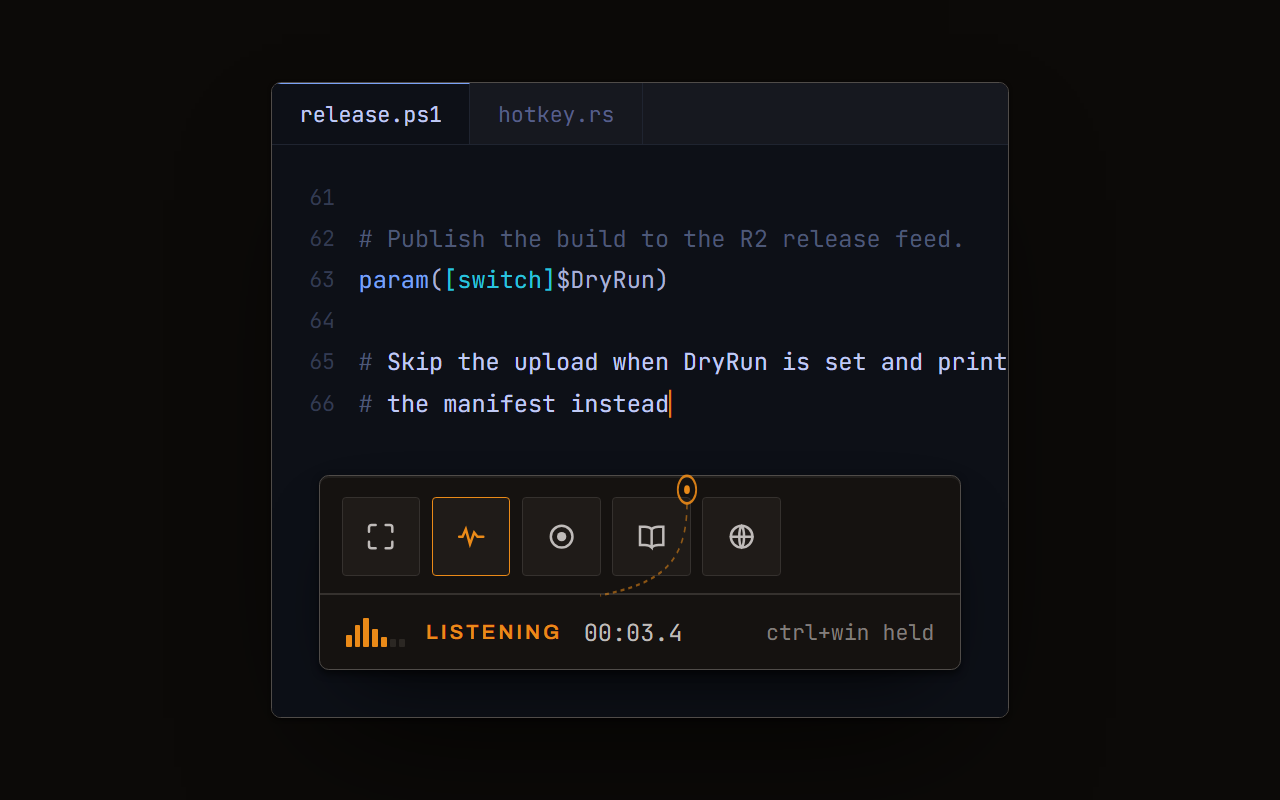
Dictation, where your cursor is
Hold a key, speak, release. Clean, punctuated text lands in whatever has focus, on your PC, your Mac and your phone, with your clipboard handed back.
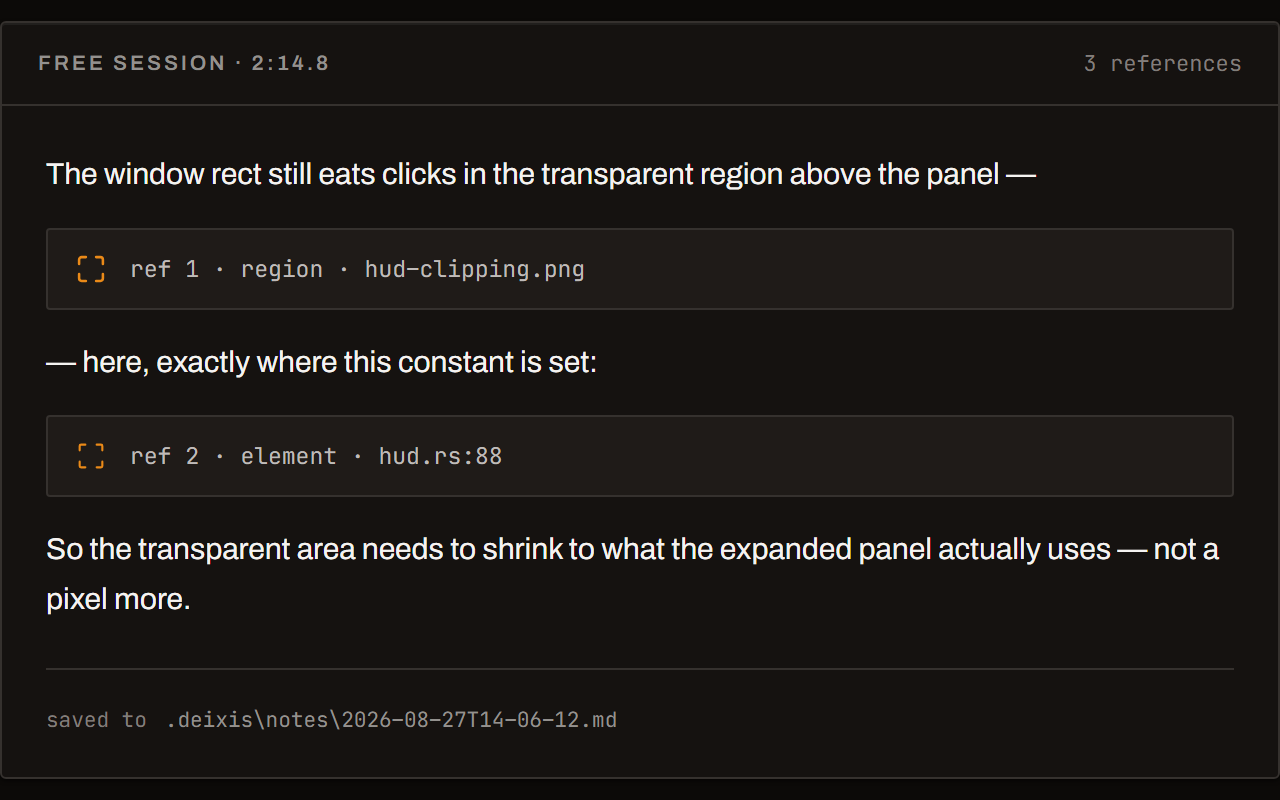
Free mode: talk and point
Narrate for as long as you like while you grab a region, pick a button on screen or take a selection. One note, what you said interleaved with what you pointed at, pasted where you finish and saved as Markdown.
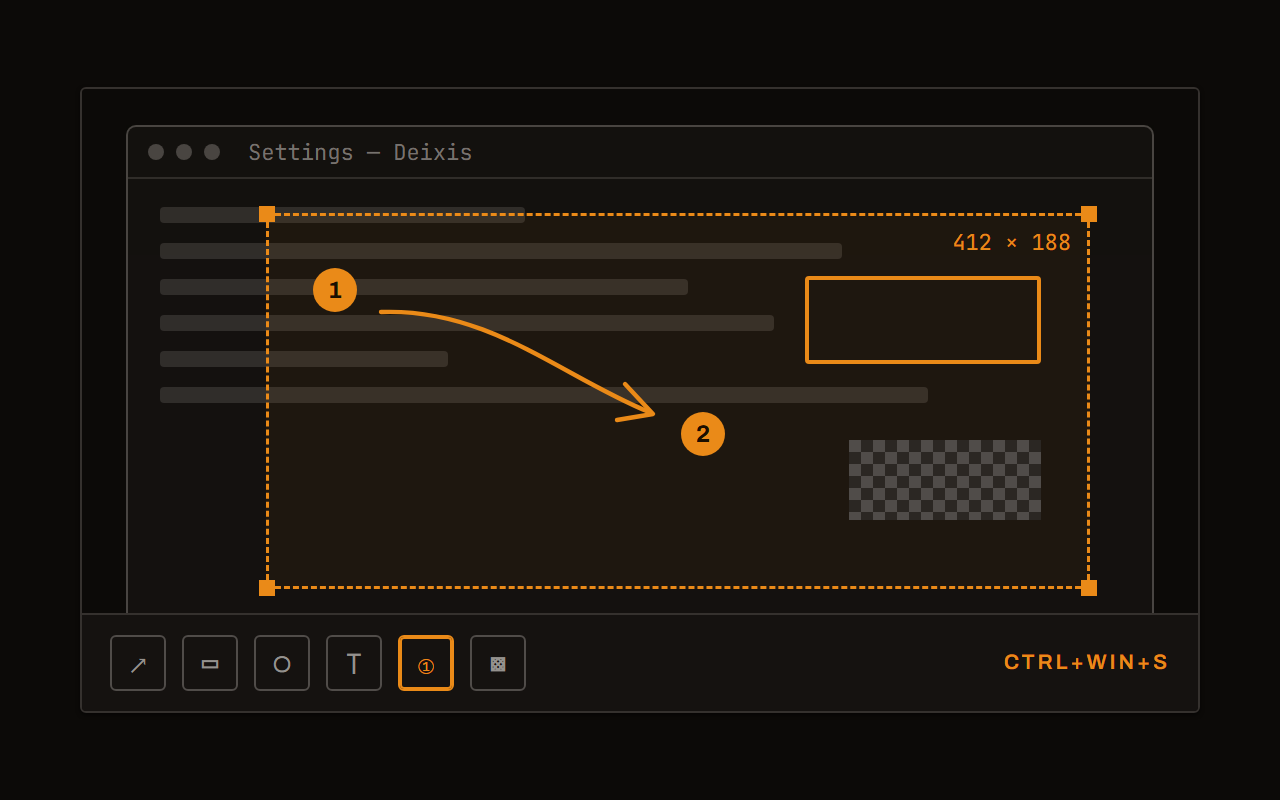
Screen grabs, annotated
Freeze every screen at the keypress, drag a region, add arrows, boxes, text and numbered steps, and pixelate what is private. Saved as a PNG that stays editable.
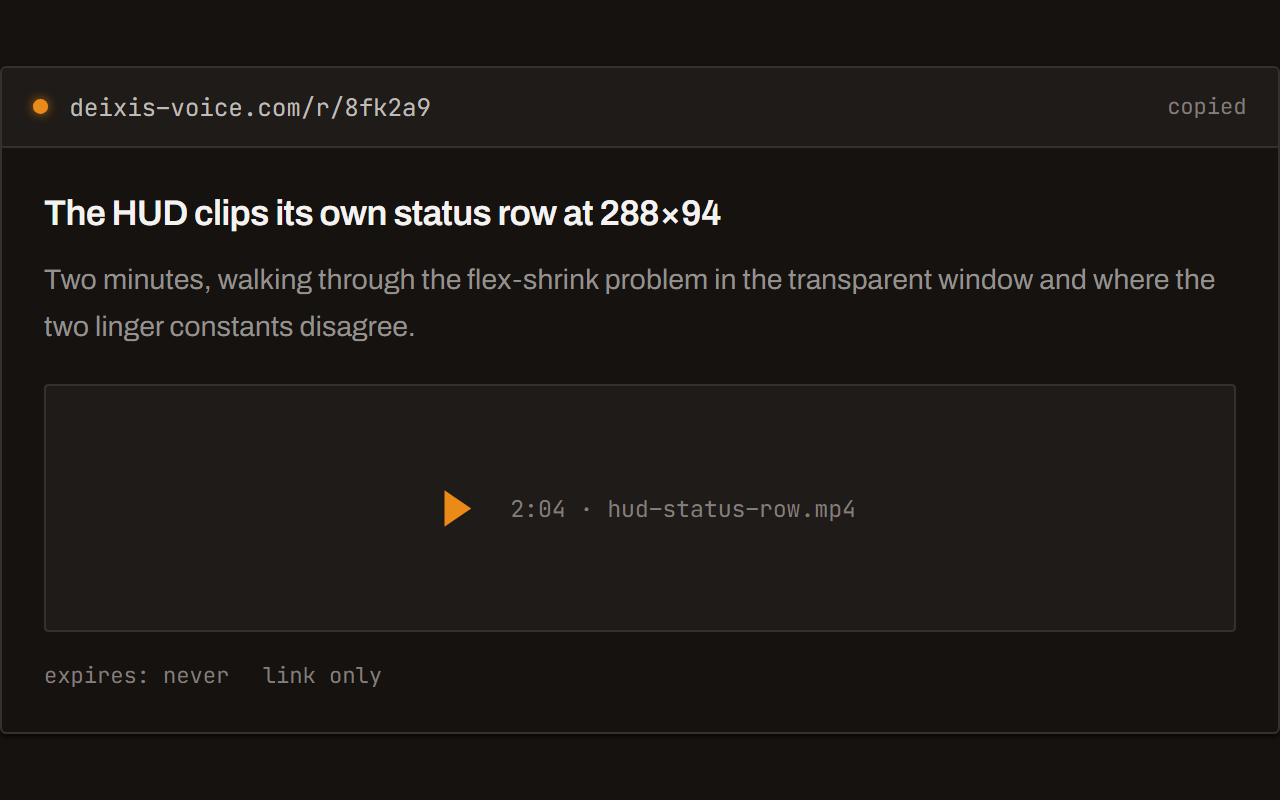
Screen recording, shared as a link
Record the screen with your narration. The recording writes itself up with a title, chapters and a summary, and from your Deixis account it shares as a link anyone can open without one. The Loom you can stop paying for.
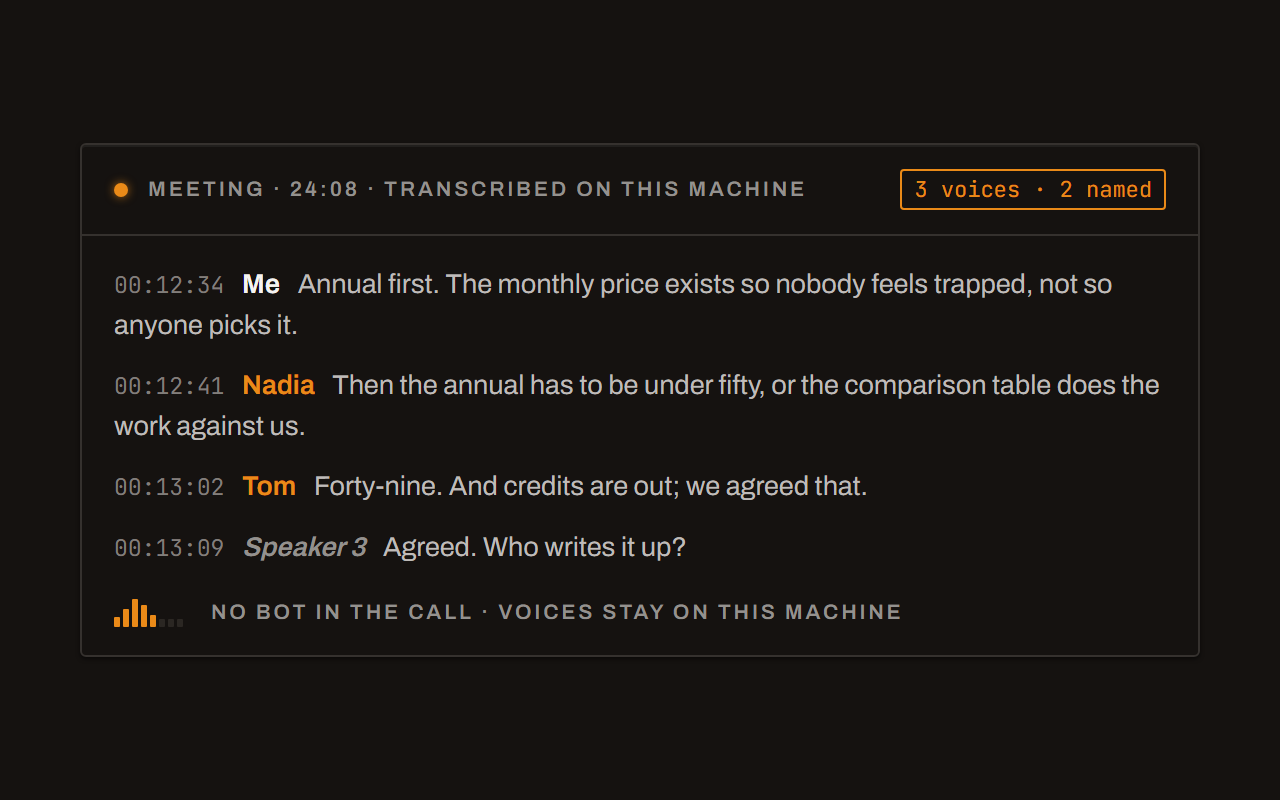
Meetings, no bot, names included
Your microphone and the other side, transcribed on your machine while the call runs. Deixis tells the voices apart and remembers the ones you name, and never uploads a voice.
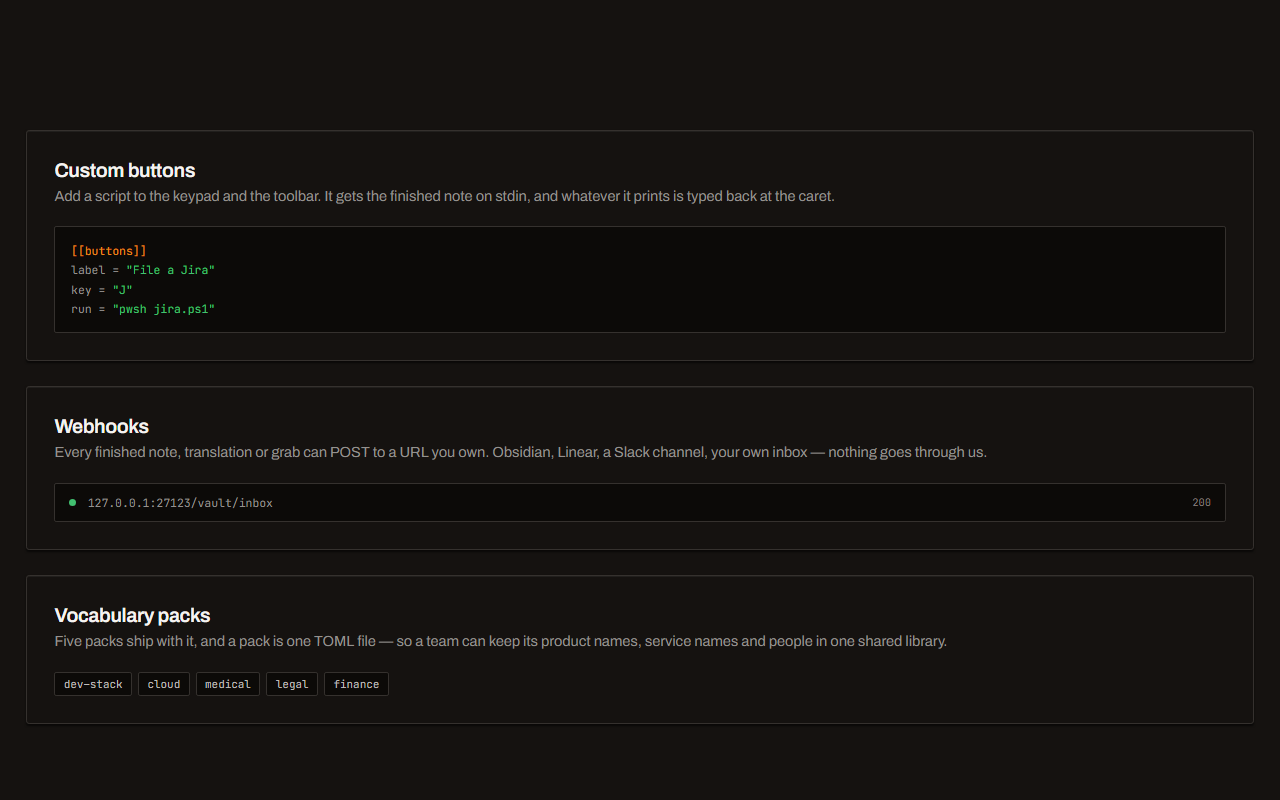
Your own buttons and workflows
Add a button to the palette: it gets the note on stdin and types back whatever it prints. Send finished notes to any URL you own. Chain steps: read the text off a screenshot, translate it, summarise it, post it.
Side by side
tl;dv and Deixis, side by side
| Row | Deixis | tl;dv |
|---|---|---|
| Runs on | Windows 10 and 11 (64-bit, on a CPU with AVX2: 2013 and later), Mac (Apple Silicon) and Android (a dictation bubble in any app, plus meetings), with an iPhone keyboard in beta on TestFlight and not yet in the App Store. One engine on all of them, and dictation audio never leaves the device. | Chrome extension, Desktop app (Windows, Mac), Mobile app (iOS, Android), Web |
| Speech recognition happens | On your own device, inside the app, on every platform. Your audio never leaves it. | In the cloud |
| AI cleanup happens | On your device, with no provider at all. Or, if you want more, Deixis's cloud, your own Ollama, or your own key. Your choice, in one setting. | In the cloud |
| Leaves your machine | Text only, and only once you switch a cloud feature on — plus, if you press the Claude usage key, the Claude Code sign-in already stored on your machine. Never audio, never screenshots, never window titles. | Audio, video, text |
| Account needed | None, ever, for anything that runs on your device. The cloud extras have a seven-day trial you start with an email code. No card. | Required |
| Price | Free forever for everything local, meetings included. Pro is $49 a year for the cloud extras with nothing to set up. | Free tier: $0: unlimited video recordings and unlimited transcription in 30+ languages, email and calendar integrations, and the mobile app — with the AI metered at ten meetings with AI notes and ten Ask AI queries. The privacy policy keeps a free user's recordings for three months.; $29 a month; $216 a year; Per seat. Pro is $29 a seat a month billed monthly, or $18 a seat a month billed annually ($216 a seat a year); it lifts the AI limits and adds premium transcription, custom note templates, global transcript search, unlimited uploads and storage, 5000+ integrations, custom bot appearance, and the MCP server, API and webhooks. Business is $39 a seat a month billed monthly or $29 billed annually, and is the tier that carries multi-language and custom vocabulary transcription, multi-meeting AI insights, playbook monitoring and team management. Enterprise is custom-priced and adds SCIM, custom SSO, privately hosted AI and organisation activity logs. The pricing page advertised up to 40% off annual plans on the date it was read. |
| Your transcripts live | In plain files, in one folder you own and can back up. Uninstall Deixis and every note is still readable. | In the cloud |
| Make it yours | Add your own buttons that run a script, send finished notes to any URL you own, and switch on vocabulary packs for your field. | HubSpot, Salesforce, Zoho and SalesLoft; Slack and Microsoft Teams; ClickUp, Asana, Jira, Monday.com and Miro; Dropbox, Google Drive and Box; Greenhouse; and over 5000 further applications through Zapier. Notion is named among the integrations on the home page. The MCP server, the API and webhooks are Pro features; team-wide and organisation-wide integrations are Business and Enterprise. |
tl;dv facts from home, tldv.io, its privacy policy, security, integrations, desktop and meet, read on 14 September 2026. “Not documented” means those pages did not say.
tl;dv is a hosted meeting recorder and AI notetaker for Google Meet, Zoom and Microsoft Teams. It offers two ways to record, and the difference between them is not the difference from Deixis: the Chrome extension has a bot join the call, and the desktop app records the machine's own system audio so that, in tl;dv's words, "No bot joins the call". Either way the recording, the transcript and the notes go to tl;dv's servers, which is the whole gap — Deixis records the microphone and the system output to a folder on the user's own disk and transcribes on the processor, with no account and no network call. Two facts run the other way and the page says both plainly. tl;dv transcribes in more than thirty languages on its free tier, where the Deixis speech model is English-only; and tl;dv's security page states that its data centres are in Europe (Wasabi S3, private Google Cloud Platform capacity and dedicated Hetzner servers) and that "No customer data is used to train the AI", with the privacy policy adding that content is not used to "train, fine-tune, or improve foundation models, large language models, or other generative AI models". The free tier is generous on recording and metered on AI: ten meetings with AI notes and ten Ask AI queries, and a free user's recordings are kept for three months.
What leaves your machine, and what leaves theirs
Deixis publishes every byte it sends, as a table, because there is so little of it. Here is that table beside what tl;dv's own pages say.
| What | Deixis | tl;dv |
|---|---|---|
| Audio | Never. Recognition happens inside the app on your device; the recording, the model and the transcript stay there. | The meeting itself. The Chrome extension sends what a bot in the call hears and sees; the desktop app "records directly from your system audio", which is still uploaded — "Recordings are crisp quality and stored in your personal library"tl;dv's servers — S3 on Wasabi, private Google Cloud Platform capacity and dedicated Hetzner servers, all of which the security page says are "located in Europe" — and the transcription providers its privacy policy names, AssemblyAI and ElevenLabs · every recorded meeting, in both the bot and the bot-free mode |
| The dictated text | The sentence you just dictated, your vocabulary, and your previous sentence in that fieldthe endpoint you chose · only with a cloud endpoint set, and by default only when the local rules are not enough | The transcript, in more than thirty languages, and whatever the AI writes from it — notes, action items, Ask AI answers and multi-meeting insightstl;dv, and for the AI features Anthropic as a processor, with metadata anonymised and meeting segments randomised; the privacy policy adds that AI features "may process data in the US depending on user preferences" · transcription on every meeting; AI notes ten times on the free tier and without limit on Pro |
| Context around the text | The names of the app and the field the text is going into. Never the window title, never a screenshot.the same endpoint · with that request | In the bot-free desktop mode the machine's system audio, which is whatever the speakers are playing while it runs, not only the meeting; in the extension's bot mode the call as the bot sees it, and the bot is visible to everyone else in the participant listtl;dv · while a recording runs |
| Telemetry and analytics | None. No account, no telemetry, no analytics, no crash reports. | The privacy policy itemises it: "IP address, geographic location, browser type and version, your operating system, your referral source, the duration of your visit, pages viewed and navigation paths on the website, the frequency and pattern of your service use", plus the "devices used to access the Services, including device type, operating system used, device settings, application identifiers, unique device identifiers and crash data"tl;dv and the analysis-tool providers its sub-processor list names — Mixpanel, Cloudflare and Sentry · automatically, while you use the service |
| Update check | Nothing but the request; the version check happens on your PCapi.deixis-voice.com · every launch, and when you ask in Settings | not documented |
| Model download | Nothing but the requesthuggingface.co · once, when you press Download on first run | Meeting content reaches Anthropic for the AI features. tl;dv states "No customer data is used to train the AI", and the privacy policy says content is not used to "train, fine-tune, or improve foundation models, large language models, or other generative AI models". Enterprise can have the AI privately hostedAnthropic, as a processor for tl;dv · when an AI feature runs on a meeting |
| Account and sign-in | An email address, only if you choose to start the trial, plus the partner tag from a partner download link and the first partner website that connected to Deixis on this computer, if there are anythe Deixis endpoint · when you start the trial | You sign in to record anything: the extension, the desktop app and the mobile apps all record into a tl;dv workspace, and every paid plan is priced per seattl;dv · before the first recording |
| Integrations | The finished note, and for a screenshot its file name, never the imagea URL you added yourself · on finish, only for destinations you added | The summary, the transcript or the insights, to whichever service you connect: HubSpot, Salesforce, Zoho, SalesLoft, Slack, Microsoft Teams, ClickUp, Asana, Jira, Monday.com, Miro, Dropbox, Google Drive, Box, Greenhouse, and over 5000 more through Zapierthe service you connect · only once you connect one, though the connections are built to run automatically after every call |
Before you switch
Before you switch
Who should not switch
If your meetings are not in English, stay on tl;dv. The Deixis speech model is English-only, the gap is not close, and nothing about local processing makes up for a model that does not speak the language your customers do. Stay too if the recording has to happen when you are not there — tl;dv's calendar-driven bot attends calls you skip, and Deixis has nothing equivalent, by decision rather than by oversight. And stay if the value is in what happens after the call rather than in the recording itself: if a summary must land on a HubSpot or Salesforce record automatically, if a manager reviews calls across a team from one searchable library, or if the AI coaching and playbook monitoring on the Business tier is the reason your company bought it, then Deixis is not a replacement for that and this page will not pretend otherwise.
Making the switch
Where the session files land
A meeting lands in %USERPROFILE%\.deixis\sessions\<timestamp>\. Inside it: meta.json with the
devices, sample rates, model and start and end times; audio\mic-0001.wav and onwards for your
microphone at 16 kHz mono, one file per minute; audio\sys-0001.wav and onwards for the system
output when loopback is available; transcript.mic.jsonl and transcript.sys.jsonl as the
timestamped lines arrive; transcript.md as the merged, readable version; and notes.md with the
summary, decisions, action items and open questions.
Each session is named from what was said in it, so a month of meetings reads as a list of subjects
rather than thirty timestamps — and a name you type yourself is never overwritten by any of that.
Because the WAVs are finalised a segment at a time, a crash costs at most a minute, and
deixis-core --transcribe <session-dir> rebuilds the transcript from the audio that survived.
The keys
Hold Ctrl+Win and press M to start a meeting, and press it again to stop. The tray item and the
record button on the Meetings tab do the same thing. While a meeting runs, the app says so from
wherever you are: a red dot on the tray icon, the elapsed time in its menu, and a recording dot and
clock on the Meetings item in the side rail. Dictation always wins — starting a push-to-talk
dictation takes priority over transcribing the meeting, so the chord you use to type stays fast
while an hour-long recording runs behind it.
Loopback and headphones
Deixis captures the far end by recording the system output, and that has one practical consequence: wear headphones if you can. On speakers, your microphone also hears what the speakers are playing, so the far end bleeds into your own side of the transcript. Echo cancellation is out of scope.
Loopback is not always available — exclusive-mode devices and some virtual sound cards refuse it.
When that happens Deixis does not fail the meeting: it falls back to recording the microphone only,
says so at the time, and records the fact in meta.json so you know later why one side is missing.
Two optional steps reach the network, and they are deliberately the last ones: the notes, and the
session's name — unless you have typed one yourself, Deixis sends the opening of the transcript,
about 1,500 characters rather than the whole session, to be turned into a short title. They need a cleanup endpoint that serves /summarize, which is either the managed one on
the $49-a-year plan or your own provider key pointed at your own. Without either, the meeting still
records and transcript.md is still written; Regenerate notes retries them later if you set one
up.
The tl;dv library you leave behind
There is no import path, and there is no honest way to build one: your recordings are in your tl;dv workspace and the transcripts are generated by their models. Export what matters before you stop paying, and read the retention row first — tl;dv's privacy policy keeps a free user's recordings for three months and a paying user's until the account is deleted, so downgrading is not the same as keeping the archive. Nothing you record with Deixis afterwards lands anywhere but your own disk, so this is a migration you only do once.
Before you ask
Questions people search for
Is there a tl;dv alternative that does not use a bot?
Both tools can record without a bot, but they mean different things by it. tl;dv's desktop app keeps a bot out of the participant list and still uploads the recording to its servers. Deixis records the microphone and the system output on your own machine and uploads nothing, so there is no bot in the call and no copy anywhere else.
Does tl;dv train AI on my meetings?
Its own pages say no. tl;dv's security page states that "No customer data is used to train the AI", and its privacy policy says content is not used to "train, fine-tune, or improve foundation models, large language models, or other generative AI models". The AI features are processed with Anthropic as a provider, with metadata anonymised and meeting segments randomised.
Where does tl;dv store my recordings?
On tl;dv's servers. Its security page says data is stored in S3 on Wasabi and processed in private Google Cloud Platform capacity and dedicated Hetzner servers, and that "All our data centers are located in Europe"; the privacy policy adds that personal data is primarily processed and stored in the European Economic Area, while AI features may process data in the US depending on your preferences.
Can I transcribe a meeting without an internet connection?
With Deixis, yes. The speech model runs on your own processor, so recording and transcription work with the network unplugged and with no account. The only part that reaches out is the optional notes step, which retries afterwards if you were offline when the meeting ended.
What does tl;dv's free plan actually include?
Unlimited video recordings and unlimited transcription in more than thirty languages, plus email and calendar integrations and the mobile apps — with the AI metered at ten meetings with AI notes and ten Ask AI queries. The privacy policy keeps a free user's recordings for three months.
Does Deixis work with Zoom, Teams and Google Meet?
Yes, and with anything else. It does not integrate with a meeting platform at all — it records your microphone and whatever your computer is playing, so Zoom, Teams, Meet, a Slack huddle, a Discord call or a phone on speaker are all the same recording to it.
Keep reading
Related pages
A free meeting recorder that sends nothing
Record both sides of a call and transcribe it on your own machine, free and with no account. Nothing joins the meeting and nothing uploads the audio.
Here is every byte that leaves your machine, for each tool
Every byte Deixis sends off your machine in one table, and the same table filled in for other dictation tools from their own documentation, dated.
The same no-bot idea, with the transcript left on your disk
Krisp transcribes English on your device, then stores the transcript, recording and notes in its cloud. Deixis leaves the whole session in your folder.
The Granola alternative that keeps the audio on your machine
Granola streams your meeting audio to a cloud transcriber. Deixis records the same call and transcribes it on your own machine, with no account.
The Fireflies alternative that keeps the call off the cloud
Fireflies sends a bot into your call and keeps the recording in its cloud. Deixis records the call on your own PC and transcribes it there.
The Fathom alternative where the meeting never leaves the room
Fathom's free tier is generous, but every call lands on its servers. Deixis records and transcribes a meeting on your own machine, with no account.
Hold a key. Speak. Keep working.
Deixis is free, needs no account, and runs on your own device. Everything on this page is in the current release.
v1.2.2 · 64‑bit Windows 10/11 · macOS 13 on Apple silicon · 51 MB · nothing else to install · also for Windows