The same no-bot idea, with the transcript left on your disk
This page is for someone already sold on the idea Krisp sells — a meeting assistant that sits under the call rather than joining it as a guest — who has since read the privacy policy and noticed that the transcript does not stay where the speech recognition ran.
Start with what the two tools agree about, because it is most of the page. Neither sends a bot into
your meeting: Krisp works at the audio layer of your device as a virtual microphone and speaker, and
Deixis records the microphone and the system output on your own machine, so in both cases the other
people in the call see nothing new in the participant list. Both transcribe English on the device
rather than in a data centre. What you gain by switching is the second half of that promise: with
Deixis the finished transcript.md, the audio and the notes are files in a folder on your own disk,
and there is no account to sign into, no per-user price and nothing stored on our side. What you
lose is real: Krisp's noise, echo and cross-talk removal on the live call, its accent conversion, its
fifteen extra transcription languages, and a searchable workspace with the meeting recording played
back beside the transcript.
The facts about Krisp below are taken from Krisp's own pages on the date at the bottom, and the distinction those pages draw is worth quoting rather than paraphrasing. Krisp's privacy policy says that with noise cancellation alone, "no audiovisual data leaves the users' devices". The meeting assistant is the other case: the same policy says Krisp "may store such meeting transcripts, recordings and summaries on our servers", and the security page for the meeting assistant says the summaries are generated through Microsoft Azure once the transcript exists. So the recognition can run on your CPU and the record of the meeting still ends up hosted. That is the one real difference, and the rest of this page is what follows from it.
Why switch
What you gain, and what you give up
Why Deixis
- The transcript stays where the recognition happened. Krisp's own pages separate the two:
transcripts are generated on your machine, and then transcripts, recordings and summaries may be
stored on Krisp's servers. With Deixis a meeting lands in
%USERPROFILE%\.deixis\sessions\<timestamp>\and stays there — the per-minute WAVs, the timestamped JSONL, the mergedtranscript.mdand the notes. Nothing is uploaded, because there is nowhere for it to be uploaded to unless you set one up. - No account, no key and no network for the meeting itself. Recording and transcribing a meeting in Deixis is free, forever, with no sign-in. The Krisp meeting assistant is a per-user subscription after a seven-day trial: $16 a user a month for Core, shown as $8 when paid annually, and $30 or $15 for Advanced. Deixis charges $49 a year, or $10 a month, only for the managed cloud extras — and you can skip even that by pointing it at your own provider key or a local model.
- What can leave is a short list, and you choose the endpoint. Four things in Deixis send any of
your content anywhere: cleanup escalation, translate, meeting notes, and the session's name —
the opening of the transcript, about 1,500 characters, and only when you have not named it
yourself. They all go to the endpoint you configure, which can be a model running on your own
machine. (The other calls Deixis makes carry no content of yours at all: the update check, the
one-off speech-model download, and a check for an announcement from us when you open the Settings
window. One more happens only if you press its key: Claude usage reads the sign-in Claude Code
has already stored on your machine and asks Anthropic what is left of that plan, and carries
nothing else.) With nothing configured the meeting still records, still transcribes and still writes
transcript.md; notes are deliberately the last, failure-tolerant step, and Regenerate notes retries them later. - It tells the people apart, on the device. Deixis gives each voice its own place in the transcript, and when you name a person it remembers that voice and labels them in later meetings. The voiceprint is a mathematical fingerprint that stays on the machine, is never uploaded, and can be deleted per person.
- Sessions are named from what was said in them. A month of meetings reads as a list of subjects rather than thirty timestamps. The name comes from a local model if you have one, otherwise from the same endpoint the notes use, and otherwise from the first substantial sentence somebody said. A name you type yourself is never overwritten by any of them.
- The meeting tool is the dictation tool. The same chord that records a meeting also dictates into any text field, grabs the screen and records it. Dictation always wins: transcription of a meeting yields to any dictation you start, so push-to-talk stays fast while an hour-long recording runs in the background.
- A crash costs at most a minute. The WAVs are finalised one segment at a time, and a broken
session is rebuilt from them with
deixis-core --transcribe <session-dir>. There is no state to recover from a server.
Where Krisp still wins
- Noise, echo and cross-talk removal on the live call. This is what Krisp is famous for and it is a straight gap, not a difference of philosophy. Krisp cleans the audio in both directions in real time, so the builders outside your window stop being everyone else's problem too. Deixis does not do this at all, and the README says in as many words that echo cancellation is out of scope — its own advice for meetings is to wear headphones. If a noisy room or a bad line is your actual problem, Krisp solves it and Deixis does not.
- Accent conversion. Krisp converts accents in real time — an hour a day on Core, unlimited on Advanced. Nothing in Deixis resembles this, and nothing is planned that does.
- Fifteen more transcription languages. Krisp transcribes English on the device and fifteen further languages on its servers — Spanish, French, German, Portuguese, Hindi, Korean and the rest are on its own list. The Deixis speech models are English-only and no setting changes that. If your meetings are not in English, this page ends here and the honest answer is Krisp.
- A searchable workspace with the recording beside the transcript. Krisp keeps the meeting recording, the transcript and the summary together in an account you can search, play back and share, with storage allowances published per tier. Deixis gives you a folder of files, which is a different and plainer thing.
- It plugs into the tools a sales or support team already runs. Salesforce and HubSpot, Asana, Jira, monday.com, Zapier and Slack are named on Krisp's product page, and you can connect a calendar for one-click meeting access. Deixis has webhooks to your own URLs and no CRM integrations.
- An optional bot when you want one. Krisp is bot-free by default, but will also join a platform like Zoom as a visible participant if that is what a meeting needs. Deixis has no such mode: if you are not at the machine, nothing is recorded.
What you get
More than dictation. One key, and everything behind it.
Hold the key and press a letter: free mode, a grab, a meeting, a recording, a translation, your own buttons. All of it on your own device, all of it free, none of it behind an account.
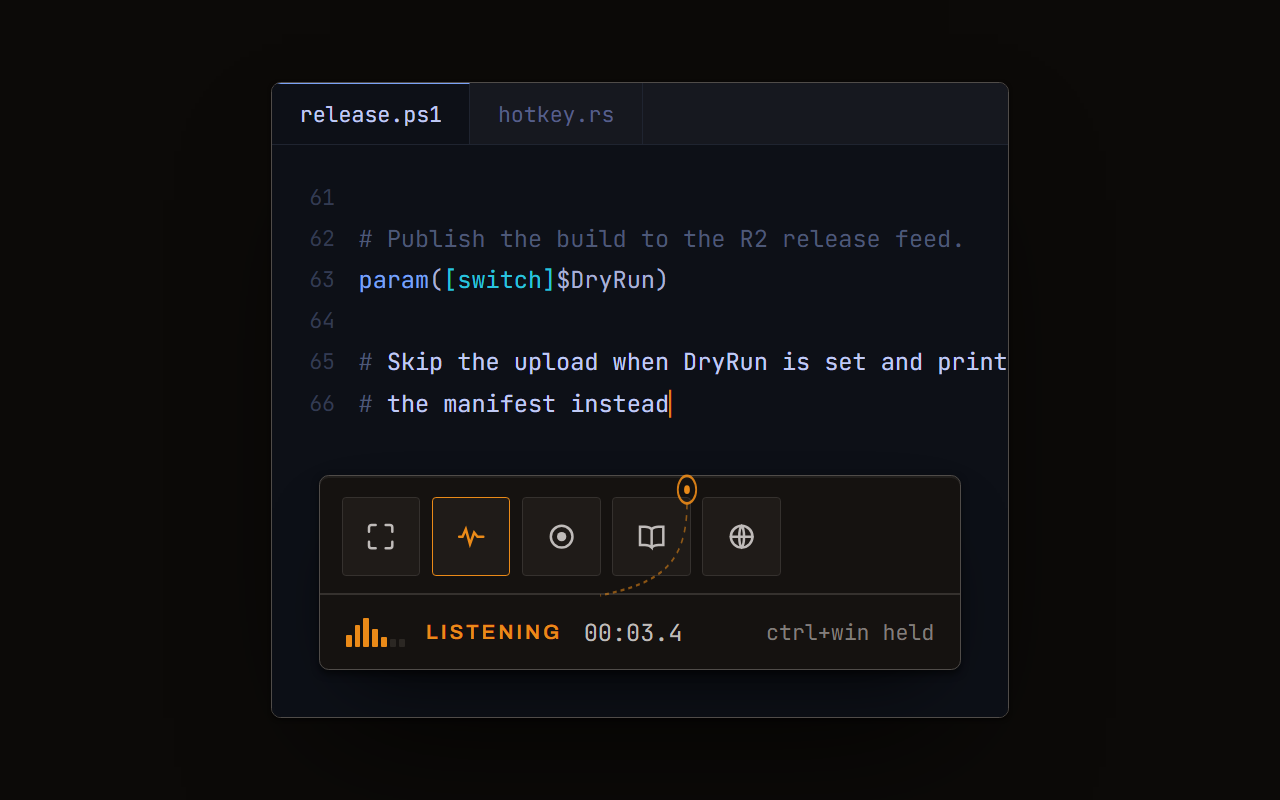
Dictation, where your cursor is
Hold a key, speak, release. Clean, punctuated text lands in whatever has focus, on your PC, your Mac and your phone, with your clipboard handed back.
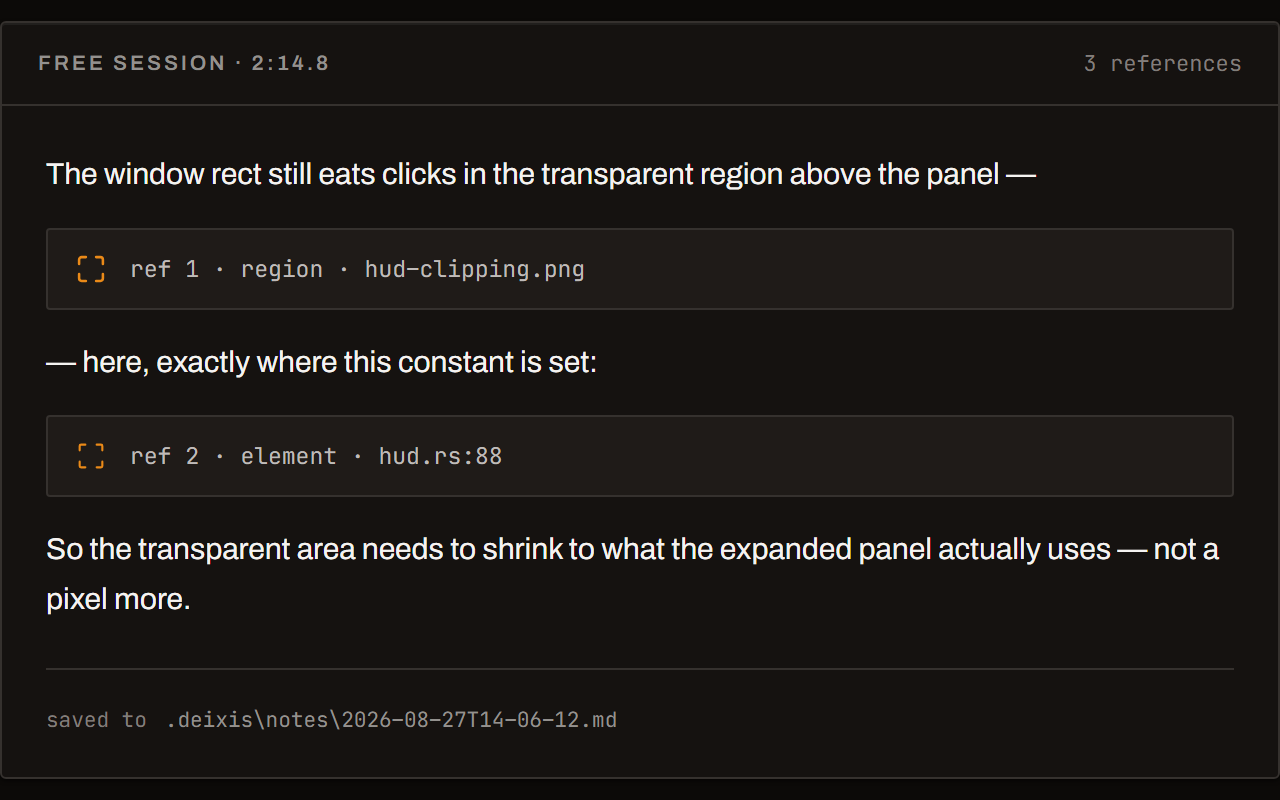
Free mode: talk and point
Narrate for as long as you like while you grab a region, pick a button on screen or take a selection. One note, what you said interleaved with what you pointed at, pasted where you finish and saved as Markdown.
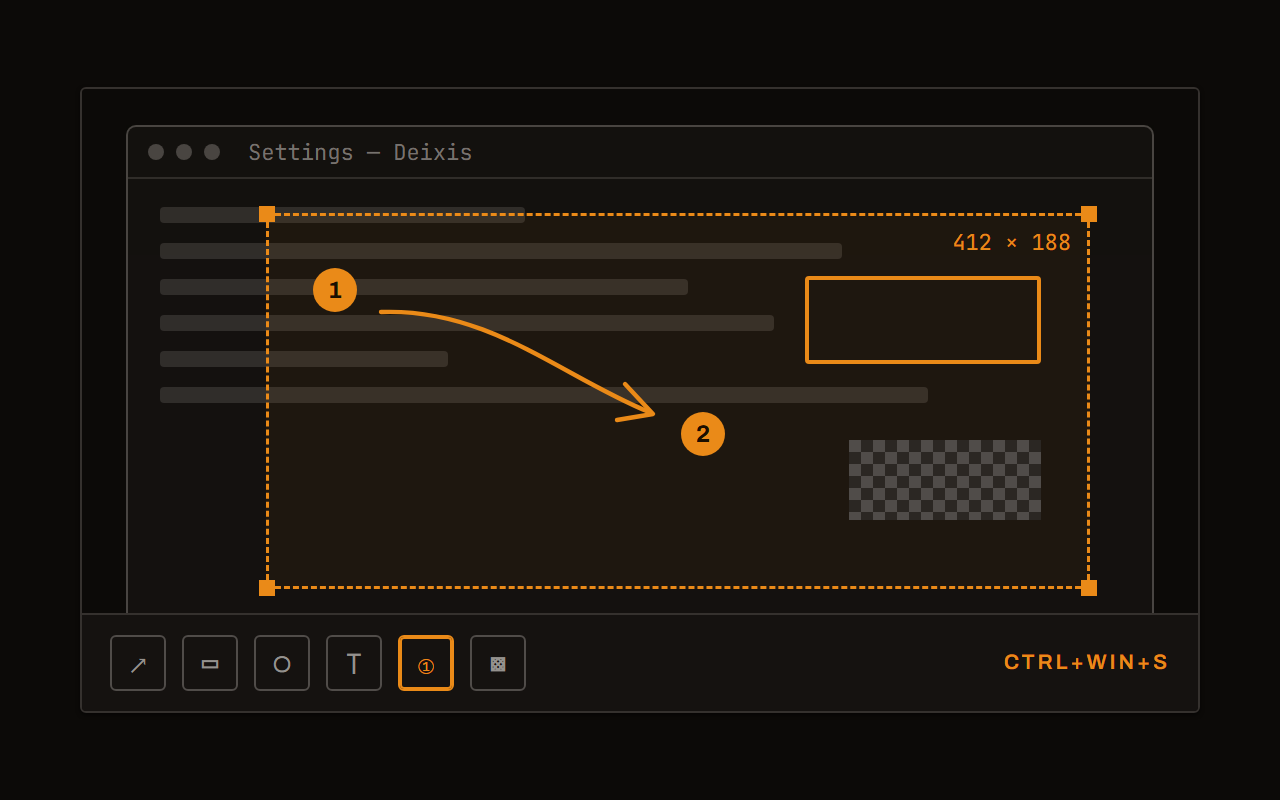
Screen grabs, annotated
Freeze every screen at the keypress, drag a region, add arrows, boxes, text and numbered steps, and pixelate what is private. Saved as a PNG that stays editable.
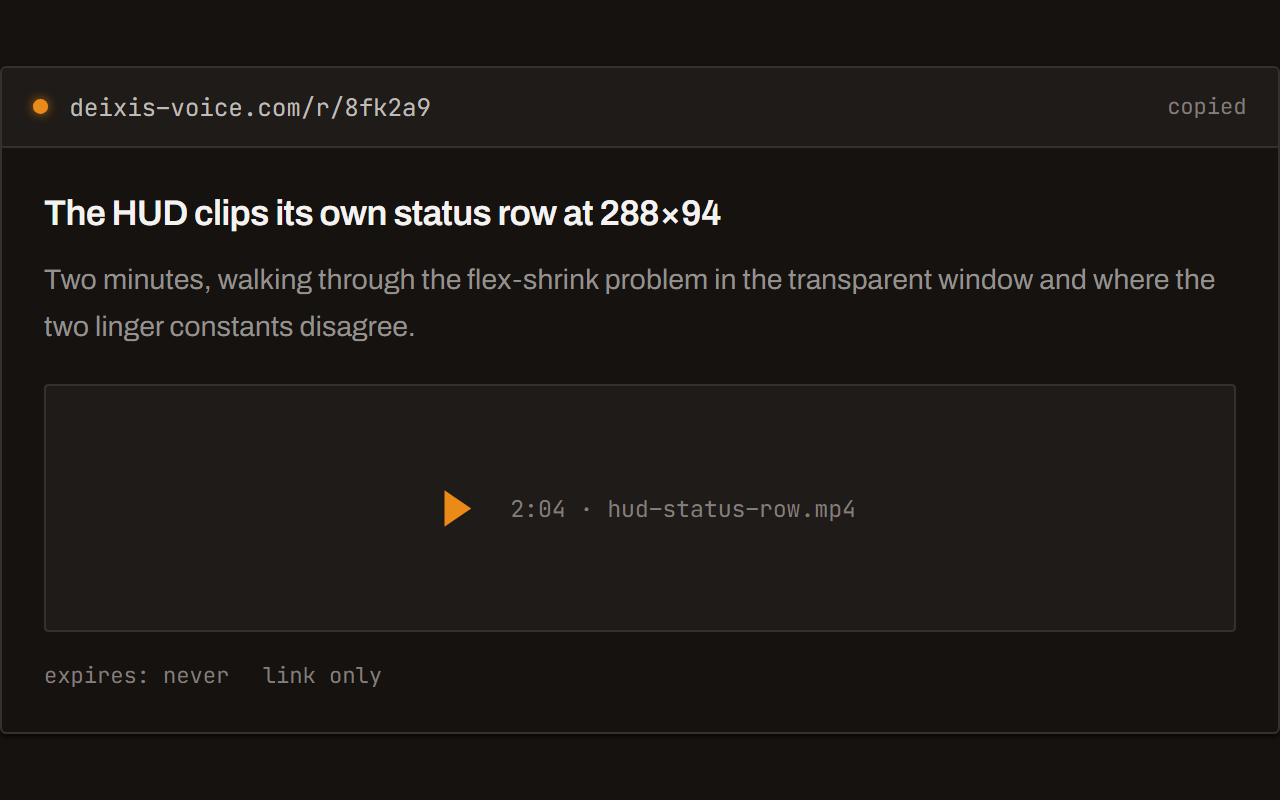
Screen recording, shared as a link
Record the screen with your narration. The recording writes itself up with a title, chapters and a summary, and from your Deixis account it shares as a link anyone can open without one. The Loom you can stop paying for.
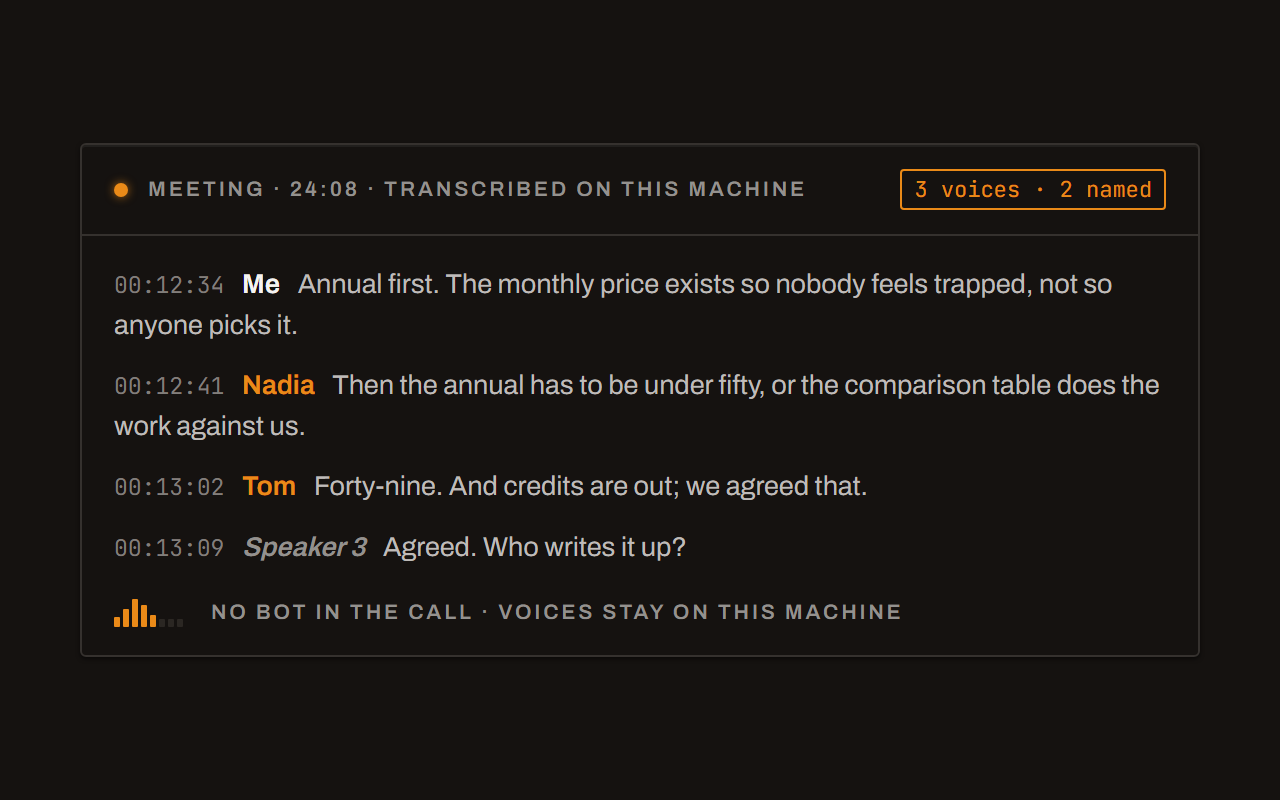
Meetings, no bot, names included
Your microphone and the other side, transcribed on your machine while the call runs. Deixis tells the voices apart and remembers the ones you name, and never uploads a voice.
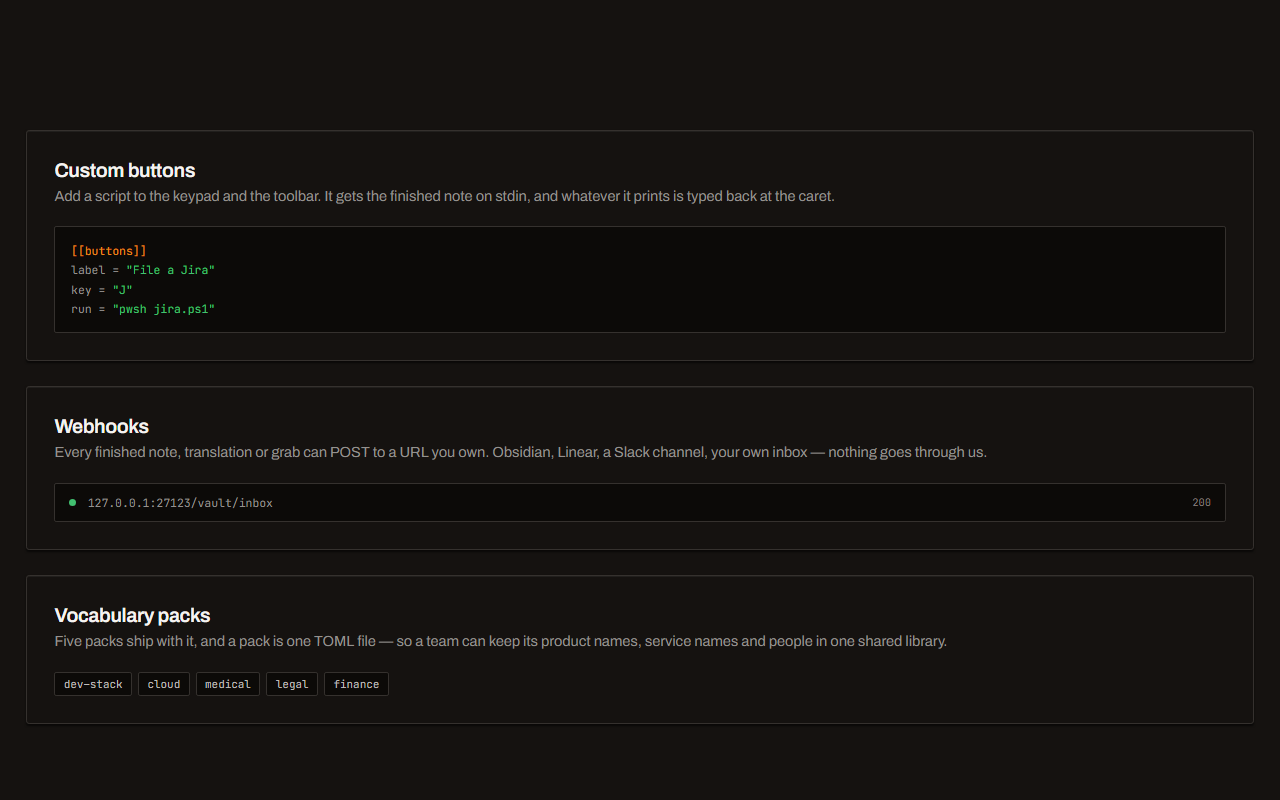
Your own buttons and workflows
Add a button to the palette: it gets the note on stdin and types back whatever it prints. Send finished notes to any URL you own. Chain steps: read the text off a screenshot, translate it, summarise it, post it.
Side by side
Krisp and Deixis, side by side
| Row | Deixis | Krisp |
|---|---|---|
| Runs on | Windows 10 and 11 (64-bit, on a CPU with AVX2: 2013 and later), Mac (Apple Silicon) and Android (a dictation bubble in any app, plus meetings), with an iPhone keyboard in beta on TestFlight and not yet in the App Store. One engine on all of them, and dictation audio never leaves the device. | Windows desktop app, macOS desktop app, iOS app, Android app, Browser extension |
| Speech recognition happens | On your own device, inside the app, on every platform. Your audio never leaves it. | On your device or in the cloud, your choice |
| AI cleanup happens | On your device, with no provider at all. Or, if you want more, Deixis's cloud, your own Ollama, or your own key. Your choice, in one setting. | In the cloud |
| Leaves your machine | Text only, and only once you switch a cloud feature on — plus, if you press the Claude usage key, the Claude Code sign-in already stored on your machine. Never audio, never screenshots, never window titles. | Audio, text, video |
| Account needed | None, ever, for anything that runs on your device. The cloud extras have a seven-day trial you start with an email code. No card. | Required |
| Price | Free forever for everything local, meetings included. Pro is $49 a year for the cloud extras with nothing to set up. | Free tier: A 7-day free trial, no credit card, with unlimited transcription, unlimited noise cancellation, unlimited audio and video recording and unlimited AI notes and action items; $16 a month; $96 a year; Meeting AI, per user. Core is $16 a user a month, shown as $8 a user a month when paid annually (Krisp labels that a 50% saving). Advanced is $30 a user a month, or $15 paid annually, and adds unlimited accent conversion (Core is capped at one hour a day), a manager view, Salesforce and ConnectWise integrations and 60 GB of storage. Enterprise is custom-priced and is the tier where the pricing page lists SSO and SCIM, private on-device transcription and unlimited storage. The pricing page publishes no permanently free plan for Meeting AI: the $0 column is the seven-day trial. Call Center AI is priced separately from $15 an agent a month billed annually. Krisp publishes that annual rate per user per month rather than as a yearly figure; $96 a user a year is that rate multiplied out. |
| Your transcripts live | In plain files, in one folder you own and can back up. Uninstall Deixis and every note is still readable. | In the cloud |
| Make it yours | Add your own buttons that run a script, send finished notes to any URL you own, and switch on vocabulary packs for your field. | Works at the audio layer with Zoom, Microsoft Teams, Google Meet, Slack Huddles and other conferencing apps by selecting the Krisp microphone and speaker. Integrations named on the product page: Salesforce, HubSpot, Asana, Jira, monday.com, Zapier, Slack, and connecting your calendar for one-click meeting access. Salesforce and ConnectWise are listed on the Advanced tier. |
Krisp facts from home, product, krisp.ai, its privacy policy and security, read on 14 September 2026. “Not documented” means those pages did not say.
Krisp is the nearest neighbour Deixis has, and the page is worth reading carefully because the two agree about more than they disagree about. Both sit under the meeting rather than in it: Krisp works "directly at the audio level on your device" as a virtual microphone and speaker, so no bot appears in the call — the product page says plainly "you don't need a bot in your meeting", while also offering an optional bot for platforms like Zoom if you want one. Both transcribe English speech on the machine: Krisp's own pages describe "on-device English transcription for maximum privacy and speed, plus server-based transcription in 15 additional languages", and the security page for the meeting assistant says "Meeting transcripts are generated on the user's machine". The difference is what happens next. Krisp's privacy policy draws the line itself: "COMPANY DOES NOT HAVE ACCESS TO OR STORE ANY AUDIOVISUAL DATA WHEN YOU USE NOISE CANCELLATION FEATURE ONLY. IN SUCH A CASE NO AUDIOVISUAL DATA LEAVES THE USERS' DEVICES" — noise cancellation alone keeps everything on the device, and the meeting assistant is a different case, where "WE MAY STORE SUCH MEETING TRANSCRIPTS, RECORDINGS AND SUMMARIES ON OUR SERVERS". The summaries are generated off the device too: the security page says meeting summaries are generated via Microsoft Azure after the transcript exists. For a language other than English the audio itself goes: the policy says Krisp "MAY AUTOMATICALLY RECORD THE RELEVANT AUDIO CONTENT OF YOUR MEETING IN ORDER TO ENABLE MULTILINGUAL TRANSCRIPTION". So the honest summary is that Krisp's recognition can run on your CPU and its storage does not: the finished transcript, the recording and the notes live in a Krisp workspace behind a paid, per-user account. Two things Krisp does that Deixis does not do at all: real-time noise, echo and cross-talk removal on the live call, and accent conversion in both directions. The Deixis README puts echo cancellation out of scope in as many words.
What leaves your machine, and what leaves theirs
Deixis publishes every byte it sends, as a table, because there is so little of it. Here is that table beside what Krisp's own pages say.
| What | Deixis | Krisp |
|---|---|---|
| Audio | Never. Recognition happens inside the app on your device; the recording, the model and the transcript stay there. | With noise cancellation alone, nothing: the privacy policy says no audiovisual data leaves the device. With the meeting assistant, the recording — the policy says transcripts, recordings and summaries may be stored on Krisp's servers, and that Krisp may automatically record the audio of a meeting in order to enable multilingual transcriptionKrisp · when you record a meeting, and when the language is one of the fifteen that are transcribed on Krisp's servers rather than on the device |
| The dictated text | The sentence you just dictated, your vocabulary, and your previous sentence in that fieldthe endpoint you chose · only with a cloud endpoint set, and by default only when the local rules are not enough | The meeting transcript and the summary. The transcript is generated on your machine for English and then stored: the security page says Krisp stores meeting transcripts and summaries in connection with providing the service, and that summaries are generated through Microsoft Azure once the transcript existsKrisp, and Microsoft Azure for the summary · every meeting the assistant is on for |
| Context around the text | The names of the app and the field the text is going into. Never the window title, never a screenshot.the same endpoint · with that request | Meeting metadata stored with the transcript — the security page describes the transcription record as carrying metadata about participants and timing. Connecting your calendar for one-click meeting access is offered on the product pageKrisp · with every stored meeting; calendar data only if you connect a calendar |
| Telemetry and analytics | None. No account, no telemetry, no analytics, no crash reports. | The security page itemises what Krisp keeps in its cloud beyond the meeting: "Analytics data", the "Application name which Krisp has been used with (e.g. Zoom, Skype)", the "Microphone, speaker names which Krisp is being used with (e.g. AirPod)", call metadata, "Time and duration when Krisp has been used" and "Total time the user has been speaking in the call"Krisp, on servers it says are in the United States · while you use it |
| Update check | Nothing but the request; the version check happens on your PCapi.deixis-voice.com · every launch, and when you ask in Settings | not documented |
| Model download | Nothing but the requesthuggingface.co · once, when you press Download on first run | Nothing, by Krisp's account: the security page says "We always make sure to opt out of any data sharing or training permissions when working with third-party service providers. This ensures that neither Krisp's data nor that of our customers is ever used for model training purposes"Krisp's sub-processors, under opt-out terms · never, on Krisp's own statement |
| Account and sign-in | An email address, only if you choose to start the trial, plus the partner tag from a partner download link and the first partner website that connected to Deixis on this computer, if there are anythe Deixis endpoint · when you start the trial | Sign-up is the front door: the product page's calls to action are sign-up and sign-in on app.krisp.ai, and every Meeting AI plan is priced per user. SSO and SCIM are listed on the Enterprise tierKrisp · before you can use the meeting assistant at all |
| Integrations | The finished note, and for a screenshot its file name, never the imagea URL you added yourself · on finish, only for destinations you added | Whatever the service you connect receives: Salesforce, HubSpot, Asana, Jira, monday.com, Zapier and Slack are named on the product page, and Salesforce and ConnectWise on the Advanced tierthe service you connect · only once you connect one |
Before you switch
Before you switch
Who should not switch
Anyone whose actual problem is a noisy room, a bad line or an echo should stay on Krisp, and should not read this page as an argument otherwise — that is the thing Krisp does better than anyone and the thing Deixis has decided not to do. The same goes for anyone who meets in a language other than English, anyone who needs a colleague's accent converted to be understood, and any team whose meeting notes are expected to land in Salesforce or HubSpot without somebody moving them. And if what you want is a searchable library of recordings you can scrub through months later, Krisp already has it and Deixis hands you a folder instead. Worth saying plainly: these two are not mutually exclusive and sit perfectly well on one machine. Krisp cleans the audio on the way into the call; Deixis records what your machine actually plays and hears, and transcribes it locally. Running both is a reasonable answer, and the Switching notes below say how.
Making the switch
Where the session files land
Hold Ctrl+Win and press M, or use the tray item or the record button on the Meetings tab. A
session lands in %USERPROFILE%\.deixis\sessions\<timestamp>\: meta.json with the devices, sample
rates, model and segment length; audio\mic-0001.wav and onward for your microphone at 16 kHz mono,
one file per minute; audio\sys-0001.wav and onward for the system output when loopback is
available; transcript.mic.jsonl and transcript.sys.jsonl as they were transcribed; the merged,
readable transcript.md; and notes.md with the summary, decisions, action items and open
questions. Back that folder up and you have backed up every meeting you have ever recorded. There is
no import path from Krisp — your Krisp meetings live in your Krisp workspace, so export the ones
that matter before you cancel a plan.
The keys
Ctrl+Win+M starts a meeting and Ctrl+Win+M stops it. While one runs, it says so from wherever
you are: the tray icon carries a red dot, its menu counts the elapsed time, and the Meetings item in
the app's side rail shows a recording dot and the clock on every page. The floating bar shows it
too, unless you have set it to Hidden. The same Ctrl+Win chord held on its own is dictation, so
you can type a note into the ticket while the meeting records.
Loopback and headphones
Deixis records the microphone and, when it can, the system output, so both halves of the call are
transcribed. Two things are worth knowing before your first real meeting. Wear headphones if you
can: loopback captures what the speakers play, but your microphone hears it too, so on open speakers
the remote side bleeds into your own side of the transcript, and echo cancellation is out of scope.
And loopback is not always available — exclusive-mode devices and some virtual sound cards do not
offer it. When that happens Deixis falls back to microphone-only, says so, and records the fact in
meta.json rather than failing the meeting.
Running the two together
If you keep Krisp for the noise cancellation, the order matters. Krisp presents itself as a virtual microphone and speaker that your conferencing app selects, so the cleaned audio is what Zoom or Teams sends and what your speakers play. Deixis records the microphone and the system output of the machine, which means it transcribes whatever your device is actually playing and hearing, whichever virtual device is in the path. Headphones remain the advice either way, because the bleed Deixis cares about is acoustic. If you do run both, turn off Krisp's own note taker rather than leaving two transcripts of the same meeting in two places — the point of the exercise is to stop the record of the conversation being hosted, and one still-running assistant undoes it.
Notes, if you want them
Notes are the one optional step that reaches the network, and they need an endpoint that serves
/summarize. Point it at a model running on your own machine and nothing leaves at all; set
DEIXIS_PROVIDER_KEY and the request carries your key and your billing; or pay for Pro and have it
managed. With none of the three, the meeting still records and transcript.md is still written.
Before you ask
Questions people search for
Does Krisp send my meeting audio to the cloud?
For noise cancellation on its own, Krisp's privacy policy says no audiovisual data leaves the device. For the meeting assistant the answer changes: the same policy says transcripts, recordings and summaries may be stored on Krisp's servers, and that Krisp may record the audio of a meeting in order to enable transcription in one of the fifteen server-side languages.
Does Krisp transcribe on my device or on its servers?
Both, depending on the language. Krisp's pages describe on-device English transcription plus server-based transcription in fifteen further languages, and the meeting assistant's security page says meeting transcripts are generated on the user's machine. The summary written from that transcript is generated off the device, through Microsoft Azure.
Is there a meeting transcription tool that does not use a bot?
Both of these are. Krisp works at the audio layer of your device as a virtual microphone and speaker, and Deixis records your microphone and your system output locally, so neither appears in the participant list. Krisp additionally offers a bot for platforms like Zoom if you would rather have one.
Is Krisp free?
Not for the meeting assistant. Krisp's pricing page publishes a seven-day free trial with no credit card, then Core at $16 a user a month or $8 paid annually, and Advanced at $30 or $15. Recording and transcribing a meeting in Deixis is free with no account, and the $49-a-year tier buys only the optional cloud extras.
Can Deixis remove background noise the way Krisp does?
No. Real-time noise, echo and cross-talk removal is Krisp's core product and Deixis does not attempt it — the README puts echo cancellation out of scope and recommends headphones instead. If that is the problem you are solving, keep Krisp; the two run side by side on one machine.
Does Deixis work with Zoom, Teams and Google Meet?
It does not need to know about them. Deixis records the microphone and the system output of your machine, so anything that plays through your speakers and anything you say into your microphone is transcribed, whether the call is in Zoom, Teams, Meet, a Slack huddle or a phone bridge on the desk.
Keep reading
Related pages
A free meeting recorder that sends nothing
Record both sides of a call and transcribe it on your own machine, free and with no account. Nothing joins the meeting and nothing uploads the audio.
Here is every byte that leaves your machine, for each tool
Every byte Deixis sends off your machine in one table, and the same table filled in for other dictation tools from their own documentation, dated.
The Granola alternative that keeps the audio on your machine
Granola streams your meeting audio to a cloud transcriber. Deixis records the same call and transcribes it on your own machine, with no account.
The Fireflies alternative that keeps the call off the cloud
Fireflies sends a bot into your call and keeps the recording in its cloud. Deixis records the call on your own PC and transcribes it there.
The Fathom alternative where the meeting never leaves the room
Fathom's free tier is generous, but every call lands on its servers. Deixis records and transcribes a meeting on your own machine, with no account.
The meeting recorder that never sends the meeting anywhere
tl;dv records your calls to its European cloud and transcribes in 30+ languages. Deixis records mic and system audio to your own disk, on your own CPU.
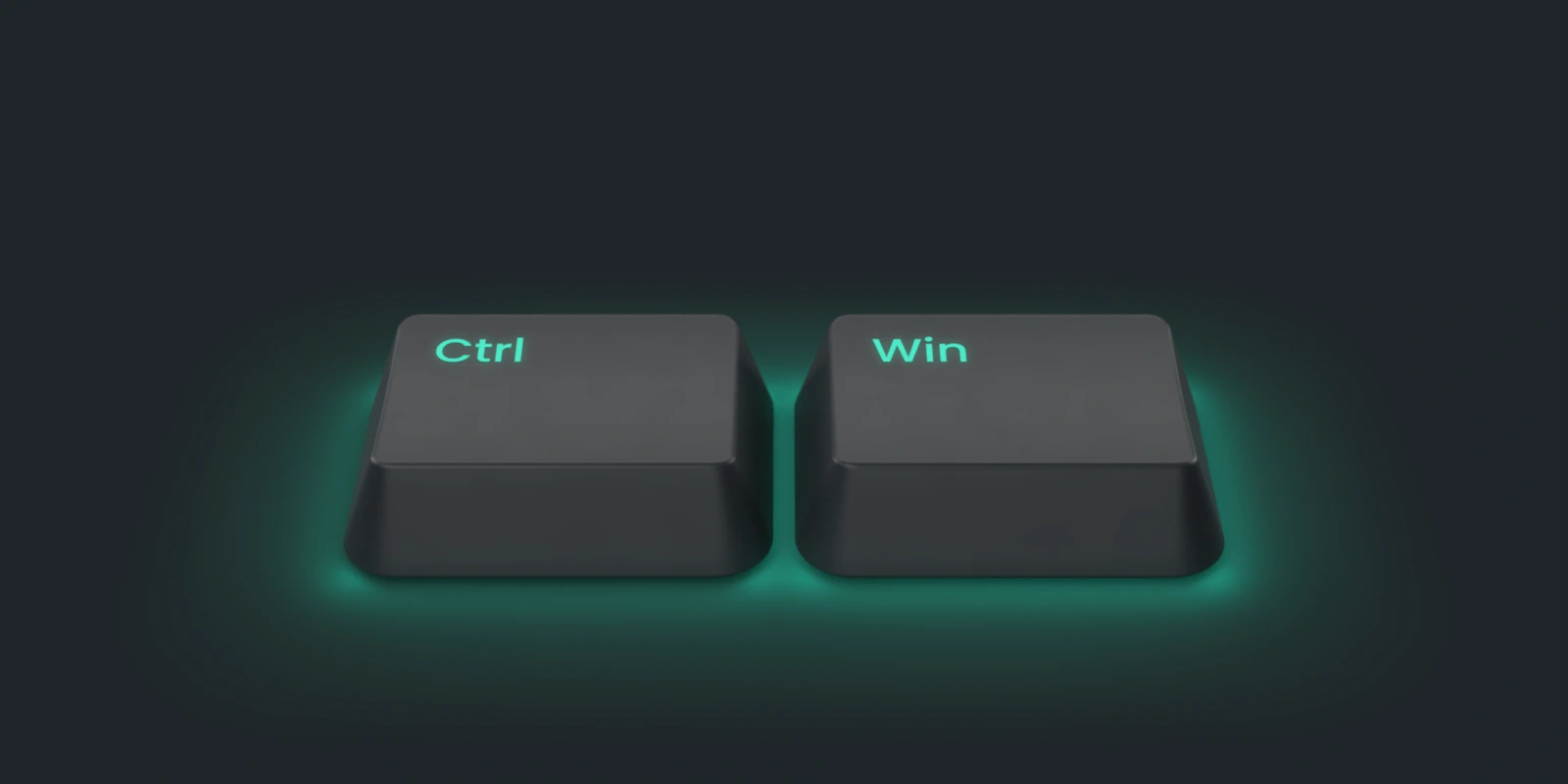
Hold a key. Speak. Keep working.
Deixis is free, needs no account, and runs on your own device. Everything on this page is in the current release.
v1.2.2 · 64‑bit Windows 10/11 · macOS 13 on Apple silicon · 51 MB · nothing else to install · also for Windows