The Granola alternative that keeps the audio on your machine
This page is for someone who already likes taking meeting notes without a bot in the call, and has started to wonder where the audio goes once their laptop has picked it up.
What you gain by switching is the recognition: Deixis records the same two streams Granola does — your microphone and your computer's own output — and turns them into a transcript on your own processor, with no account, no key and no network call of any kind. What you lose is a polished cloud product built around a calendar: a note history you can search and chat with, shared folders and templates, connectors into Notion and HubSpot, apps on both phones, and notes written for you on the free tier with nothing to configure.
One thing the two agree on, and it is worth saying plainly rather than pretending otherwise: neither of them sends a bot into your call. Granola's help centre says "No bot joins your meeting — other participants will not see any additional attendee", and Deixis works the same way. If avoiding the extra attendee is the whole reason you are here, both tools already solve it, and the rest of this page is about the quieter difference underneath.
Why switch
What you gain, and what you give up
Why Deixis
- The audio of your meeting does not leave the machine. This is the whole difference. Granola's
security page says it uses "best-in-class transcription providers (like Deepgram and Assembly)",
and Granola's own network allowlist — published so IT departments can unblock it — requires
api.deepgram.comandstreaming.us.assemblyai.comto be reachable. So while your meeting runs, its audio is streaming to a third party. Granola is straight about not keeping it: "Once transcription is complete, the audio is deleted from our systems". Deixis never sends it at all. Speech recognition is in-process, the WAVs stay in the session folder, and a meeting recording cannot be shared even if you wanted to. - No account, and no network. Recording a meeting, transcribing it and writing
transcript.mdneed no sign-in, no key and no connection. Granola requires an account before you can use it — Google, Microsoft, or SSO on the Enterprise tier — and signing in connects a calendar, which Granola then reads for attendees, time, date and title. - Your notes do not expire behind a plan. Granola's free tier shows the last 30 days in the
app; older notes are still stored but out of reach until you pay $14 a user a month. A Deixis
session is a folder under
%USERPROFILE%\.deixis\sessions\, and a meeting from last year opens exactly as fast as one from this morning, on any tier, including none. - Everything is a file, so there is no export to request. Each session holds
meta.json, the per-minute WAVs for both streams,transcript.mic.jsonlandtranscript.sys.jsonl,transcript.mdas a readable merged transcript, andnotes.mdwhen you have notes configured. Back up that folder and you have backed up every meeting you have ever recorded. Getting your data out of Granola means asking for a CSV, waiting a few hours for an email, and doing it at most once every 24 hours. - It tells the people apart, on the machine. Deixis identifies the voices in a meeting and gives each one its own place in the transcript, and when you put a name to a voice it recognises that person in later meetings. The voiceprint is a mathematical fingerprint that stays on the computer, is never uploaded, and can be deleted per person.
- Nothing is used to improve anybody's model. On Granola's Basic and Business plans anonymised data may be used to improve Granola's models unless you turn it off under Settings, Preferences, Data and sharing; Enterprise has it off by default. Deixis has no such setting because it has no such pipe: there is no telemetry, and the only things a fresh install calls on its own are the update check and, when you open the Settings window, a check for an announcement from us. Both send nothing but the request.
- One person, $49 a year, and the meeting half is free. Granola is priced per user per month. Deixis's paid tier is the managed cloud convenience — cleanup, translate, meeting notes and share links — and recording and transcribing a meeting are not on it. With your own provider key the cloud features cost nothing either.
- It is the same chord as everything else.
Ctrl+Win+Mstarts and stops a meeting, andCtrl+Winheld is the dictation you were already using to type the follow-up email. Dictation wins over meeting transcription, so push-to-talk stays fast while an hour-long recording runs.
Where Granola still wins
- It works in more than one language. Granola lists multi-language support on its free Basic plan. The Deixis speech model is English-only, and no setting changes that. If your meetings are in German or Portuguese or Japanese, this page ends here and the honest answer is Granola.
- Notes that write themselves, free, with nothing to set up. AI meeting notes are the headline
of Granola's free tier: you sign in, it reads your calendar, and the notes arrive. Deixis writes
the transcript on its own, always, but the
notes.mdsummary is the one step that needs a cleanup endpoint configured — your own provider key against a Worker you deploy, or the managed subscription. Without one the meeting still records and the transcript is still written, and the app says so, but you are looking at a transcript rather than a summary. - A note history you can search and ask questions of. AI chat within and across meetings, shared folders and customised templates are all on Granola's free plan. Deixis gives you a folder of sessions on your disk; searching them is your file manager's job, and there is nothing to ask a question of across six months of calls.
- Meetings from an iPhone. Granola is available for macOS, Windows, iOS and Android. Deixis runs on all four too, but the iPhone host is a dictation keyboard: meetings on the phone are Android today, and recording a call from an iPhone is not something Deixis does.
- No hardware floor, because the hard part happens elsewhere. Granola's app has very little to ask of your machine, since the transcription is done on somebody's servers. Deixis compiles its speech recognition against AVX2, so a PC older than about 2013 stops with an illegal-instruction error rather than running slowly. That is a hard floor, not a recommendation.
- Connectors into the tools a sales or research team already runs. Granola's Business tier at $14 a user a month adds Attio, Notion, Slack, HubSpot, Affinity and Zapier, plus API access. Deixis has webhooks to URLs you write yourself, which is a different and more manual thing.
What you get
More than dictation. One key, and everything behind it.
Hold the key and press a letter: free mode, a grab, a meeting, a recording, a translation, your own buttons. All of it on your own device, all of it free, none of it behind an account.
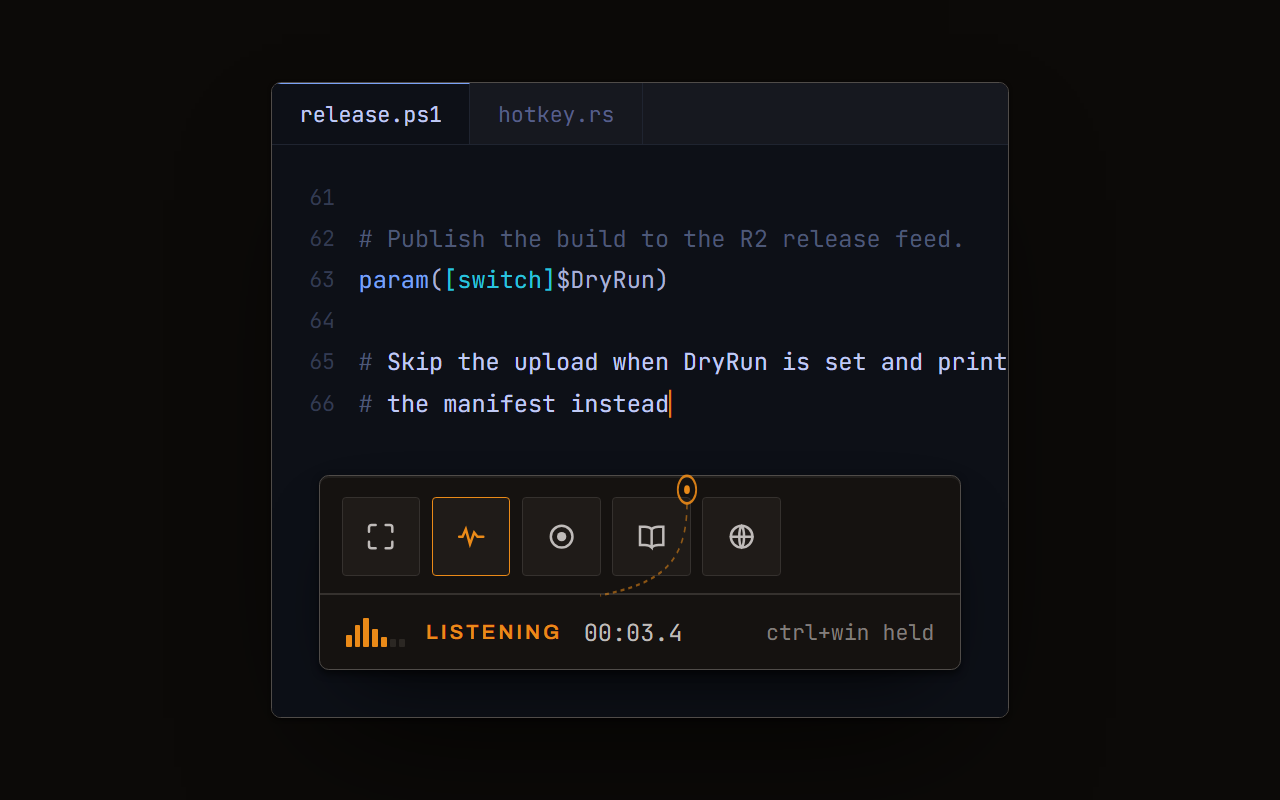
Dictation, where your cursor is
Hold a key, speak, release. Clean, punctuated text lands in whatever has focus, on your PC, your Mac and your phone, with your clipboard handed back.
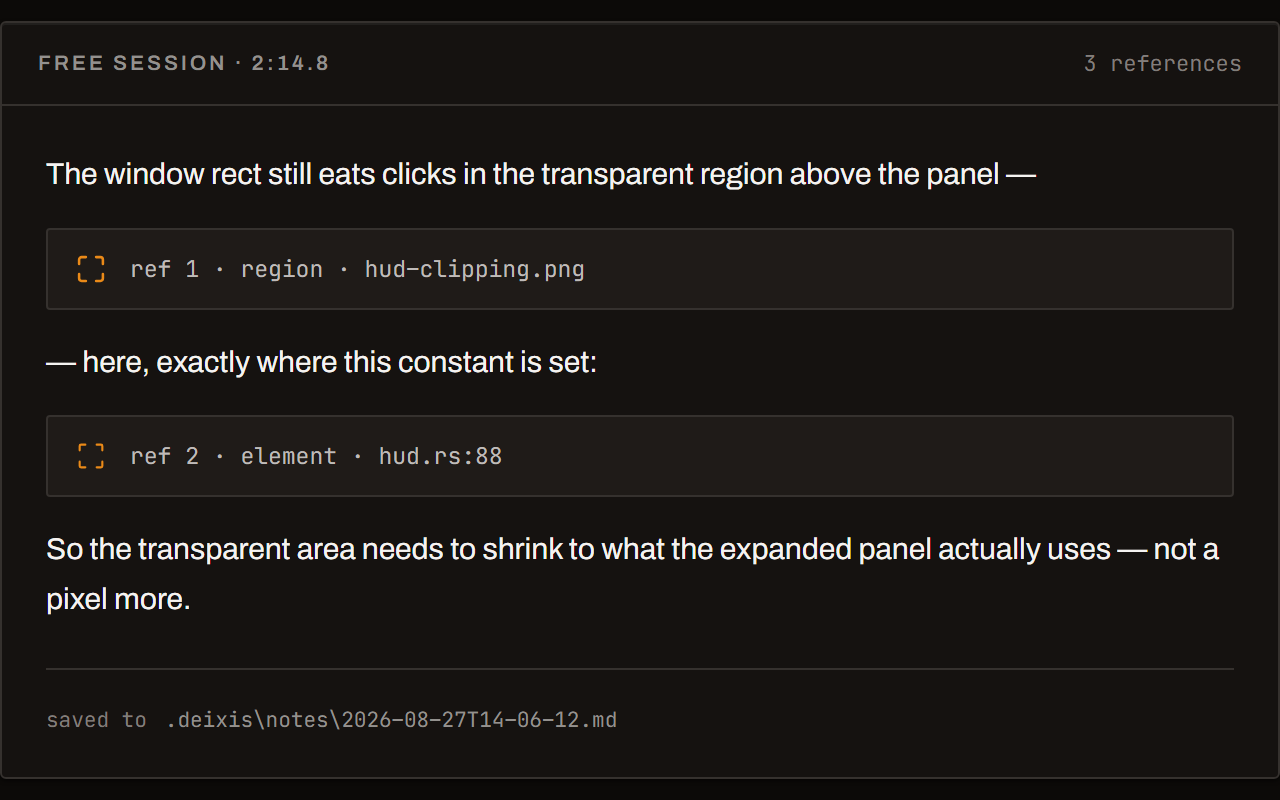
Free mode: talk and point
Narrate for as long as you like while you grab a region, pick a button on screen or take a selection. One note, what you said interleaved with what you pointed at, pasted where you finish and saved as Markdown.
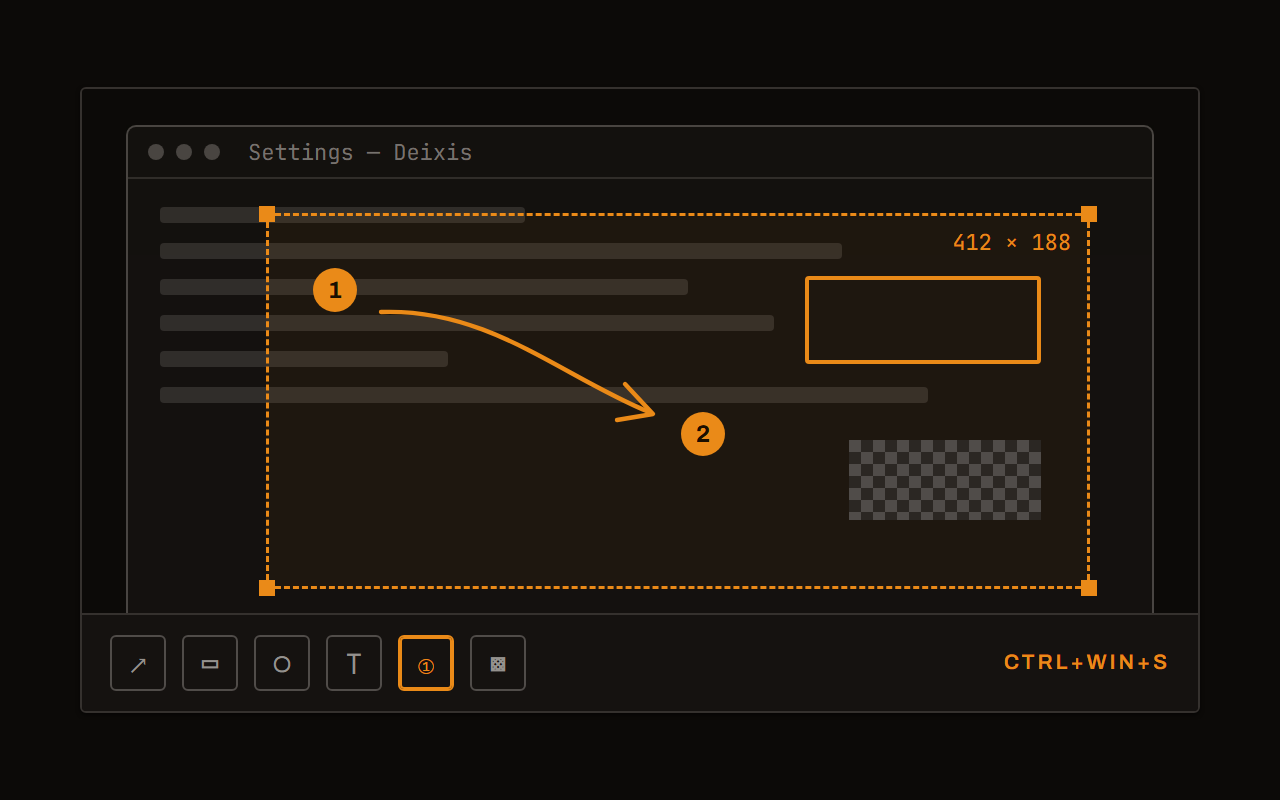
Screen grabs, annotated
Freeze every screen at the keypress, drag a region, add arrows, boxes, text and numbered steps, and pixelate what is private. Saved as a PNG that stays editable.
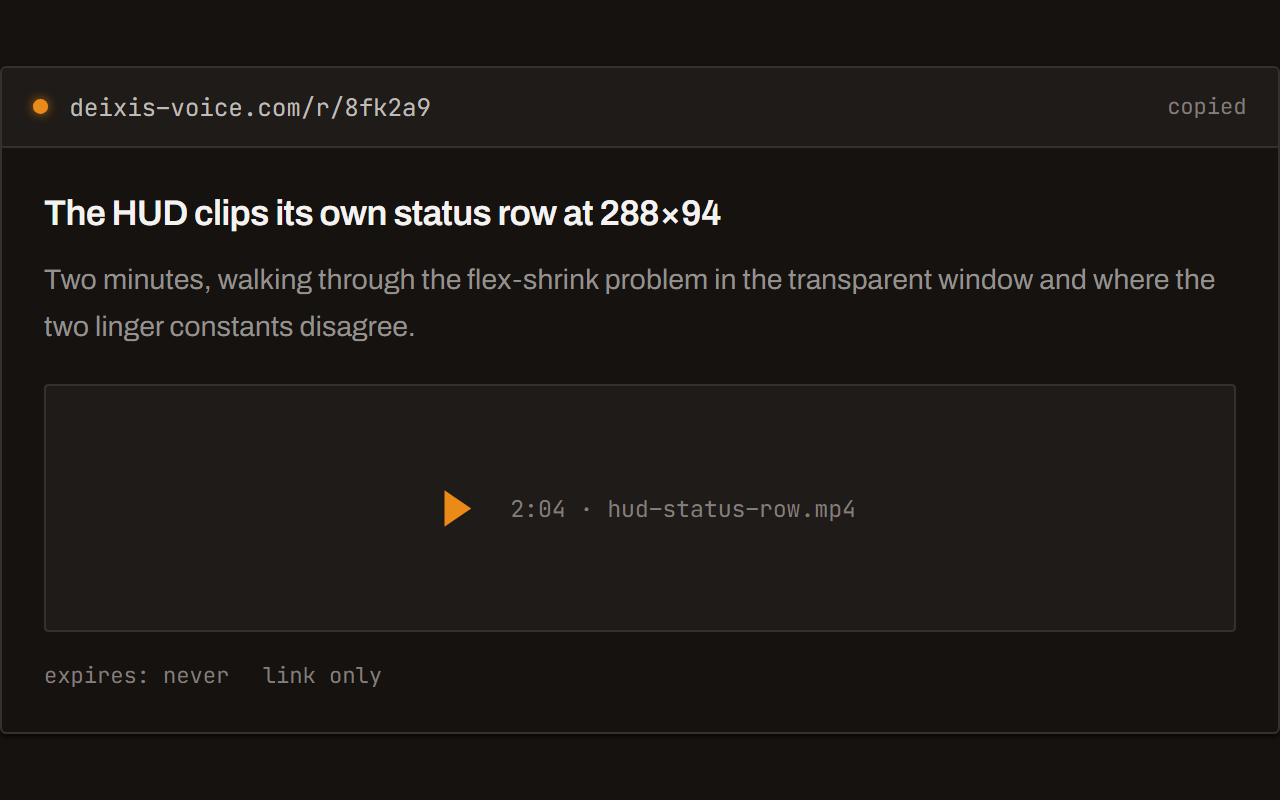
Screen recording, shared as a link
Record the screen with your narration. The recording writes itself up with a title, chapters and a summary, and from your Deixis account it shares as a link anyone can open without one. The Loom you can stop paying for.
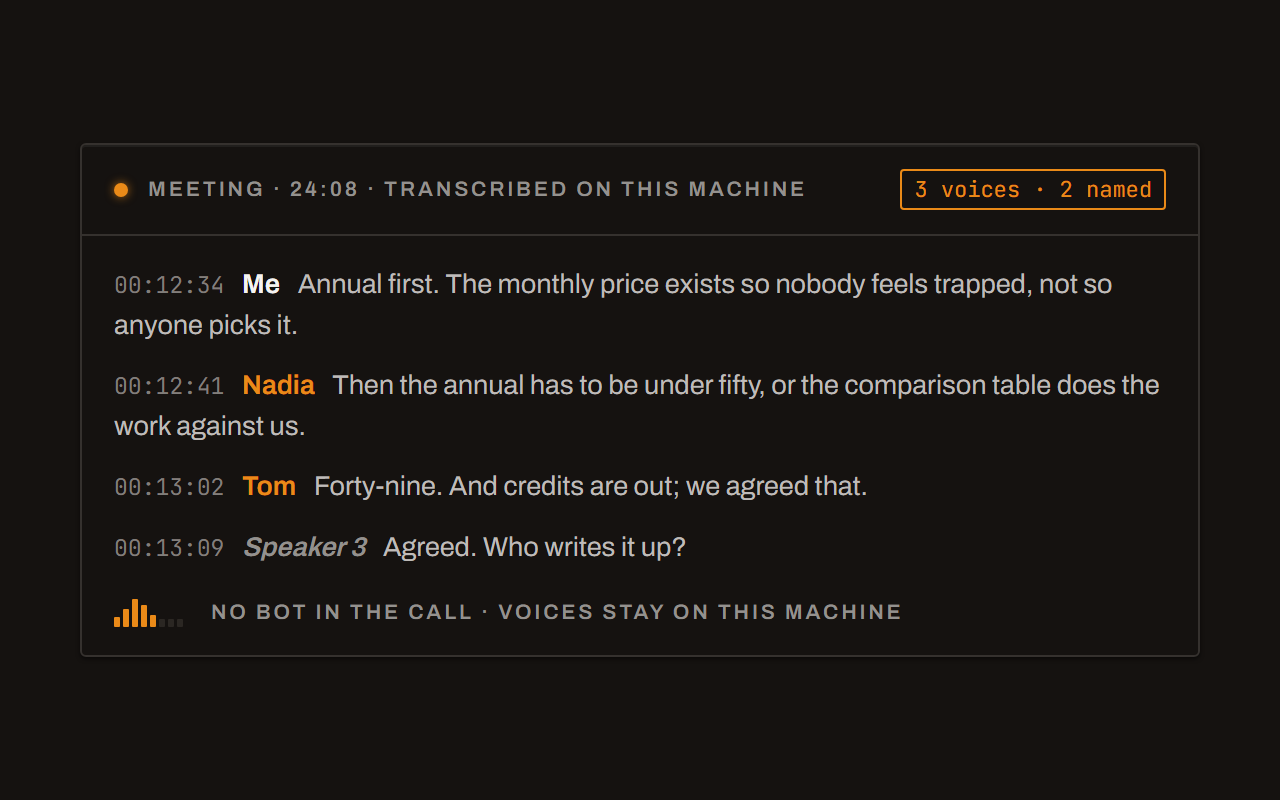
Meetings, no bot, names included
Your microphone and the other side, transcribed on your machine while the call runs. Deixis tells the voices apart and remembers the ones you name, and never uploads a voice.
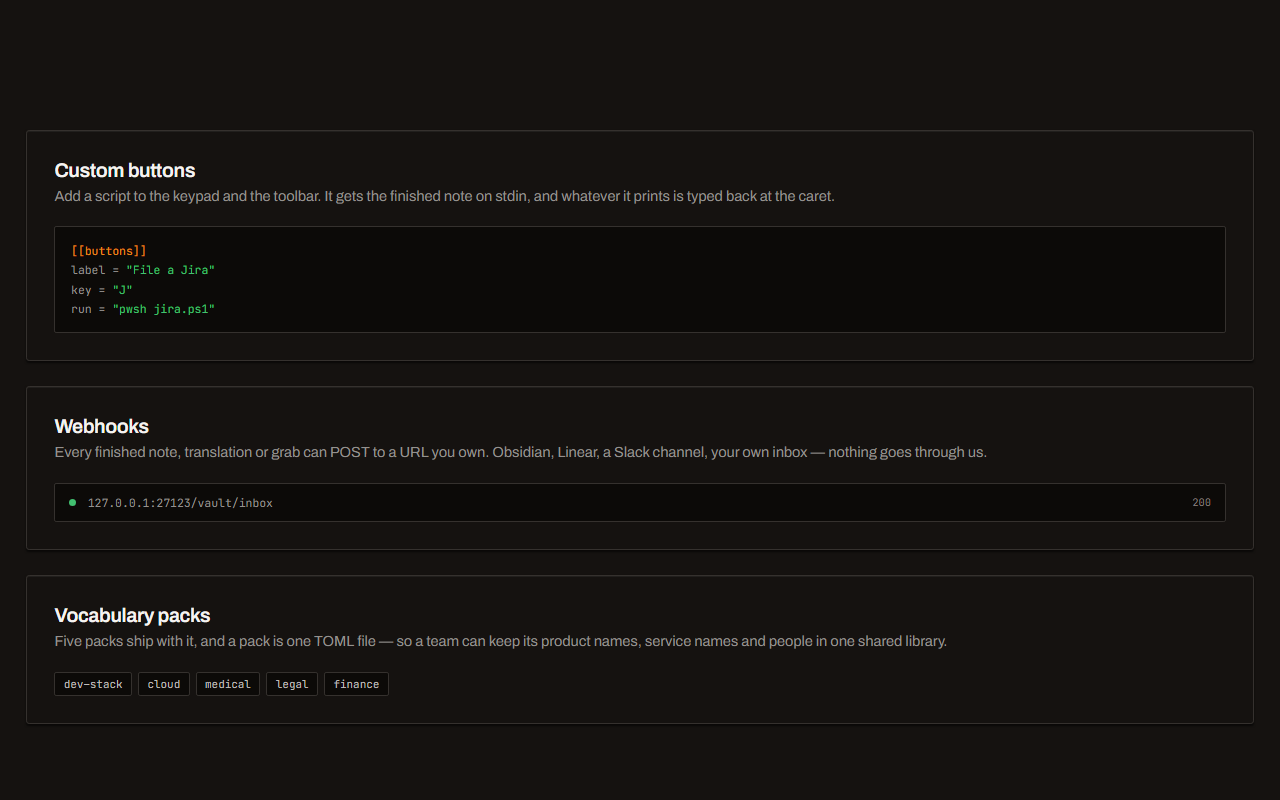
Your own buttons and workflows
Add a button to the palette: it gets the note on stdin and types back whatever it prints. Send finished notes to any URL you own. Chain steps: read the text off a screenshot, translate it, summarise it, post it.
Side by side
Granola and Deixis, side by side
| Row | Deixis | Granola |
|---|---|---|
| Runs on | Windows 10 and 11 (64-bit, on a CPU with AVX2: 2013 and later), Mac (Apple Silicon) and Android (a dictation bubble in any app, plus meetings), with an iPhone keyboard in beta on TestFlight and not yet in the App Store. One engine on all of them, and dictation audio never leaves the device. | macOS, Windows, iOS, Android |
| Speech recognition happens | On your own device, inside the app, on every platform. Your audio never leaves it. | In the cloud |
| AI cleanup happens | On your device, with no provider at all. Or, if you want more, Deixis's cloud, your own Ollama, or your own key. Your choice, in one setting. | In the cloud |
| Leaves your machine | Text only, and only once you switch a cloud feature on — plus, if you press the Claude usage key, the Claude Code sign-in already stored on your machine. Never audio, never screenshots, never window titles. | Audio, text |
| Account needed | None, ever, for anything that runs on your device. The cloud extras have a seven-day trial you start with an email code. No card. | Required |
| Price | Free forever for everything local, meetings included. Pro is $49 a year for the cloud extras with nothing to set up. | Free tier: Basic: free, with AI meeting notes, AI chat within and across meetings, shared folders, customised templates and multi-language support; the app shows the last 30 days of notes only; $14 a month; Per user. Business at $14 per user a month lifts the 30-day window to unlimited note history and adds advanced AI models, the Attio, Notion, Slack, HubSpot, Affinity and Zapier integrations, centralised billing, MCP integration and API access. Enterprise is $35 per user a month and adds enterprise-grade security and admin controls, SSO, priority support, org-wide auto-deletion settings and a company-wide opt-out of model training. The billing help page describes billing per workspace per active seat, a time-limited trial of Business or Enterprise whose length it does not state, and twelve months free of Business for accepted startups and students. Granola's own pages do not publish an annual price, so the annual cell is null rather than a guess. |
| Your transcripts live | In plain files, in one folder you own and can back up. Uninstall Deixis and every note is still readable. | On your device and in the cloud |
| Make it yours | Add your own buttons that run a script, send finished notes to any URL you own, and switch on vocabulary packs for your field. | Slack on the free Basic plan. Business adds Attio, Notion, HubSpot, Affinity and Zapier, MCP integration and API access. Enterprise adds SSO and org-wide admin controls. Notes come out as a CSV: Settings, Profile, Generate CSV, emailed within a few hours, one export per account every 24 hours, containing the title, note summary, transcript and basic details for every note including ones older than the 30-day window. |
Granola facts from home, granola.ai, security, its privacy policy, faq, network, export, signin and billing, read on 14 September 2026. “Not documented” means those pages did not say.
Granola and Deixis agree on the thing most meeting tools get wrong: neither sends a bot into the call. Granola's own help centre says "No bot joins your meeting — other participants will not see any additional attendee", and its home page says it "Uses your computer audio, so doesn't invite a bot". It is also no longer a Mac tool: the home page reads "Available for macOS, Windows, iOS, Android". Where the two part is what happens to the audio after it is captured. Granola's help centre says "Granola runs locally on your device and captures audio directly from your microphone and system audio" — that is capture, not recognition. The recognition is somebody else's cloud: the security page says Granola uses "best-in-class transcription providers (like Deepgram and Assembly)", and Granola's own network allowlist, published for IT departments, lists api.deepgram.com and streaming.us.assemblyai.com among the domains that must be reachable. So the audio of the meeting streams off the machine to a third party while the meeting runs. Granola is clear that it is not kept: "Audio is temporarily cached during the meeting for transcription only. Once transcription is complete, the audio is deleted from our systems", and the privacy policy says "We do not retain or store such recordings once the transcription is created". The transcript and the notes are kept, on AWS servers in the United States, encrypted at rest and in transit. On the Basic and Business plans anonymised data may be used to improve Granola's models unless you turn it off in Settings, Preferences, Data and sharing; Enterprise has training off by default; third parties such as OpenAI and Anthropic are never permitted to train on it. An account is required — Google, Microsoft or enterprise SSO — and signing in connects a calendar, which Granola reads for event metadata: attendees, time, date and title. Deixis records the same two audio streams and transcribes them on the machine that recorded them, with no account and no network at all, and writes transcript.md into a folder. The comparison runs Granola's way in several places worth naming: multi-language support on the free tier against an English-only speech model here, the calendar-driven workspace with shared folders and templates, the phone apps, and AI chat across a note history that Deixis has no equivalent of.
What leaves your machine, and what leaves theirs
Deixis publishes every byte it sends, as a table, because there is so little of it. Here is that table beside what Granola's own pages say.
| What | Deixis | Granola |
|---|---|---|
| Audio | Never. Recognition happens inside the app on your device; the recording, the model and the transcript stay there. | The meeting's audio — your microphone and your computer's own output, captured without a bot in the callGranola, and the transcription provider it uses: the security page names "best-in-class transcription providers (like Deepgram and Assembly)", and Granola's network allowlist requires api.deepgram.com and streaming.us.assemblyai.com to be reachable · while the meeting runs — the security page says Granola "transcribes in real time on macOS/Windows, or after your meeting using temporarily cached audio on Mobile". It is not kept: "Once transcription is complete, the audio is deleted from our systems" |
| The dictated text | The sentence you just dictated, your vocabulary, and your previous sentence in that fieldthe endpoint you chose · only with a cloud endpoint set, and by default only when the local rules are not enough | The transcript, the AI notes written from it, and whatever you type into a note or ask the AI chatGranola's US-hosted AWS virtual private cloud, encrypted at rest and in transit · every meeting. The notes are the product, so this is not optional. Anonymised data may be used to improve Granola's models on Basic and Business unless you opt out in Settings, Preferences, Data and sharing; Enterprise has it off by default, and third parties such as OpenAI and Anthropic are never allowed to train on your data |
| Context around the text | The names of the app and the field the text is going into. Never the window title, never a screenshot.the same endpoint · with that request | Calendar event metadata: Granola asks "to view events in your calendar and get basic metadata from them (attendees, time, date, and title)", for context and notificationsGranola · from sign-in onwards, because signing in with Google or Microsoft is what connects the calendar |
| Telemetry and analytics | None. No account, no telemetry, no analytics, no crash reports. | The privacy policy lists "Device/IP Data" including "IP address" and "Device ID" alongside your name and email. The network allowlist carries two diagnostics endpoints, cognito-identity.us-east-1.amazonaws.com and logs.us-east-1.amazonaws.comGranola, and AWS · while you use the service |
| Update check | Nothing but the request; the version check happens on your PCapi.deixis-voice.com · every launch, and when you ask in Settings | Granola's own allowlist names download.granola.ai, a CloudFront distribution, go.granola.ai and go.granola.so as the download and update path; what the update check itself carries is not statedGranola, and its CDN · not documented |
| Model download | Nothing but the requesthuggingface.co · once, when you press Download on first run | not documented |
| Account and sign-in | An email address, only if you choose to start the trial, plus the partner tag from a partner download link and the first partner website that connected to Deixis on this computer, if there are anythe Deixis endpoint · when you start the trial | You sign in before you can use it, with Google, with Microsoft, or with SSO on the Enterprise tier; the privacy policy collects first and last name and email. Authentication runs through auth.granola.ai and api.workos.comGranola, and its identity provider · at sign-in, and per active seat for billing |
| Integrations | The finished note, and for a screenshot its file name, never the imagea URL you added yourself · on finish, only for destinations you added | Your notes, or what an integration asks for, to the service you connect: Slack on the free plan, and on Business also Attio, Notion, HubSpot, Affinity and Zapier, plus MCP integration and API accessthe service you connect · only once you connect one |
Before you switch
Before you switch
Who should not switch
Stay on Granola if your meetings are not in English — the language row is not close, and running the recognition locally does not help a model that does not speak the language. Stay if the calendar-shaped workspace is the point: if you rely on notes appearing without configuring anything, on searching and chatting across a year of calls, on shared folders and templates your team edits together, or on notes landing in HubSpot or Notion by themselves, Deixis does none of those and is not trying to. Stay if you take notes on an iPhone, if your PC predates AVX2, or if your work is feeding existing recordings through a transcriber — Deixis transcribes what it records, and there is no drop-a-file path. And if the thing you wanted was simply no bot in the call, you already have it, and switching buys you only the privacy argument.
Making the switch
Where the session files land
Hold Ctrl+Win and press M, use the tray item, or press record on the Meetings tab. The
session lands in %USERPROFILE%\.deixis\sessions\<timestamp>\: meta.json with the devices,
sample rates, model and start and end times; audio\mic-0001.wav onwards for your microphone at
16 kHz mono, one file per minute; audio\sys-0001.wav onwards for the system output when loopback
is available; transcript.mic.jsonl and transcript.sys.jsonl as the lines were transcribed;
transcript.md as the merged readable transcript; and notes.md when a cleanup endpoint is set.
Each session is named from what was said in it, so a month of meetings reads as a list of subjects
rather than thirty timestamps. A name you type yourself is never overwritten by any of that. A
crash costs at most a minute, because the WAVs are finalised per segment and
deixis-core --transcribe <session-dir> rebuilds the transcript from what is on disk.
The keys
Ctrl+Win+M starts a meeting and the same chord stops it. Holding Ctrl+Win brings up the mode
palette above the listening pill, with one chip and one letter per mode — M is meeting, S is a
screen grab, T is translate, D adds a word to your vocabulary. The letters stay live for five
seconds after the chord engages and the palette fades exactly when they stop working. While a
meeting runs the tray icon carries a red dot and its menu counts the elapsed time, and the Meetings
item in the side rail shows a recording dot and the clock from whatever page you are on.
Loopback and headphones
Deixis records the microphone and, when it can, the system output, so both halves of a call are
transcribed. Two things are worth knowing before your first real meeting. Wear headphones if you
can: loopback captures what the speakers play, but your microphone hears it too, so on open
speakers the far end bleeds into your own channel. Echo cancellation is out of scope. And
loopback can be unavailable — exclusive-mode devices and some virtual sound cards do not offer
it. Deixis falls back to microphone-only, says so, and records the fact in meta.json rather than
failing the meeting. Settings → Microphone switches the input device live, which makes this cheap
to test both ways before it matters.
Getting your Granola notes out
Granola exports as a CSV. Open Settings, click Profile in the sidebar under Preferences, and click Generate CSV; the file is emailed to you within a few hours and the link is good for 24 hours. It carries the title, note summary, transcript and basic details for every note, including the ones older than 30 days that the free plan hides in the app. You can only generate one export per account every 24 hours, and each person's export contains only their own notes — a workspace admin cannot export somebody else's. Do that before you cancel, and note that on Enterprise accounts exporting is off by default and only an admin can switch it on.
There is no import path into Deixis, and no honest way to build one: a Granola note is a summary written in Granola's shape, and Deixis's sessions are made of audio it recorded itself. Keep the CSV as your record of what came before, and let the new folder start from your next call.
Before you ask
Questions people search for
Does Granola record my meetings without a bot?
Yes. Granola listens to your computer's own audio rather than joining the call as a participant — its help centre says no bot joins your meeting and other people will not see an extra attendee. Deixis works the same way, so on this particular question the two tools are not in competition.
Does Granola send my audio to the cloud?
Yes, while the meeting is running. Granola's security page says it uses transcription providers "like Deepgram and Assembly", and its own network allowlist requires Deepgram and AssemblyAI streaming endpoints to be reachable. Granola says the audio is deleted once the transcription is made, and that the transcript and notes are kept on AWS servers in the United States, encrypted at rest and in transit.
Can I transcribe a meeting completely offline?
With Deixis, yes. The recording and the speech recognition both happen on your machine, so a
meeting records, transcribes and writes transcript.md with no account, no key and no network.
Two optional steps reach an endpoint at the end of a meeting, and both go to the one you configure:
the summary in notes.md, and — only if you have not named the session yourself — the opening of
the transcript, about 1,500 characters, that Deixis asks a model to turn into a title. With no
endpoint and no local model, neither happens and the meeting is unaffected: it still records,
transcript.md is still written, and the session simply shows its date.
Is Granola free, and what does the free plan actually give me?
There is a free Basic plan with AI meeting notes, AI chat within and across meetings, shared folders, templates and multi-language support, checked on 14 September 2026. The catch is the window: the app shows only the last 30 days of notes, and unlimited history is Business at $14 a user a month. Enterprise is $35 a user a month and adds SSO, admin controls and a company-wide opt-out of model training.
Does Granola train AI models on my meetings?
Granola's own pages say third parties such as OpenAI and Anthropic are never allowed to train on your data, and that it uses de-identified or anonymised data to improve its own models, which you can switch off under Settings, Preferences, Data and sharing. Enterprise accounts have model training off by default. Deixis has nothing equivalent to opt out of, because the audio and the transcript never leave your computer.
Do I need an account to use Deixis for meetings?
No. Meeting recording and on-device transcription are free, forever, with no sign-in at all. An account only comes into it for the managed cloud extras — cleanup, translate, meeting notes and share links — and even those are open to anyone using their own provider key.
Keep reading
Related pages
How to transcribe a meeting without a bot joining the call
Record both sides of a call on your PC and transcribe it there, with no bot in the participant list and no audio uploaded. How it works, and its limits.
A free meeting recorder that sends nothing
Record both sides of a call and transcribe it on your own machine, free and with no account. Nothing joins the meeting and nothing uploads the audio.
Here is every byte that leaves your machine, for each tool
Every byte Deixis sends off your machine in one table, and the same table filled in for other dictation tools from their own documentation, dated.
The Fireflies alternative that keeps the call off the cloud
Fireflies sends a bot into your call and keeps the recording in its cloud. Deixis records the call on your own PC and transcribes it there.
The Fathom alternative where the meeting never leaves the room
Fathom's free tier is generous, but every call lands on its servers. Deixis records and transcribes a meeting on your own machine, with no account.
The meeting recorder that never sends the meeting anywhere
tl;dv records your calls to its European cloud and transcribes in 30+ languages. Deixis records mic and system audio to your own disk, on your own CPU.
Hold a key. Speak. Keep working.
Deixis is free, needs no account, and runs on your own device. Everything on this page is in the current release.
v1.2.2 · 64‑bit Windows 10/11 · macOS 13 on Apple silicon · 51 MB · nothing else to install · also for Windows
Facts about Granola checked on 2026-09-14 against granola.ai. Deixis facts are from its README for the current release. Something out of date? Tell us.