The Fireflies alternative that keeps the call off the cloud
This page is for someone whose meetings are recorded by Fred — the Fireflies.ai Notetaker that appears in the participant list — and who has started to mind it: because a client asked what the extra attendee was, because legal asked where the recording lives, or because the same question comes up in every external call.
What you gain by switching is that the call is never uploaded: nothing joins the meeting, and nothing is sent away to be transcribed either. Deixis records the call from your own machine — your microphone and the system output, the two halves of the conversation — transcribes it on your own processor, and writes the transcript into a folder on your disk, with no account, no key and no network call. What you lose is everything Fireflies built around the recording afterwards: a searchable workspace holding every call your company has ever had, an assistant that answers questions across them, transcription in a hundred languages, and a bot that attends the meetings you cannot.
The rest of this page is that trade in full, with Fireflies' facts taken from Fireflies' own pages and knowledge base on the date at the bottom.
Why switch
What you gain, and what you give up
Why Deixis
- The audio never leaves the machine, on any plan. Recognition is in-process: the recording, the model and the transcript stay local. Nothing uploads a meeting's WAVs under any setting or on any plan, and a meeting recording cannot even be shared as a link. With Fireflies, the audio is the thing that goes up — that is how the transcript gets made — and even the no-bot path on its desktop app sends the system audio to Fireflies to be transcribed.
- Nothing joins the meeting. Fireflies' own knowledge base puts it plainly: asked whether the bot's presence can be hidden, it answers "No. Fireflies is always visible in the participant list to ensure compliance." Deixis is not in the call. It records the microphone and the system output from your own machine, so what the other side sees is you, and there is no guest to admit from a lobby, no name to explain, and nothing for a host's bot policy to block.
- No account, and no calendar handed over. Meeting mode records, transcribes and writes
transcript.mdwith no key, no account and no network at all. Fireflies needs one before anything is captured, and its own pricing FAQ says sign-in "is only possible via Google Auth or Outlook Auth" — so the account and your calendar arrive together, and its privacy policy lists what that gives it: "event titles, descriptions, dates and times, and guest lists". - The meeting is a folder, not a plan. Each session lands in
%USERPROFILE%\.deixis\sessions\<timestamp>\: the audio a minute at a time, the timestamped lines as they were transcribed,transcript.mdas the readable merge, andnotes.md. Back up that folder and you have backed up every meeting. Fireflies' free tier holds 400 minutes of meetings in total, and 8,000 minutes a seat on Pro — storage is the thing the plan is sold on. - It tells the people apart, on the device. Deixis names the people in a meeting rather than labelling everything "them", gives each voice its own place in the transcript, and once you have named a voice it recognises that person in later meetings. The voiceprint is a mathematical fingerprint that stays on the machine, is never uploaded, and can be deleted per person.
- One price for the app, not a price per seat per month. Everything local is free forever: meeting recording, transcription, dictation, screen capture, the dictionary, webhooks. Pro is $49 a year, or $10 a month, and it buys the managed cloud extras — or you point Deixis at your own provider key and pay nobody. Fireflies is $18 a seat a month, or $10 a seat a month billed annually, and every teammate you add is another seat.
- The same chord does the rest of the day.
Ctrl+Winheld is dictation at the caret, andCtrl+WinthenMstarts a meeting. The tool you reach for to record the call is the one you were already using to write the follow-up, and a dictation started mid-meeting always wins, so push-to-talk stays fast while an hour-long recording runs.
Where Fireflies.ai still wins
- Every past call in one searchable place, with an assistant over it. Fireflies keeps your transcripts and summaries in a workspace you can search by keyword, speaker or timestamp across months of calls, and AskFred answers questions about them. Deixis writes each meeting into its own folder on your disk; searching them is your file manager's job, and there is no assistant reading across them.
- A bot that attends meetings you do not. Connect a Google or Outlook calendar and Fireflies
joins on its own — all meetings with a conferencing link, only the ones you own, only the ones
with teammates, or only when you invite
fred@fireflies.aiby hand. It records whether or not you turn up. Deixis records what your own machine can hear, so a meeting you are not in is a meeting it does not have. - A hundred languages, detected automatically. Fireflies advertises transcription in over a hundred languages with automatic language detection. The Deixis speech model is English-only and no setting changes that. If your calls are in German or Japanese, this page ends here and the honest answer is Fireflies.
- CRM, task trackers and an API. Notes and action items are pushed into Salesforce, HubSpot, Slack, Notion, Jira, Asana, Greenhouse and about a hundred other services after each meeting, and there is an API and an MCP server on top. Deixis posts finished notes to webhook URLs you enter yourself, which is a smaller idea and a much smaller ecosystem.
- Recording things that are not on your PC. The mobile apps capture in-person conversations and phone calls, the dashboard and the API transcribe audio and video files you already have, and dialer integrations pull in telephony calls. Deixis has no drop-a-file transcription and no phone recorder.
- The call on video, and a transcript for everyone. Paid tiers record the meeting video as well as the audio, and the recap link can be shared with participants who have no seat. Deixis records audio, and a meeting recording cannot be shared as a link at all.
What you get
More than dictation. One key, and everything behind it.
Hold the key and press a letter: free mode, a grab, a meeting, a recording, a translation, your own buttons. All of it on your own device, all of it free, none of it behind an account.
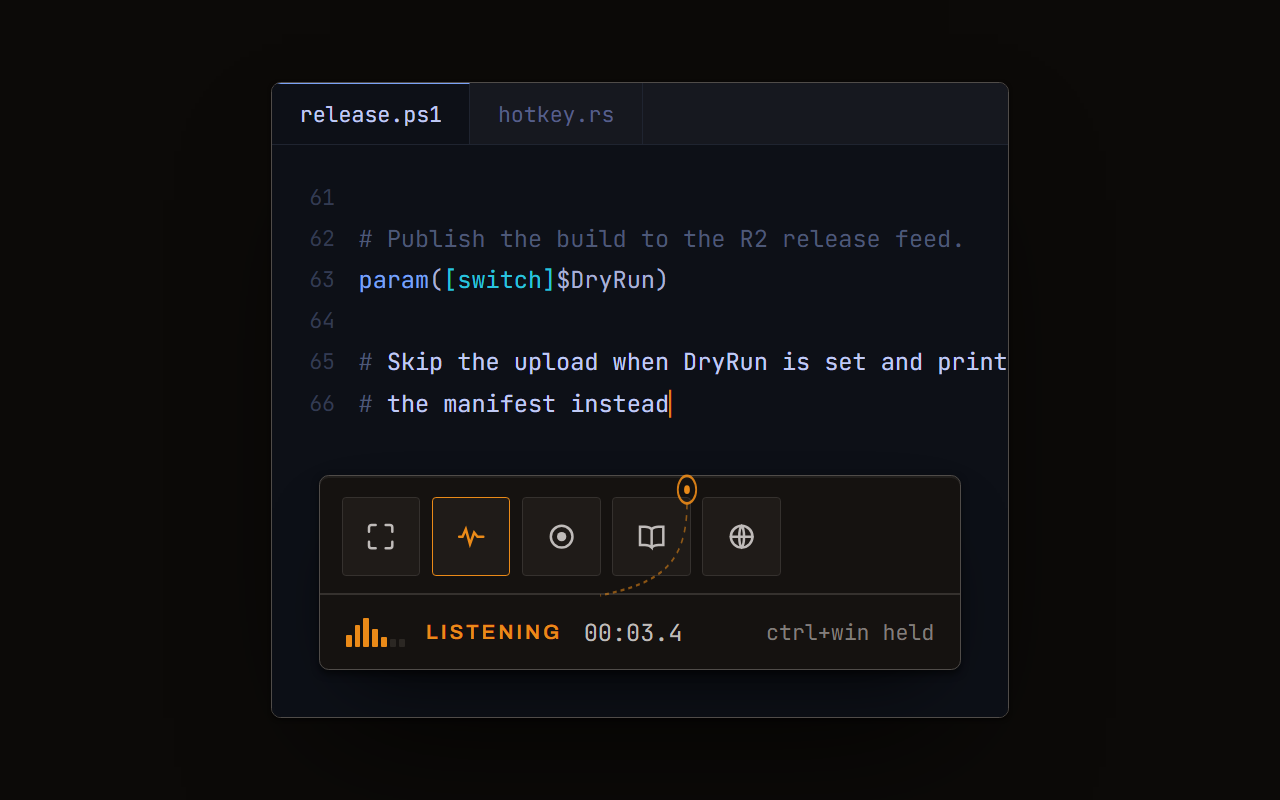
Dictation, where your cursor is
Hold a key, speak, release. Clean, punctuated text lands in whatever has focus, on your PC, your Mac and your phone, with your clipboard handed back.
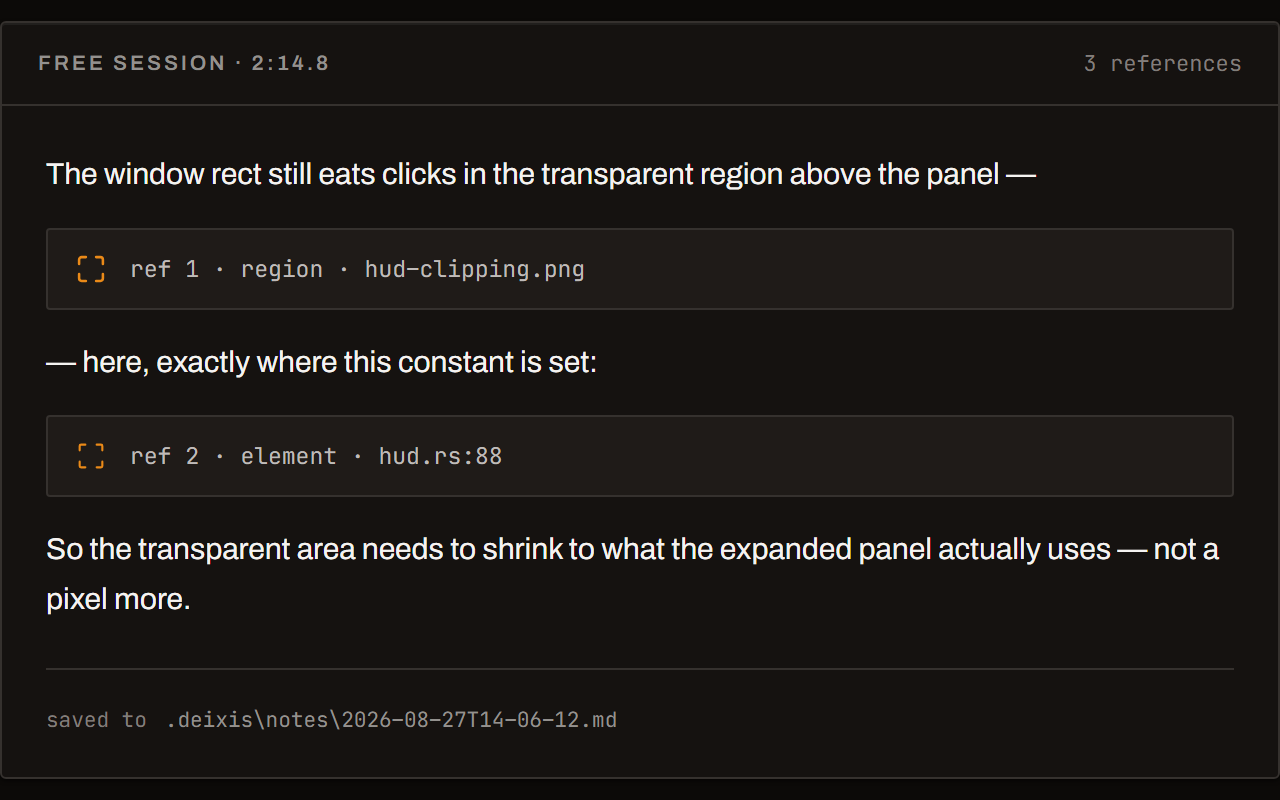
Free mode: talk and point
Narrate for as long as you like while you grab a region, pick a button on screen or take a selection. One note, what you said interleaved with what you pointed at, pasted where you finish and saved as Markdown.
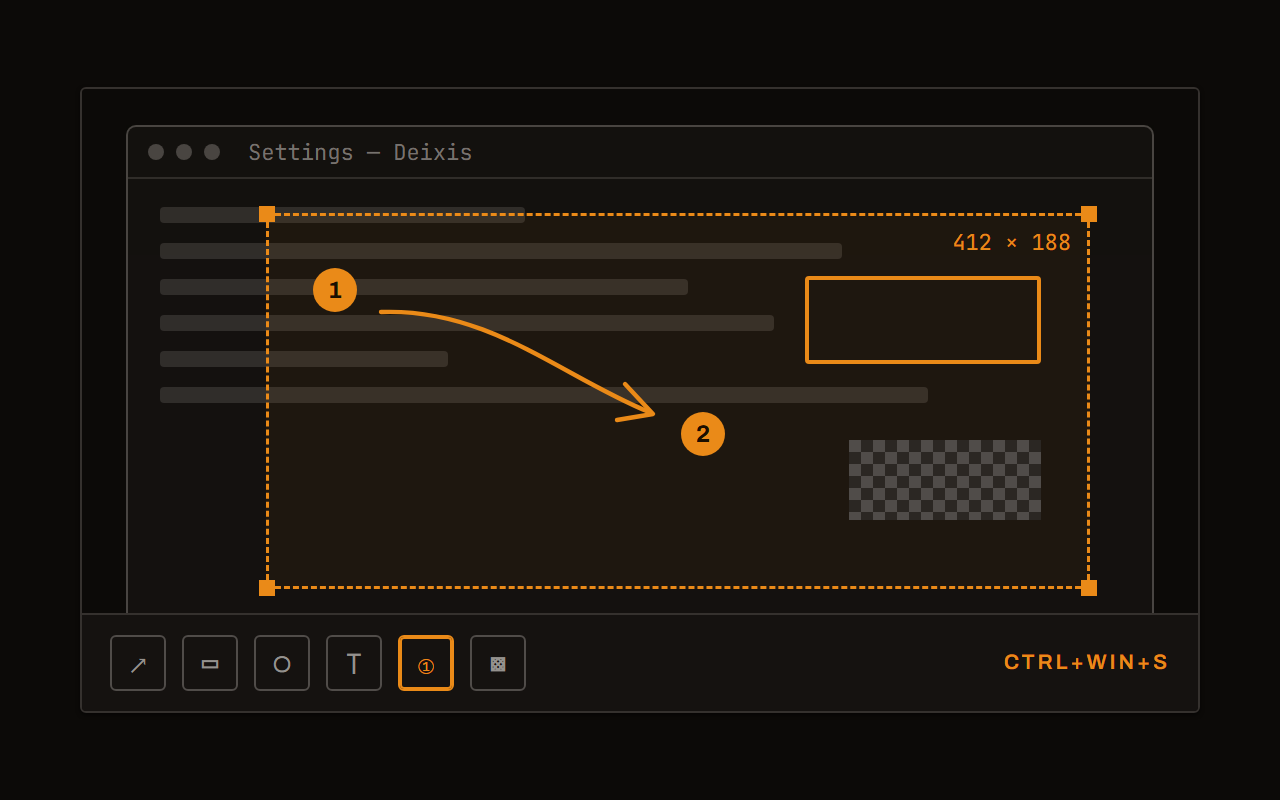
Screen grabs, annotated
Freeze every screen at the keypress, drag a region, add arrows, boxes, text and numbered steps, and pixelate what is private. Saved as a PNG that stays editable.
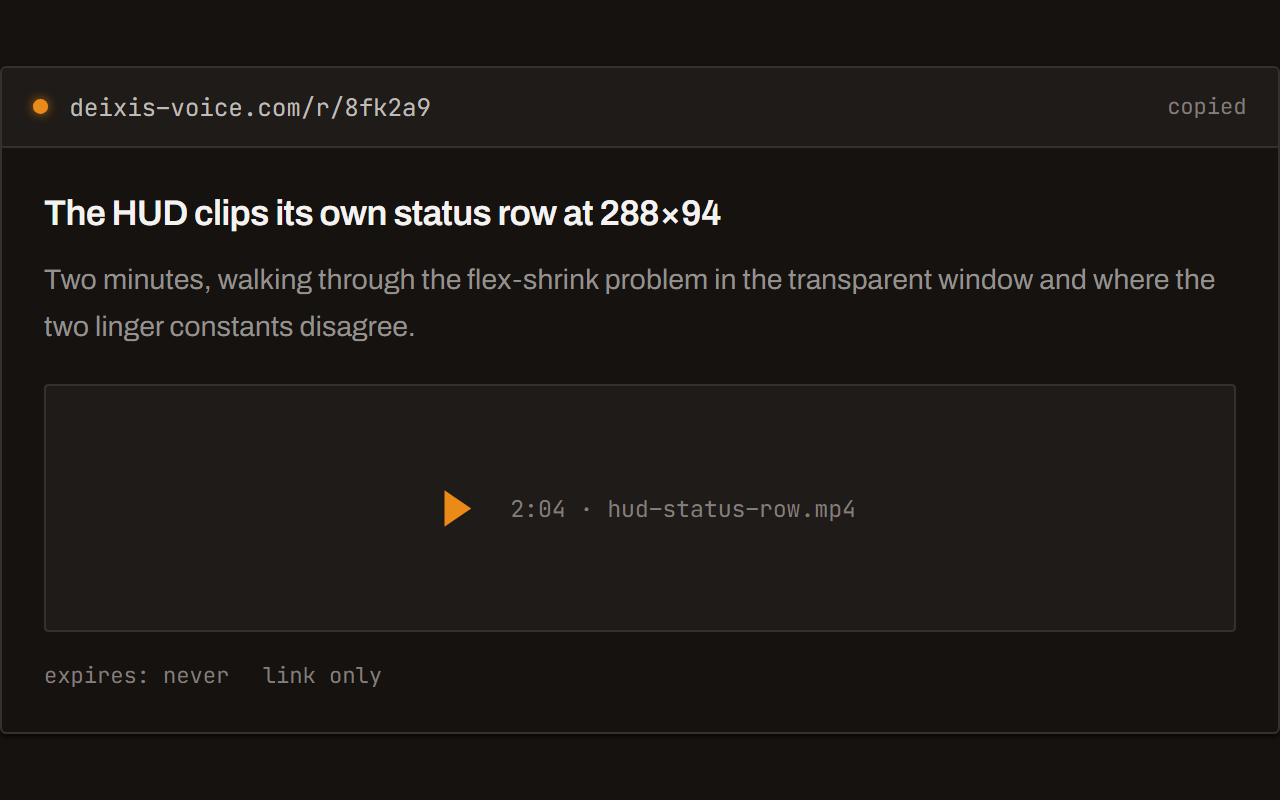
Screen recording, shared as a link
Record the screen with your narration. The recording writes itself up with a title, chapters and a summary, and from your Deixis account it shares as a link anyone can open without one. The Loom you can stop paying for.
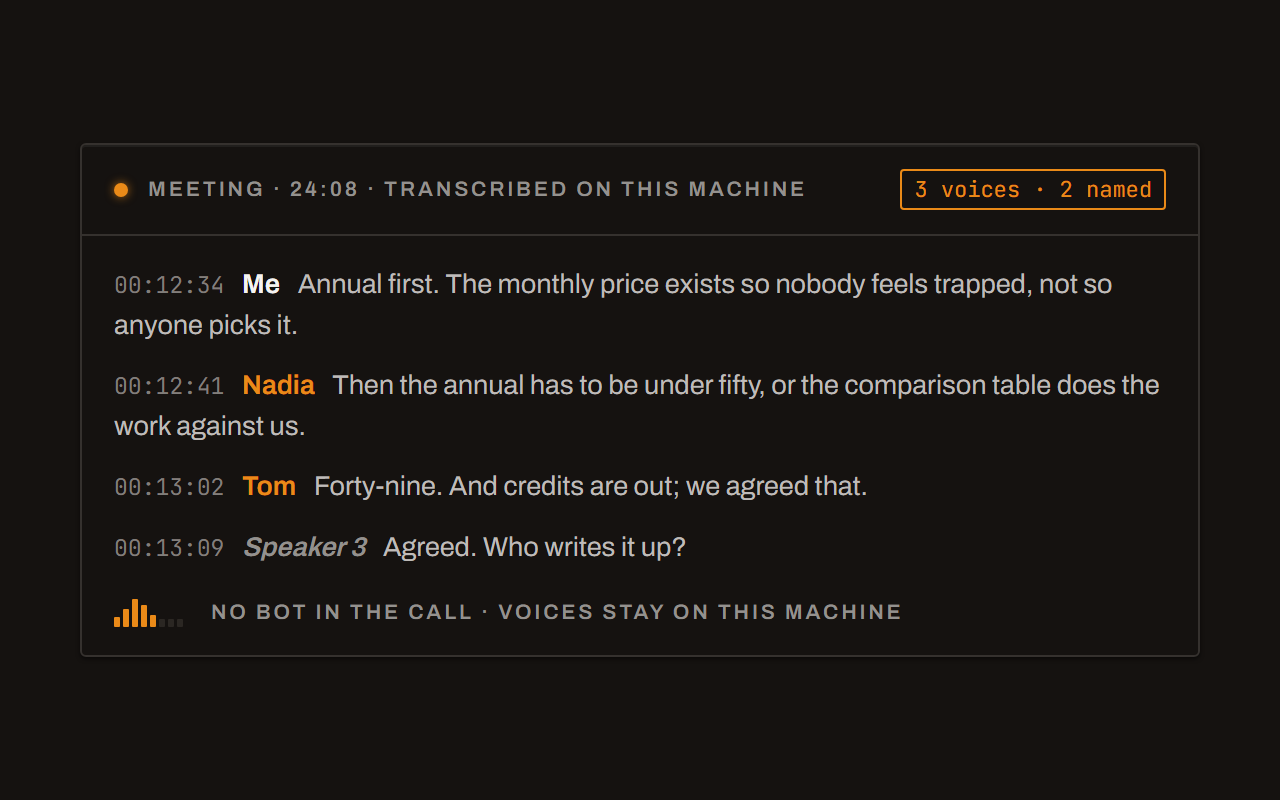
Meetings, no bot, names included
Your microphone and the other side, transcribed on your machine while the call runs. Deixis tells the voices apart and remembers the ones you name, and never uploads a voice.
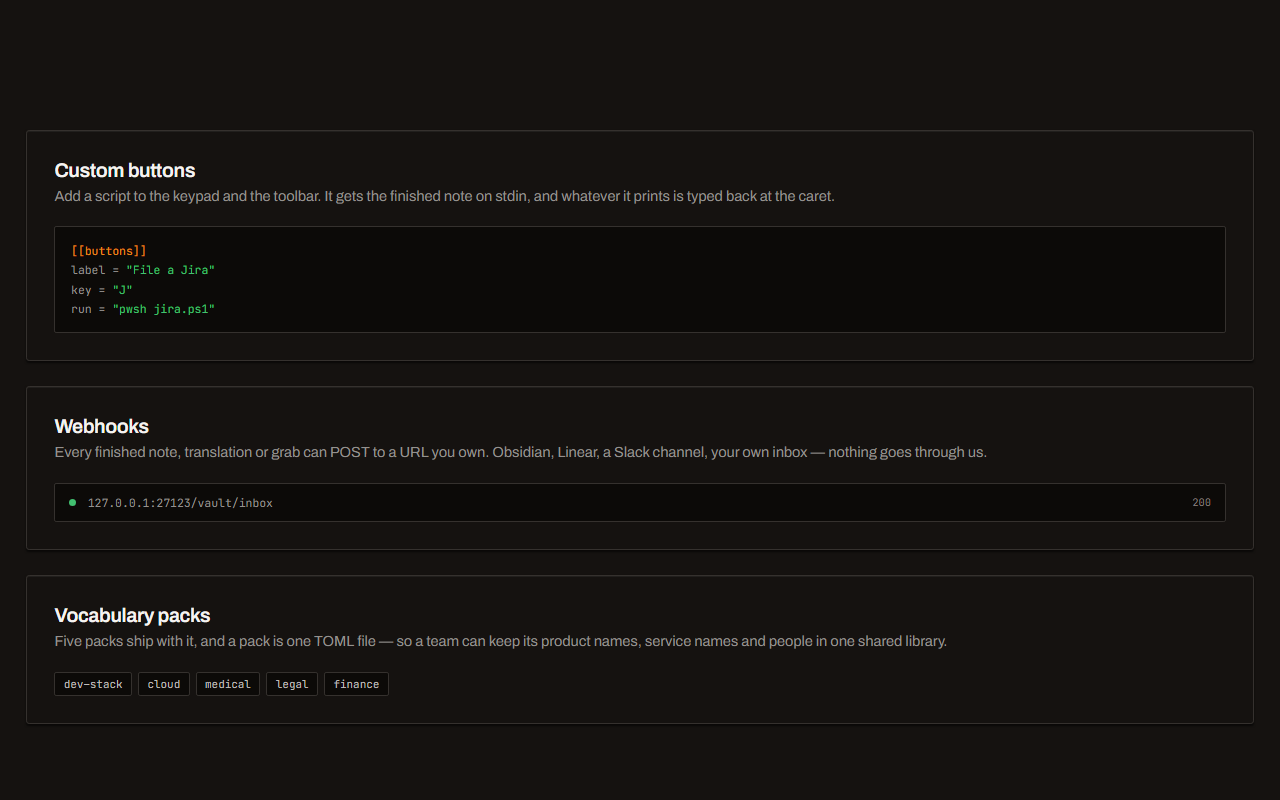
Your own buttons and workflows
Add a button to the palette: it gets the note on stdin and types back whatever it prints. Send finished notes to any URL you own. Chain steps: read the text off a screenshot, translate it, summarise it, post it.
Side by side
Fireflies.ai and Deixis, side by side
| Row | Deixis | Fireflies.ai |
|---|---|---|
| Runs on | Windows 10 and 11 (64-bit, on a CPU with AVX2: 2013 and later), Mac (Apple Silicon) and Android (a dictation bubble in any app, plus meetings), with an iPhone keyboard in beta on TestFlight and not yet in the App Store. One engine on all of them, and dictation audio never leaves the device. | Web app, Desktop app for Windows and Mac, iOS and Android apps, Chrome extension, The Fireflies.ai Notetaker bot, in Zoom, Google Meet, Microsoft Teams and Webex |
| Speech recognition happens | On your own device, inside the app, on every platform. Your audio never leaves it. | In the cloud |
| AI cleanup happens | On your device, with no provider at all. Or, if you want more, Deixis's cloud, your own Ollama, or your own key. Your choice, in one setting. | In the cloud |
| Leaves your machine | Text only, and only once you switch a cloud feature on — plus, if you press the Claude usage key, the Claude Code sign-in already stored on your machine. Never audio, never screenshots, never window titles. | Audio, video, text |
| Account needed | None, ever, for anything that runs on your device. The cloud extras have a seven-day trial you start with an email code. No card. | Required |
| Price | Free forever for everything local, meetings included. Pro is $49 a year for the cloud extras with nothing to set up. | Free tier: Free: $0 forever, with limited AI summaries, 400 minutes of stored meetings and 20 AI credits; $18 a month; $120 a year; Per seat. Pro is $18 a seat a month paid monthly, or $10 a seat a month billed annually — the $120 a seat a year in the annual field. Business is $29 monthly or $19 billed annually and is where unlimited storage, conversation intelligence and team analytics sit; Enterprise is $39 a seat a month, annual only, and is where private storage, custom data retention and single sign-on sit. Storage is a total, not a monthly allowance: 400 minutes on Free, 8,000 minutes a seat on Pro, unlimited on Business and above. |
| Your transcripts live | In plain files, in one folder you own and can back up. Uninstall Deixis and every note is still readable. | In the cloud |
| Make it yours | Add your own buttons that run a script, send finished notes to any URL you own, and switch on vocabulary packs for your field. | Over a hundred integrations: Salesforce and HubSpot for CRM, Slack, Notion, Google Docs and OneNote, Asana, Trello, Jira, Linear and Airtable for tasks, Greenhouse, Lever and BambooHR for hiring, Google Drive, Dropbox, Box, OneDrive and SharePoint for storage, dialers such as Aircall, RingCentral and Dialpad, an MCP server, and an API. The pricing page puts API access and unlimited integrations on the paid tiers. |
Fireflies.ai facts from fireflies.ai, notetaker, security, its privacy policy, integrations, joining, invite, nobot and storage, read on 14 September 2026. “Not documented” means those pages did not say.
Fireflies is a meeting recorder whose product is the bot: Fred — fred@fireflies.ai, shown in the call as "Fireflies.ai Notetaker" — joins Zoom, Google Meet, Microsoft Teams and Webex calls, records them, and puts the transcript and summary in a searchable cloud workspace. Its own knowledge base is blunt about the visibility: asked whether the bot's presence can be hidden, it answers "No. Fireflies is always visible in the participant list to ensure compliance." Auto-join reads a connected Google or Outlook calendar and can be set to all meetings with a conferencing link, only meetings you own, only meetings with teammates, or only when you invite fred@fireflies.ai by hand. There is a no-bot path — the desktop app's Take Notes captures system audio, and the Chrome extension captures Google Meet — but the audio still goes to Fireflies to be transcribed, and a no-bot recording saves no audio or video file at all. Signing up is only possible through Google or Outlook authentication, which means the calendar and the account arrive together. The privacy policy says personal information is not used for AI model training and that vendors are contractually prohibited from training on it; the security page says the same and adds a zero-day retention policy with vendors, which is a statement about third parties rather than about how long Fireflies itself keeps a meeting. Fireflies' own pages do not say where a transcript is stored geographically outside the Enterprise private-storage option, and give no retention period for meeting content beyond deleting account data within 30 days of an account being closed.
What leaves your machine, and what leaves theirs
Deixis publishes every byte it sends, as a table, because there is so little of it. Here is that table beside what Fireflies.ai's own pages say.
| What | Deixis | Fireflies.ai |
|---|---|---|
| Audio | Never. Recognition happens inside the app on your device; the recording, the model and the transcript stay there. | The meeting audio. The Notetaker bot joins the call as a participant and records it; the desktop app's Take Notes captures your computer's system audio instead, and the Chrome extension captures a Google Meet call, but in every path the audio goes to Fireflies to be transcribed. A no-bot recording saves no audio or video file — Fireflies keeps the transcript and the summary from itFireflies · every meeting it captures: automatically for calendar meetings once auto-join is on, or when you invite fred@fireflies.ai, press Take Notes, or add it to a live meeting |
| The dictated text | The sentence you just dictated, your vocabulary, and your previous sentence in that fieldthe endpoint you chose · only with a cloud endpoint set, and by default only when the local rules are not enough | The transcript, the AI summary, action items, key topics, sentiment and speaker talk-time, all generated from the recording and kept in your Fireflies workspace where they can be searched and asked questions ofFireflies · after every captured meeting |
| Context around the text | The names of the app and the field the text is going into. Never the window title, never a screenshot.the same endpoint · with that request | Calendar data from the Google or Outlook account you sign in with — the privacy policy names "event titles, descriptions, dates and times, and guest lists" — plus your account name and profile picture, contacts where you allow it, and on the paid tiers the meeting video as well as the audioFireflies · from the moment you connect the calendar; auto-join reads it continuously to know which meetings to attend |
| Telemetry and analytics | None. No account, no telemetry, no analytics, no crash reports. | The privacy policy describes cookies, pixels and SDKs used to "analyze your interactions with us, including to see which areas and features of our Services are popular and count visits", and a table of personal-information categories disclosed to marketing and advertising partnersFireflies and its advertising and analytics partners · while you use the service and its site |
| Update check | Nothing but the request; the version check happens on your PCapi.deixis-voice.com · every launch, and when you ask in Settings | not documented |
| Model download | Nothing but the requesthuggingface.co · once, when you press Download on first run | Meeting content reaches Fireflies' AI vendors to be processed, but the privacy policy says "We do not use personal information for AI model training and we contractually prohibit our vendors from using this information for their own model training", and its Zero Data Retention policy says meeting content is not "stored by any third-party vendor after processing" or "used for training internal or external AI models"Fireflies and its AI vendors · every meeting that is summarised or queried |
| Account and sign-in | An email address, only if you choose to start the trial, plus the partner tag from a partner download link and the first partner website that connected to Deixis on this computer, if there are anythe Deixis endpoint · when you start the trial | An account is required, and the pricing page's own FAQ says sign-in "is only possible via Google Auth or Outlook Auth" — so the account and the calendar connection arrive together. Teammates you add are counted and billed as seatsFireflies, through Google or Microsoft · before anything is captured at all |
| Integrations | The finished note, and for a screenshot its file name, never the imagea URL you added yourself · on finish, only for destinations you added | Notes, action items, transcripts and recordings, pushed to whichever of the hundred-plus services you connect — Salesforce, HubSpot, Slack, Notion, Jira, Asana, Greenhouse, Google Drive, Dropbox and the rest — plus whatever the API and the MCP server are asked forthe services you connect · automatically after each meeting, once a connection exists |
Before you switch
Before you switch
Who should not switch
Stay on Fireflies if your meetings are not in English — the language row is not close, and nothing about local processing makes up for a model that does not speak the language. Stay too if the searchable history is the product for you: if people in your company look up what was said in a call they were not on, if AskFred answers questions across months of conversations, or if sales notes must land in Salesforce or HubSpot without anyone touching them, Fireflies does all of that and Deixis does none of it. The same goes for anyone who needs a recorder to attend meetings they are not in, anyone whose work is transcribing files or phone calls they already have, anyone on a pre-2013 PC without AVX2, and anyone on Linux. And if your organisation's compliance position depends on the certifications Fireflies names on its security page, that is a conversation about vendors, not about where the processing happens, and this page will not settle it.
Making the switch
Where the session files land
A meeting lands in %USERPROFILE%\.deixis\sessions\<timestamp>\. Inside it: meta.json with the
devices, sample rates, model and times; audio\mic-0001.wav and its successors, your microphone at
16 kHz mono, one file per minute; audio\sys-0001.wav and its successors, the system output, when
loopback is available; transcript.mic.jsonl and transcript.sys.jsonl, the timestamped lines as
they were transcribed; transcript.md, the merged readable transcript; and notes.md. Nothing is
in a database. A crash costs at most a minute, because the WAVs are finalised per segment, and
deixis-core --transcribe <session-dir> rebuilds the transcript from them.
Each session is named from what was said in it, so a month of meetings reads as a list of subjects rather than thirty timestamps — and a name you type yourself is never overwritten by any of that, ever.
The keys
Hold Ctrl+Win and press M to start a meeting; press again to stop. The tray item and the record
button on the Meetings tab do the same thing. While it runs it says so: the tray icon carries a
red dot, its menu counts the elapsed time, and the Meetings item in the side rail shows a recording
dot and the clock from whichever page you are on.
Loopback and headphones
Deixis records the microphone and, when it can, the system output, which is how both halves of a
call are transcribed. Wear headphones if you can: loopback captures what the speakers play, but your
microphone hears it too, so on speakers the far side bleeds into your own channel. Echo cancellation
is out of scope. Loopback can also be unavailable — exclusive-mode devices, some virtual sound cards
— and when it is, Deixis falls back to microphone-only, says so, and records the fact in
meta.json rather than failing the meeting.
Notes, and what they cost
The recording and the transcript are yours with nothing configured. notes.md — the summary,
decisions, action items and open questions — is the one step that calls out, to the cleanup endpoint
you configure, and it is deliberately the last and most failure-tolerant step: without an endpoint
the meeting still records and transcript.md is still written, and Regenerate notes retries
later. The session's name is the only other thing that can call out: unless you have typed a name
yourself, Deixis sends the opening of the transcript — about 1,500 characters, not the session — to
the same endpoint to be turned into a short title, and falls back to the first substantial sentence
when there is nothing to ask. Those two are the whole cloud surface of a Deixis meeting, and you
choose whether either exists.
What happens to the Fireflies workspace you leave behind
Your Fireflies history stays in Fireflies, and there is no import path into Deixis — a folder of sessions is not a workspace and nothing would map. Download what matters before you downgrade or close the account: transcripts, summaries and recordings can be downloaded from the paid tiers, the API can pull them out, and storage on the free tier is 400 minutes in total rather than a monthly allowance, so dropping to it is not somewhere to park an archive. Fireflies' privacy policy says personal information related to a closed account is deleted within 30 days. Turning auto-join off before any of that is the step people forget: until you do, the bot keeps arriving at calendar meetings on its own.
Before you ask
Questions people search for
Can I transcribe a meeting without a bot joining the call?
With Deixis, yes — it records your microphone and the system output from your own machine, so nothing appears in the participant list and nothing is admitted from a lobby. Fireflies has a no-bot path too, in its desktop app and its Chrome extension, but the audio still goes to Fireflies to be transcribed, and its knowledge base notes that a no-bot recording saves no audio or video file.
Does Fireflies join my meetings automatically?
Yes, if auto-join is on. It reads the Google or Outlook calendar you signed in with and joins
meetings on a setting of your choosing: all meetings with a conferencing link, only the ones you
own, only the ones with teammates, or only when you invite fred@fireflies.ai by hand. It joins at
the scheduled start time and waits in the lobby for someone to admit it.
Can other people see that Fireflies is recording?
Yes. Fireflies' own knowledge base answers the question directly: the bot's presence cannot be hidden, because it is "always visible in the participant list to ensure compliance". It shows up as "Fireflies.ai Notetaker", and Google Meet may list it under participants with potential risks until a host admits it.
Is Fireflies free?
There is a free tier: $0 forever, with limited AI summaries, 400 minutes of stored meetings and 20 AI credits, checked on its pricing page on 14 September 2026. Paid tiers are $18 a seat a month, or $10 billed annually, for Pro, and $29 or $19 for Business. Deixis records and transcribes meetings free, with no account at all; $49 a year buys the optional cloud extras.
Does Fireflies train AI models on my meetings?
Its privacy policy says it does not use personal information for AI model training and that it contractually prohibits its vendors from training on it, and its security page repeats that alongside a zero-day retention policy with vendors and partners. Note what that last part is about: it constrains third parties, not how long Fireflies itself holds your meeting content, which its pages do not put a period on outside the Enterprise custom-retention option.
Does Deixis work with Zoom, Teams and Google Meet?
It works with all of them, because it does not integrate with any of them. It records what your computer's microphone and speakers carry, so the conferencing tool is irrelevant — as is whether your host allows recording bots at all. The trade is that it can only capture what your machine can hear, so a call you are not on is a call it does not have.
Keep reading
Related pages
How to transcribe a meeting without a bot joining the call
Record both sides of a call on your PC and transcribe it there, with no bot in the participant list and no audio uploaded. How it works, and its limits.
A free meeting recorder that sends nothing
Record both sides of a call and transcribe it on your own machine, free and with no account. Nothing joins the meeting and nothing uploads the audio.
Here is every byte that leaves your machine, for each tool
Every byte Deixis sends off your machine in one table, and the same table filled in for other dictation tools from their own documentation, dated.
The Fathom alternative where the meeting never leaves the room
Fathom's free tier is generous, but every call lands on its servers. Deixis records and transcribes a meeting on your own machine, with no account.
The meeting recorder that never sends the meeting anywhere
tl;dv records your calls to its European cloud and transcribes in 30+ languages. Deixis records mic and system audio to your own disk, on your own CPU.
The same no-bot idea, with the transcript left on your disk
Krisp transcribes English on your device, then stores the transcript, recording and notes in its cloud. Deixis leaves the whole session in your folder.
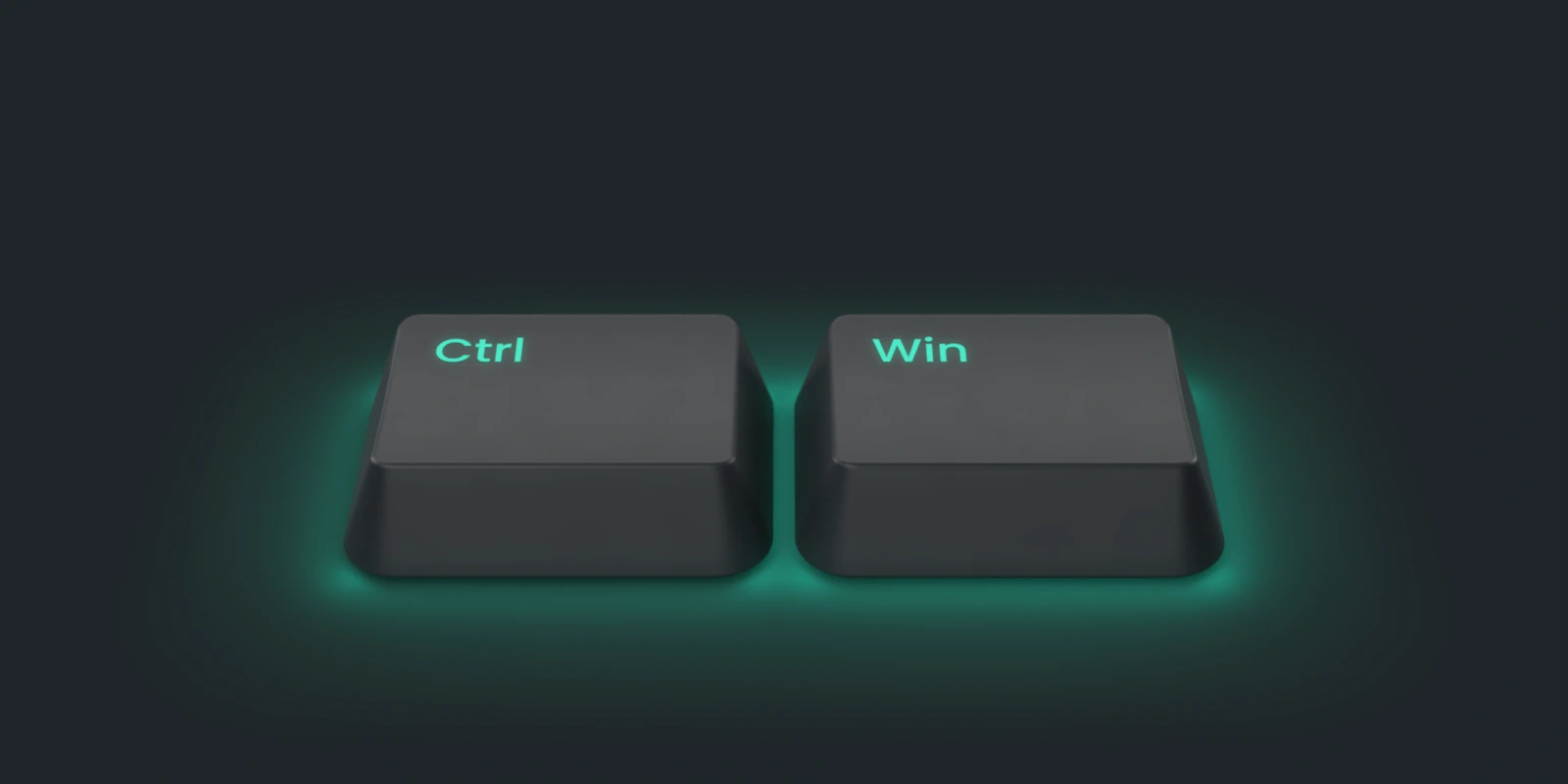
Hold a key. Speak. Keep working.
Deixis is free, needs no account, and runs on your own device. Everything on this page is in the current release.
v1.2.2 · 64‑bit Windows 10/11 · macOS 13 on Apple silicon · 51 MB · nothing else to install · also for Windows
Facts about Fireflies.ai checked on 2026-09-14 against fireflies.ai. Deixis facts are from its README for the current release. Something out of date? Tell us.