Dictation for Claude Code
Working with a coding agent is mostly writing. You describe the change you want, you answer a question about how to do it, you say what the pull request is for, and then you do it again. It is the part of the day with the most words in it and the least code, and it is the part that is quickest to say out loud.
Deixis is voice input for exactly that. Hold Ctrl+Win, say the paragraph, let go, and clean
punctuated text is typed straight into the prompt you were looking at, with your clipboard handed
back the way you left it. There is no window to switch to, no transcript to copy, no account to
make, and nothing to install into Claude Code.
That last part is the point. Deixis is not a Claude Code feature and not an extension for anything: it types wherever your cursor already is, so the key that dictates your prompt is the same key that dictates your email, your commit message, your ticket, your Slack reply and the search box in your browser. One voice input for the whole machine, not one per app — and it runs on Windows, Mac, iPhone and Android, with speech recognition on the device every time. Your audio never leaves it, under any setting, on any plan.
Why Deixis
What it gives you in Claude Code, and what it will not do
Why Deixis in Claude Code
- One key for every field on the machine, not one tool's feature. Claude Code's own docs describe five places you can run it, and Deixis is a plugin for none of them: it types at the caret, so the same key works in the terminal, in VS Code, in a JetBrains IDE, in the desktop app and in a browser tab — and in your email, your ticket tracker, your chat and any other text box you land in. You learn one gesture and it is everywhere, including on the Mac and on your iPhone and Android phone, with the same on-device speech recognition on each.
- It punctuates for the field you are in. A prompt, a permission answer, a commit line and a pull request body all read differently, and Deixis knows which one it is typing into, because the name of the app and the name of the control ride along with your words. Never the window title, and never anything on your screen.
- Your voice never leaves the machine, and there is nothing to sign in to. Claude Code has its own
/voice, and its docs say plainly that it streams your recorded audio to Anthropic's servers and does not process it locally, that it needs a Claude.ai account, and that an organisation policy can turn it off. Deixis transcribes inside itself, on your own processor, with no account and nothing to switch on for you — and it keeps recording for as long as you keep talking. - It knows your stack's words.
shadcnanduseEffectcome out spelled the way you write them, fixed on your own machine before anything is sent anywhere. Five vocabulary packs ship in the box, the software one is on by default, and adding a word takes one key. - Free, with no account, forever. Dictation, both speech models, the dictionary, meetings, screen grabs, screen recording, your own buttons and webhooks: all of it free, and none of it behind a sign-in. Deixis never asks you to make an account to dictate.
- Point as well as talk. Double-tap the key and Deixis keeps listening while you drag a region of the screen, pick a button, or take a selection. What you said and what you pointed at come out as one note — which is most of a good bug report, dictated in the time it takes to describe it.
- Your own actions, on the same palette. Add a button that runs a program with your finished note and types back whatever it prints, straight at the caret: file the ticket and get the key back, open the branch, post the note. Or chain steps together as plain settings — read the text off a screenshot, translate it, summarise it, post it — and put the result where you want it. Nothing to script if you do not want to: the Buttons panel has ready-made ones a click adds.
- A webhook to your own endpoint, signed. Send every finished note, grab or translation to a URL you own, with an HMAC signature and a timestamp so your receiver can prove it came from you and reject a replay. Delivery never blocks you: it retries in the background while your text is already pasted. Your URLs are yours — they do not go through anybody's cloud.
- A screen recording with a link, for the change you would rather show.
Ctrl+Win+Vrecords the screen with your narration and writes it up with a title and a summary on your own machine. Handing it over as a link is the one part that needs a Deixis account, and the person you send it to needs nothing at all. - Everything is a file you can read. Notes, transcripts, recordings, screenshots, your dictionary and every setting sit in one folder as ordinary files, and your dictation history has its own tab with an export. Back it up, grep it, uninstall tomorrow and it is all still there.
- The cleanup can stay on your machine too. Out of the box Deixis tidies your dictation with rules and no network at all. If you want a language model to polish every sentence, that is one setting with three answers: let Deixis run it, run it against a model on your own machine, or use your own provider key. All three are free; the paid plan only removes the setting up.
What it will not do
- It does not read your screen or your session. Deixis is dictation, not an agent. It sends the name of the app and the field, never the contents, so it cannot see the diff Claude Code just showed you. You still have to say what you mean.
- It types in English only. The speech models are English models, and Claude Code's own dictation does twenty languages. If you prompt your agent in one of them, theirs is the better tool for that and this is not yours yet.
- It does not know your branch name on its own. Claude Code's dictation adds your project and branch names as recognition hints automatically. Deixis learns your words from your dictionary and its packs, which is a key press rather than nothing, but it is a key press.
- It will not read a recording you hand it. Deixis transcribes what it records: your dictation, your meetings, your screen recordings. Drop-a-file transcription is not in it.
- No Linux build, and no PC older than 2013. The speech engine is compiled against an instruction set that arrived in 2013, so an older processor stops rather than running slowly. Linux is not planned.
- It is not a keyboard replacement. Symbols, paths and flags are still faster typed. Deixis is for the prose half of the work, which in agent work happens to be most of it.
What you get
More than dictation. One key, and everything behind it.
Hold the key and press a letter: free mode, a grab, a meeting, a recording, a translation, your own buttons. All of it on your own device, all of it free, none of it behind an account.
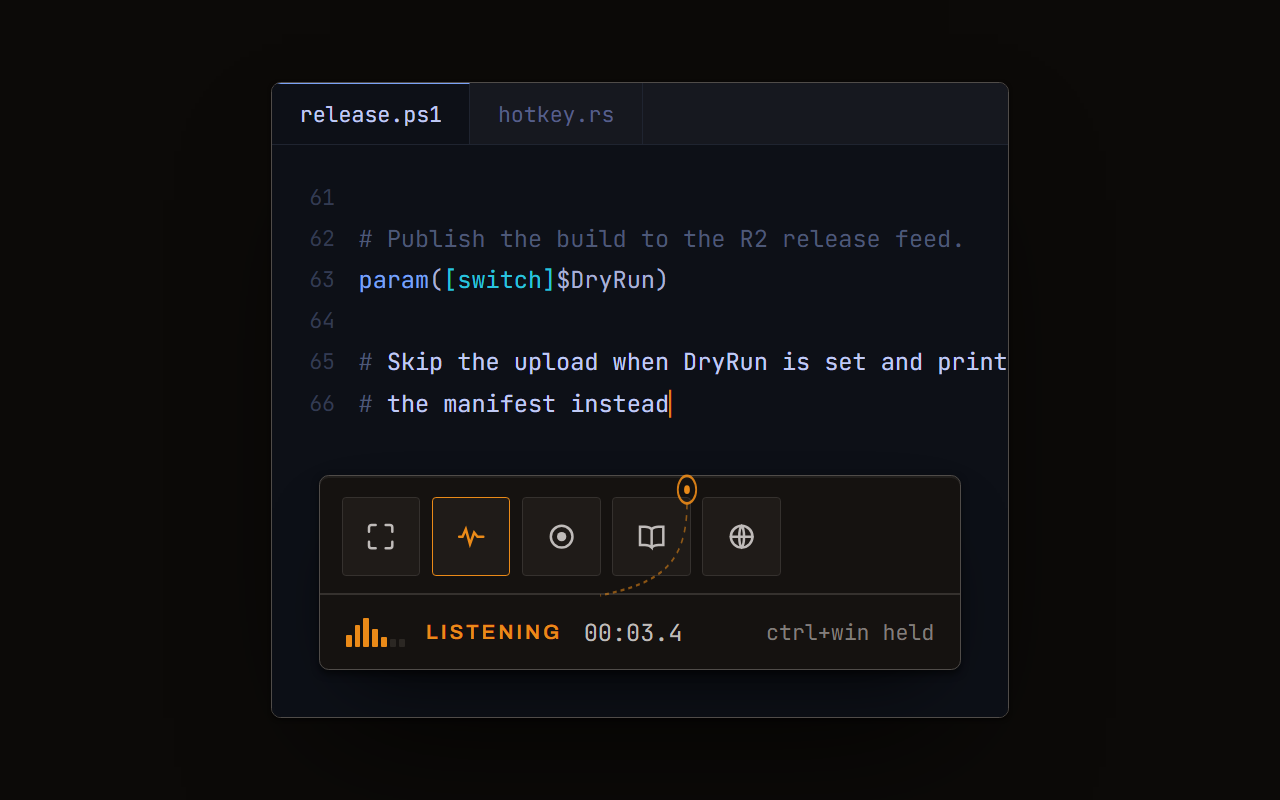
Dictation, where your cursor is
Hold a key, speak, release. Clean, punctuated text lands in whatever has focus, on your PC, your Mac and your phone, with your clipboard handed back.
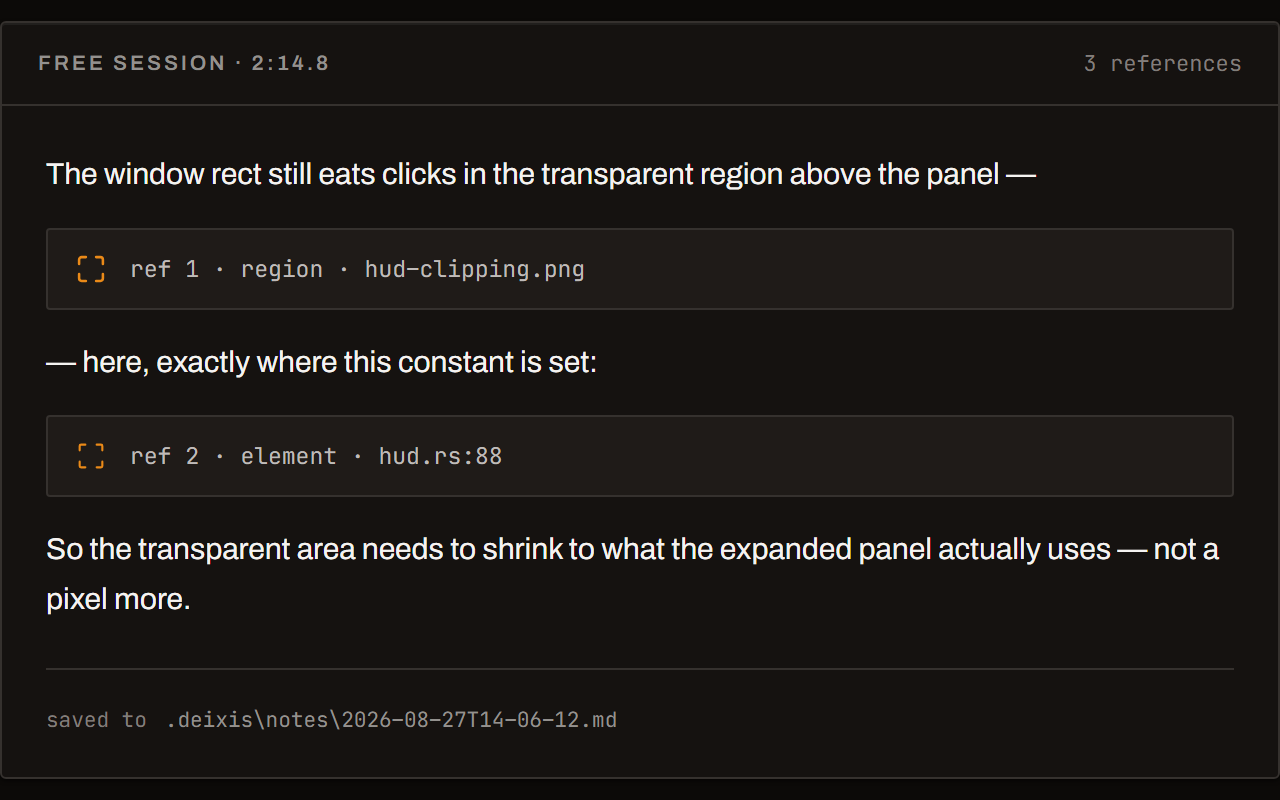
Free mode: talk and point
Narrate for as long as you like while you grab a region, pick a button on screen or take a selection. One note, what you said interleaved with what you pointed at, pasted where you finish and saved as Markdown.
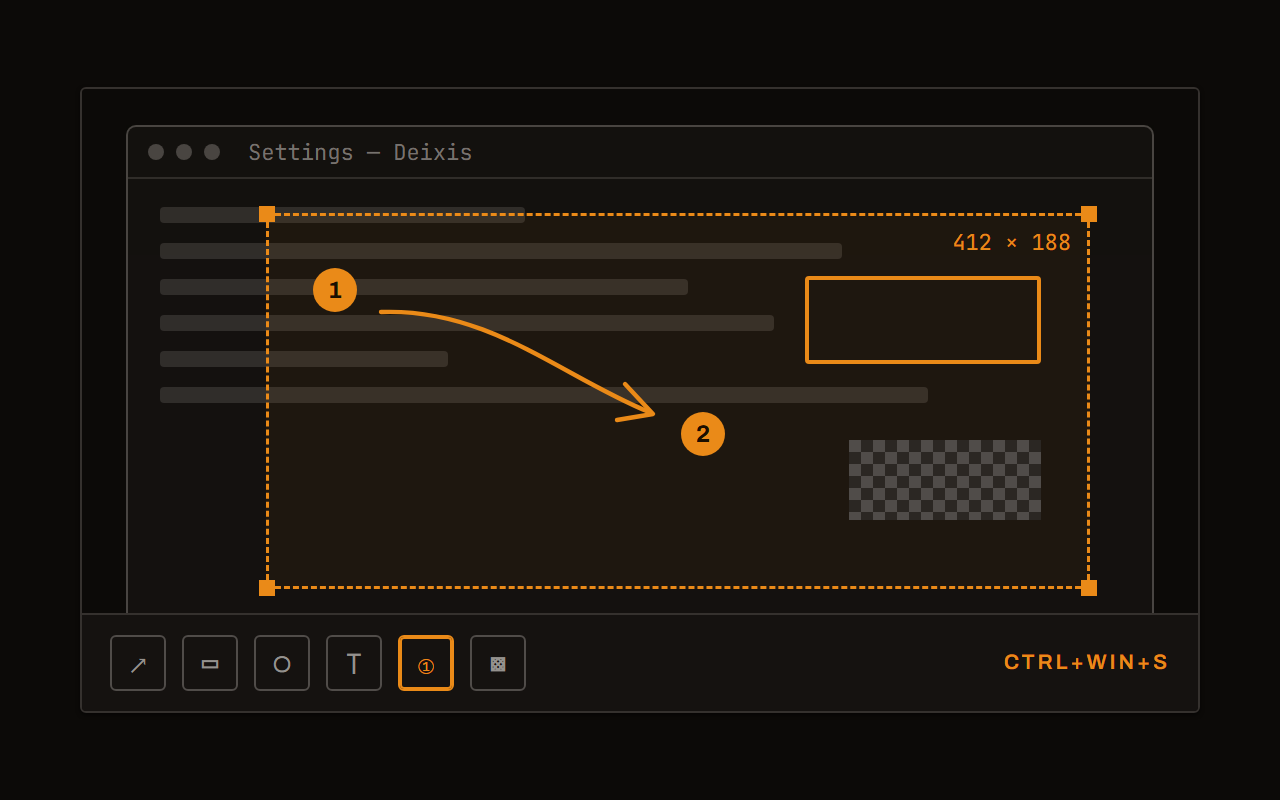
Screen grabs, annotated
Freeze every screen at the keypress, drag a region, add arrows, boxes, text and numbered steps, and pixelate what is private. Saved as a PNG that stays editable.
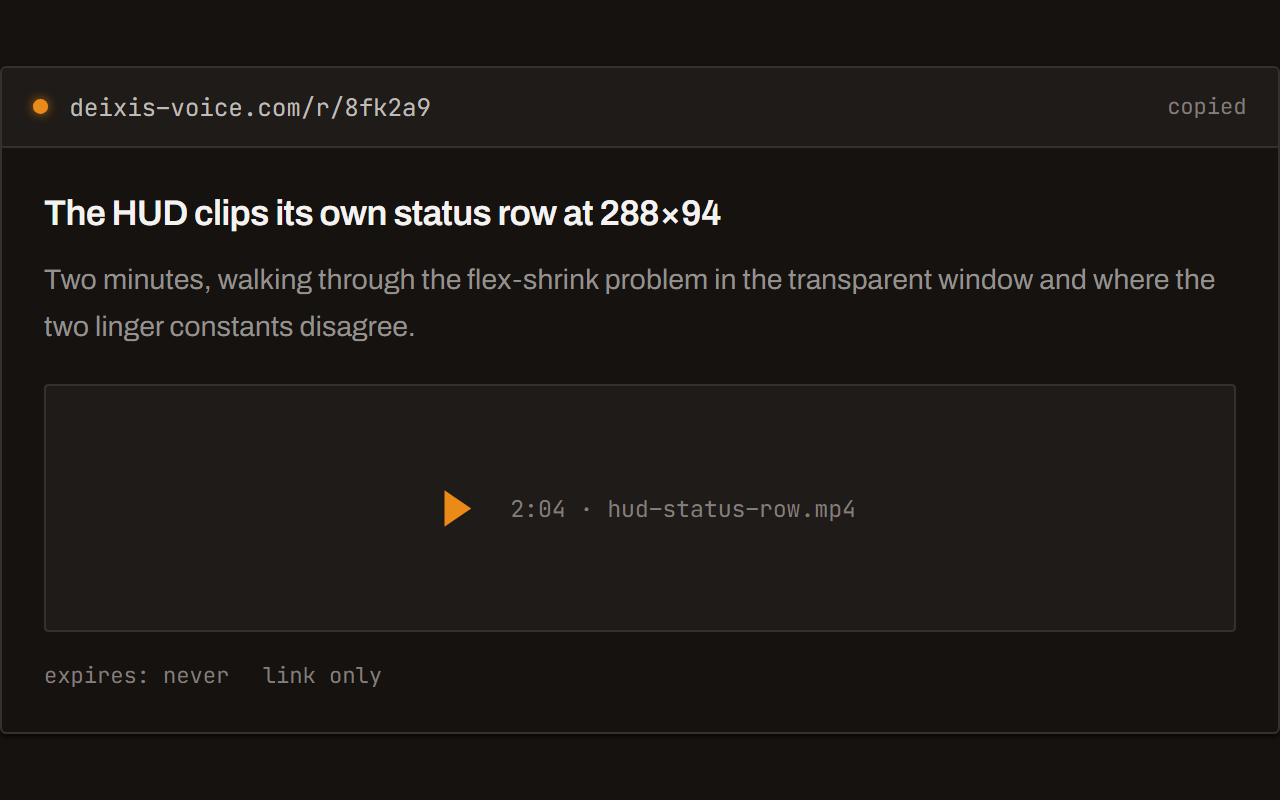
Screen recording, shared as a link
Record the screen with your narration. The recording writes itself up with a title, chapters and a summary, and from your Deixis account it shares as a link anyone can open without one. The Loom you can stop paying for.
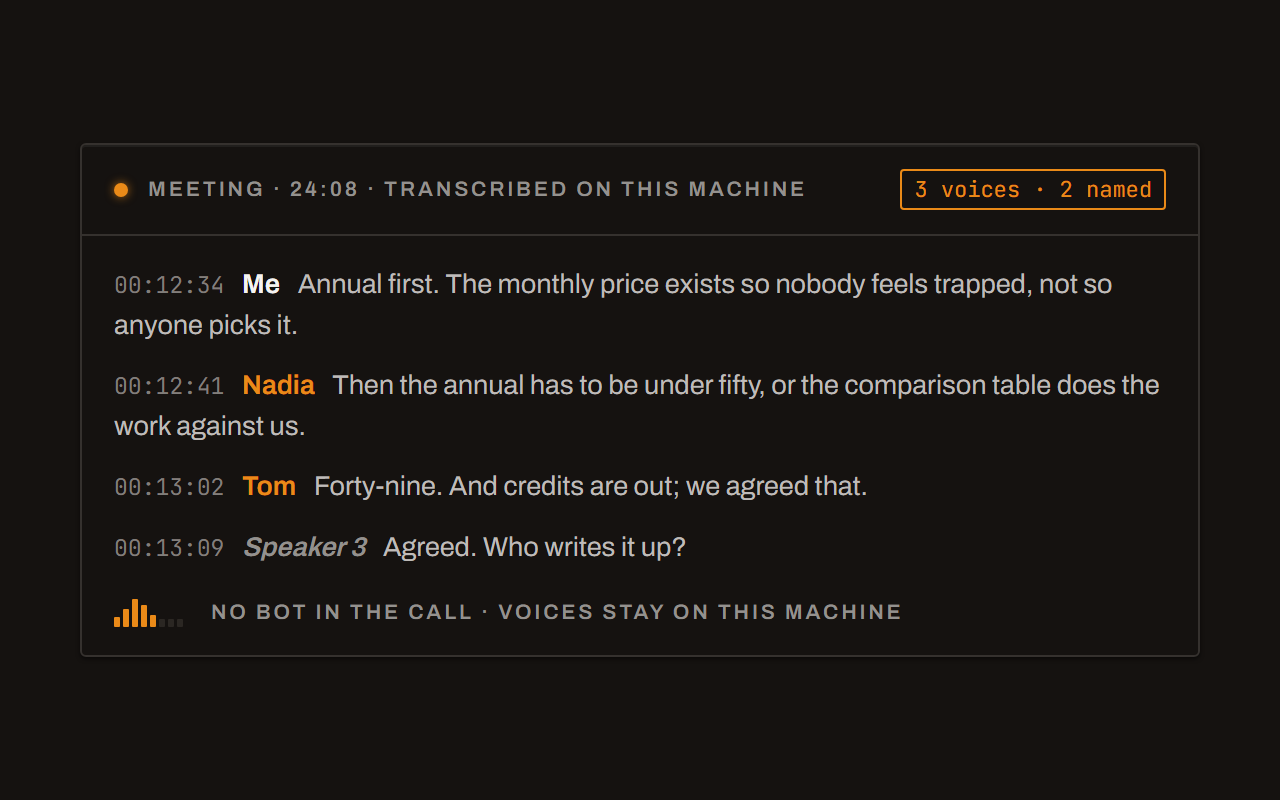
Meetings, no bot, names included
Your microphone and the other side, transcribed on your machine while the call runs. Deixis tells the voices apart and remembers the ones you name, and never uploads a voice.
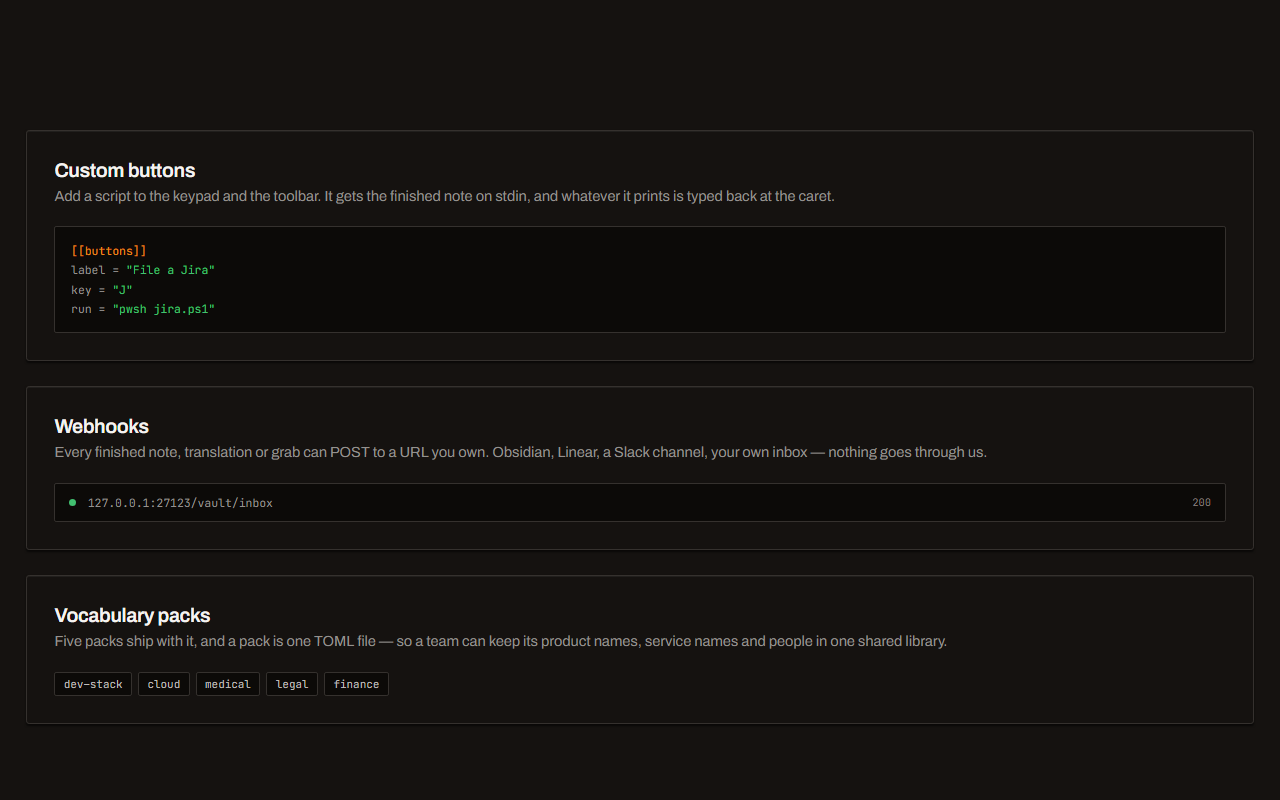
Your own buttons and workflows
Add a button to the palette: it gets the note on stdin and types back whatever it prints. Send finished notes to any URL you own. Chain steps: read the text off a screenshot, translate it, summarise it, post it.
Field by field
The same voice, punctuated for wherever you are in Claude Code
Deixis knows which app and which field your words are going into — the name of the app and the name of the control, never the window title and never what is on your screen. A prompt, a message and a commit line therefore come out differently. Here is the terminal, the editor and the browser, kind by kind.
| Where you are | What you say | What Deixis types |
|---|---|---|
| A prompt to the agentthe Claude Code prompt, in your terminal | “um, refactor the auth middleware so the session check happens before the rate limiter and add a test for the expired token case” | Refactor the auth middleware so the session check happens before the rate limiter, and add a test for the expired token case.The filler goes, the sentence gets a capital and a full stop. Long instructions are where speaking beats typing by the most. |
| An answer to a permission promptthe yes-or-no prompt before Claude Code runs something | “yes but only in the worker directory” | Yes, but only in the worker directory.A short reply is punctuated as a short reply and left alone. Nothing is rewritten or expanded. |
| A project instructionyour CLAUDE.md, open in the editor | “prefer shad kin components and keep use effect out of the render path” | Prefer shadcn components, and keep useEffect out of the render path.Your dictionary fixes shadcn and useEffect on this machine, before anything is sent anywhere and before any cleanup sees it. |
| A commit messagethe terminal, or your Git client's message box | “fix the race in the release poller it was reading the feed twice on a cold start” | Fix the race in the release poller: it was reading the feed twice on a cold start.A commit line is punctuated as a line. The same words in a chat window would come out as two sentences. |
| A pull request descriptionthe PR body, on the review page in your browser | “this moves the cleanup call off the hot path so the insert doesn't wait on the network um and it adds a timeout” | This moves the cleanup call off the hot path, so the insert doesn't wait on the network. It also adds a timeout.A long field gets sentences, because Deixis knows it is a body and not a one-line box. |
Claude Code facts from its docs, its command reference and voice, read on 7 September 2026. Everything about Deixis on this page is from its README for the current release.
Worth knowing about Claude Code
- Claude Code's own docs describe five surfaces — the terminal, VS Code, JetBrains IDEs, a desktop app and the browser — each connected to the same engine. Deixis is not a plugin for any one of them: it types where your caret is, so the one key covers all five.
- CLAUDE.md is the file Claude Code reads at the start of every session, and it is prose rather than code — standards, architecture decisions, review checklists. Prose is exactly what dictation is fastest at.
- Claude Code has voice dictation of its own, and its docs are refreshingly plain about the trade: “Voice dictation streams your recorded audio to Anthropic’s servers for transcription. Audio is not processed locally.” It needs a Claude.ai account and is unavailable on an API key, Bedrock, Google Cloud or Foundry; an organisation policy can switch it off entirely.
- It also has edges: the CLI, agent view and the VS Code extension only — not Claude Code on the web, not SSH, Dev Containers or Codespaces, because the microphone is on your machine and the session is not. In tap mode a recording stops on its own after fifteen seconds of silence, or two minutes in total.
- Where it beats Deixis outright: twenty dictation languages against Deixis’s English, and transcription tuned for coding words with your project and branch names added as hints automatically.
Five minutes
Setting it up
About five minutes, and nothing goes into Claude Code at all.
Install and fetch the model
One installer for any 64-bit Windows 10 or 11 PC, with nothing else to install. The first launch shows one Download button for the speech model — about the size of a short video, fetched once, and checked before it is kept. From then on you are offline unless you choose otherwise.
The gesture
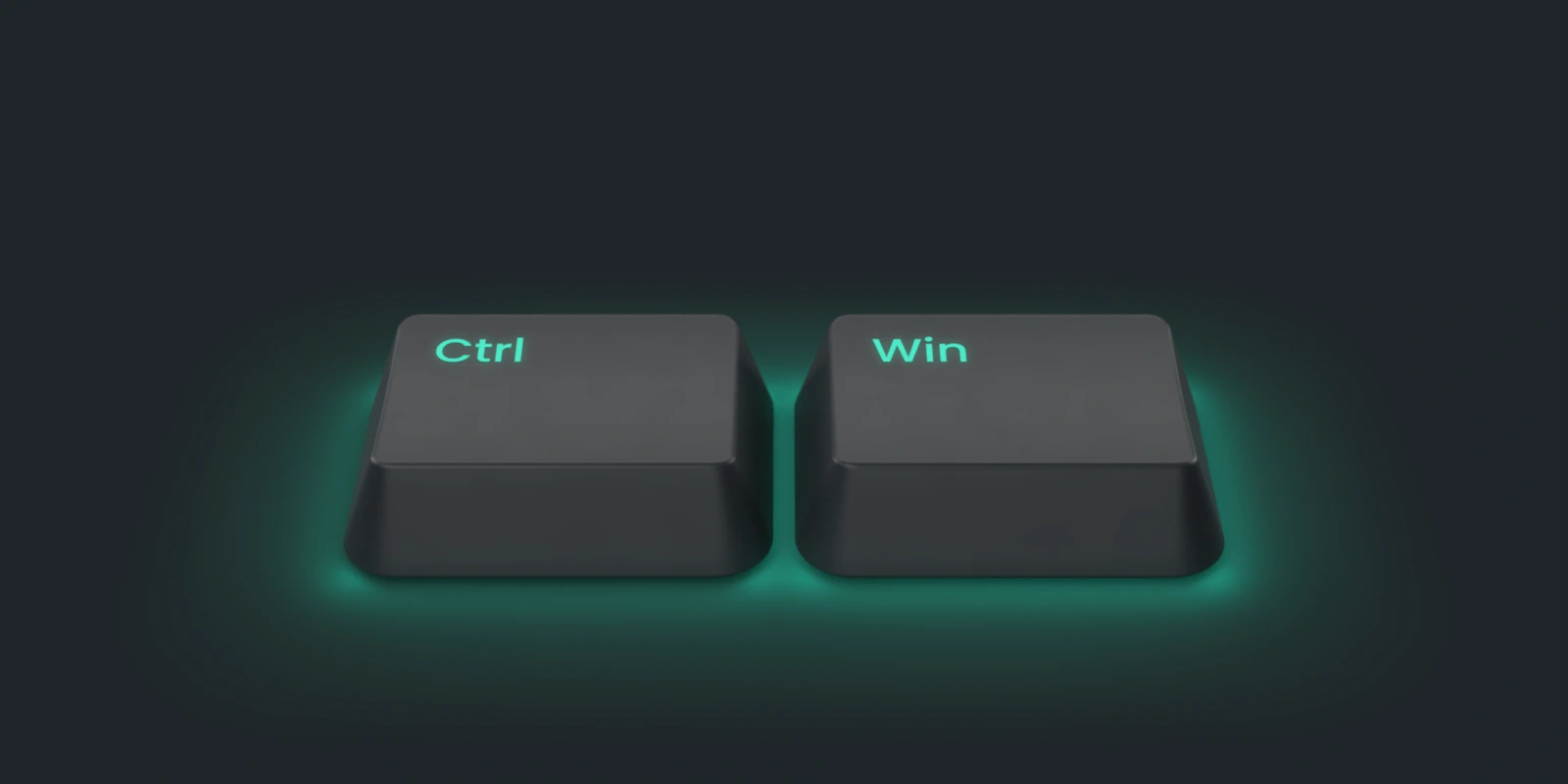
Hold Ctrl+Win, speak, release. That is the whole product. Double-tap it instead and Deixis keeps
listening until you double-tap again, which is the one to use for a long prompt you have not
finished thinking through. If the chord fights something else in your setup, Settings changes it.
Hold the chord a moment longer and a small palette appears with a letter per mode: S grabs and
annotates a region of the screen, M records a meeting, T translates what you have selected, and
D puts the word under your cursor into your dictionary. Ctrl+Win+V records the screen.
Teach it your stack
The single biggest improvement, and it costs nothing in speed. Select a word anywhere — a library
name in a README, a symbol in a diff — press Ctrl+Win+D, and it is in your vocabulary. Names it
keeps mishearing can be corrected once and stay corrected. The Dictionary tab is the same list
if you would rather edit it in one place, and the five packs that ship are a click each.
Decide what may leave, once
Settings → Cleanup is the only privacy decision to make, and its default is the quiet one: rules handle your words on this machine unless you asked for a transform or dictated a long stretch with no punctuation. Set it to never, or leave the endpoint empty, and dictation never touches the network at all. Point it at a model running on your own machine and the better prose stays local too. Whatever you choose, the audio is not part of it — that never leaves, and there is no setting that makes it.
Your own actions, if you want them
This is the part worth ten minutes once. A button on the palette can run a program with your finished note and type back whatever it prints — so "file a bug about the poller reading the feed twice" becomes a ticket, and the ticket's key lands at your caret. Your script gets the note as JSON, arguments are handed to the process as a list so nothing needs escaping, and the first run shows you the exact command line and does nothing until you approve it. Edit the command and it asks again.
A button can also just be steps: translate, summarise, apply an instruction of your own, post to a webhook, read the text off a screenshot. No scripting language — the steps are settings, the panel tells you what each one costs before you add it, and the template library has ready-made ones a click adds and you can then edit.
And separately from buttons, any finished note, grab or translation can be posted to a URL you own, signed with HMAC and a timestamp so your receiver can verify it and refuse a replay. Secrets are encrypted on your machine, delivery retries in the background, and every attempt shows in the Activity feed. Your endpoints are yours: they do not pass through us.
Before you ask
Questions people search for
Does Claude Code have voice input of its own?
Yes — /voice, and it is good. The difference is where your voice goes. Anthropic's own page says
it streams your recorded audio to their servers and that audio is not processed locally; it needs a
Claude.ai account, is unavailable on an API key or a cloud provider, can be switched off by an
organisation policy, and works in the CLI, agent view and the VS Code extension but not on the web
or over SSH. Deixis transcribes on your machine, with no account, in every app you use. Many people
run both.
Which one should I use?
If you dictate in one of the twenty languages Claude Code supports and you only ever talk to the agent, use theirs. Use Deixis if you would rather the audio never left your machine, if you want the same key to work in your email and your tickets as well as the prompt, if you have no Claude.ai account or your organisation has turned voice off, or if you talk for longer than the two minutes a Claude Code recording in tap mode runs to.
Can I dictate into a terminal?
Yes. Deixis types where the caret is, and a terminal prompt is a caret like any other. It is one of the places the field-aware punctuation matters most: a line you are about to run is punctuated as a line, not as an email.
Do I need an account or a subscription?
No. Dictation, both speech models, the dictionary, meetings, screen grabs and recordings are free with no sign-in at all. The optional cloud cleanup is free too if you bring your own provider key, or if you point it at a model on your own machine. Paying only buys not having to set that up.
Does it work outside Claude Code too?
Everywhere. Deixis is not an extension for a particular editor or a feature of a particular app: it types at the caret in whatever has focus, so Cursor, VS Code, JetBrains, your terminal, your email, your ticket tracker, your chat and the address bar all take the same key. What changes between them is the punctuation, from the name of the app and the field it is typing into.
Will it work offline?
Completely. With no cleanup endpoint set, dictation, free mode, screen grabs and meeting recording and transcription all run with no network. Two calls a fresh install makes on its own: the update check, and — when you open the Settings window — a check for an announcement from us. Both send nothing but the request.
Keep reading
Related pages
Voice input for your product, without the audio leaving your user
Put voice input in your web or desktop app in about ten lines. Recognition runs on your user's machine, so no audio reaches you, us, or any cloud.
Offline dictation on Windows
Dictation that works with no internet: speech recognition on your own device, free, no account. Which Windows speech-to-text tools genuinely run offline.
Dictation for Cursor
Deixis dictates into Cursor on one key — the agent prompt, the editor, the terminal, anywhere else. Recognition on your own device, no account, free.
Dictation for VS Code
Deixis dictates into VS Code on one key — chat, editor, terminal, and every other window on your machine. Speech recognition on your device, no account.
Dictation for Windows Terminal
Deixis dictates into Windows Terminal on one key — commands, commit messages, long notes. Speech recognition on your own device, offline, with no account.
Dictation for PowerShell
Deixis dictates into PowerShell on one key — the prompt, the script, the commit message. Speech recognition on your own device, no account, free.
Hold a key. Speak. Keep working.
Deixis is free, needs no account, and runs on your own device. Everything on this page is in the current release.
v1.2.2 · 64‑bit Windows 10/11 · macOS 13 on Apple silicon · 51 MB · nothing else to install · also for Windows
Facts about Claude Code checked on 2026-09-07 against code.claude.com. Deixis facts are from its README for the current release. Something out of date? Tell us.