The Loom alternative that keeps the file on your disk
This page is for someone who records walkthroughs for colleagues — a bug reproduced, a design walked through, a deploy explained — and has started to mind that every one of them lives on somebody else's servers, or who has hit the five-minute wall on Loom's free plan for the third time this week.
What you gain by switching is the file: a Deixis recording is an ordinary MP4 in a folder you own, with the transcript beside it, made on your own processor, and nothing goes anywhere until you decide to hand someone a link. What you lose is the thing Loom is genuinely good at — a polished viewing page with a comment thread under it, captions in fifty languages, and the knowledge of who watched how much. Those are on Loom's free tier, and a Deixis share link is a plainer page.
The rest of this page is that trade in full, with Loom's facts taken from Loom's own pages on the date at the bottom.
Why switch
What you gain, and what you give up
Why Deixis
- No five-minute wall, at any price. Loom's free Starter tier stops a recording at five minutes and holds twenty-five videos a person; unlimited length and count is $18 a user a month. Deixis has no limit on either at any tier, because the file is on your own disk and its size is a question for your drive rather than for a plan.
- What Loom charges $24 a user a month for is free here — and it stays on your machine. Auto summaries and auto chapters are Loom's Business + AI tier, $288 a user a year. (Auto titles are on every Loom tier, including the free one, so that row is theirs as much as ours.) Deixis transcribes the recording on your own machine, splits it into chapters, and gives it a title and a short summary, so a recording reads as "Deploying the worker" and a sentence about it rather than as a timestamp. The transcript is always local. The title and the summary come from a model on your own machine if you have one set up, and from Deixis's endpoint otherwise; with nothing configured at all you still get the transcript and the chapters, and the app says so. Loom's own pricing FAQ says where its version goes: "OpenAI receives transcript data as text files in order to generate titles and summaries."
- The recording is a file, not an account. Every take is an MP4 under
.deixis\recordings\, with its audio, its transcript as Markdown and as JSONL, and its title and summary as a small JSON file beside it. Uninstall Deixis and they are all still there and still readable. There is no library to be locked out of, and no export to request. - Nothing is uploaded unless you press Share. The recorder makes no network call of its own. When you do share, the dialog asks who the link is for — anyone with the link, your team, or a list of named addresses who prove their own email — and how long it lives, between one and ninety days. A password can be set on top of any of the three, and any link can be revoked afterwards.
- It is free, and the recording needs no account. Recording, transcribing, chaptering and the local title and summary cost nothing and need no sign-in. Making a share link is the one part that needs a Deixis account, because it uploads a file to be hosted.
- The recorder is one chord, beside everything else.
Ctrl+Win+Vfreezes the screen so you can aim: drag a region, click a window, Enter for the whole screen, Esc to cancel. The same chord stops and saves. That key is also dictation, meeting mode and screen grab, so the tool you reach for to record a bug is the one you were already using to type the ticket.
Where Loom still wins
- Transcription in more than fifty languages, free. Loom's Starter tier transcribes and captions in over fifty languages. The Deixis speech model is English-only, and no setting changes that. If your team records in Portuguese or Japanese, this page ends here and the honest answer is Loom.
- A viewing page built for an audience. Comments, emoji reactions and viewer insights — who opened a video and how far they got — are all on Loom's free tier. If the video is a sales asset and you need to know who watched it, that is a thing Deixis does not do, and has decided against doing in that form.
- Nothing to install, on any machine. Loom's Chrome extension records from a browser, on a Chromebook or a locked-down laptop where you cannot install software. Deixis is a desktop application that needs a 64-bit Windows PC from 2013 or later, or a Mac with Apple Silicon, and permission to install it.
- Editing after the fact, in the browser. Loom's paid tiers carry trimming and stitching, custom thumbnails, editing by transcript and removing Loom's branding from the player. Deixis hands you an MP4; anything you want done to it, you do in a video editor. (Embedding a Loom in Notion, FigJam or Zendesk is on the free tier — it is only the branding that costs.)
- A team workspace with folders and an administrator. Loom is built around a shared library with members and spaces and someone running it. Deixis's recordings live in each person's own folder, and sharing is per link rather than per library.
What you get
More than dictation. One key, and everything behind it.
Hold the key and press a letter: free mode, a grab, a meeting, a recording, a translation, your own buttons. All of it on your own device, all of it free, none of it behind an account.
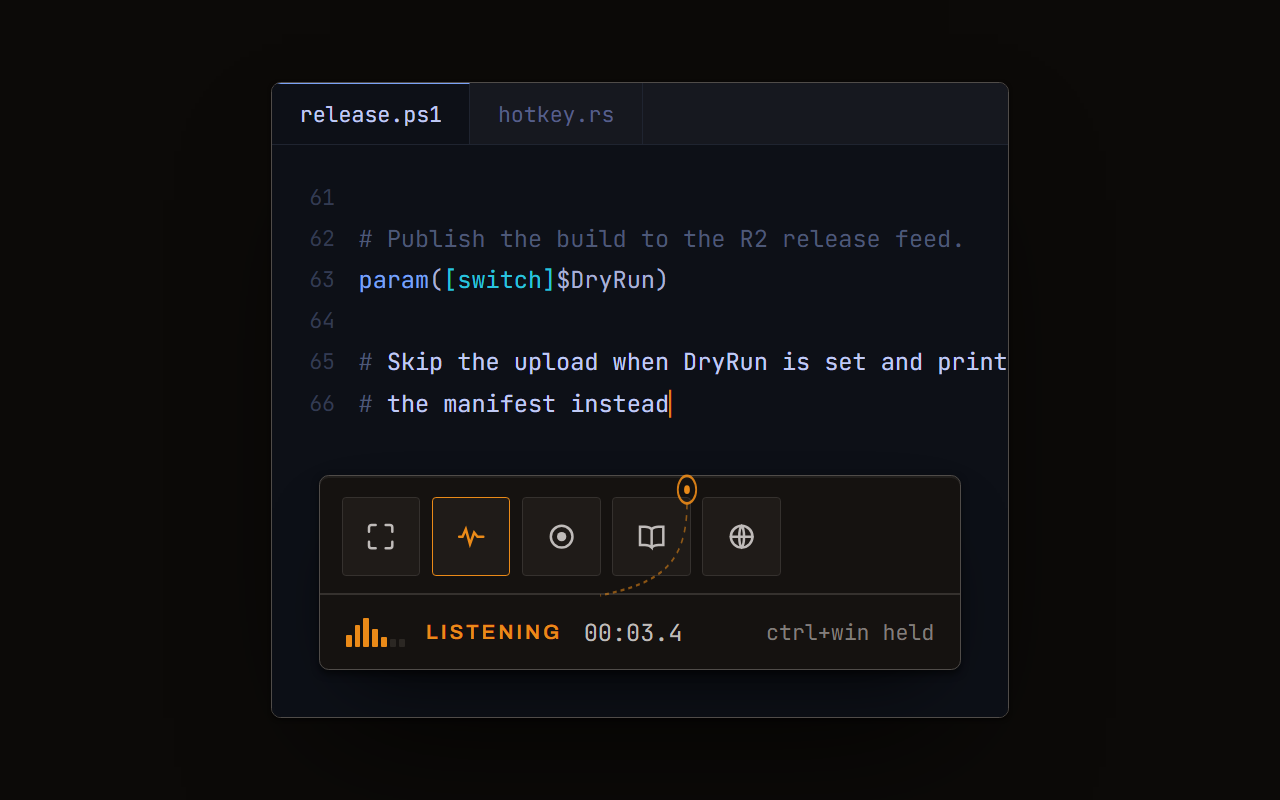
Dictation, where your cursor is
Hold a key, speak, release. Clean, punctuated text lands in whatever has focus, on your PC, your Mac and your phone, with your clipboard handed back.
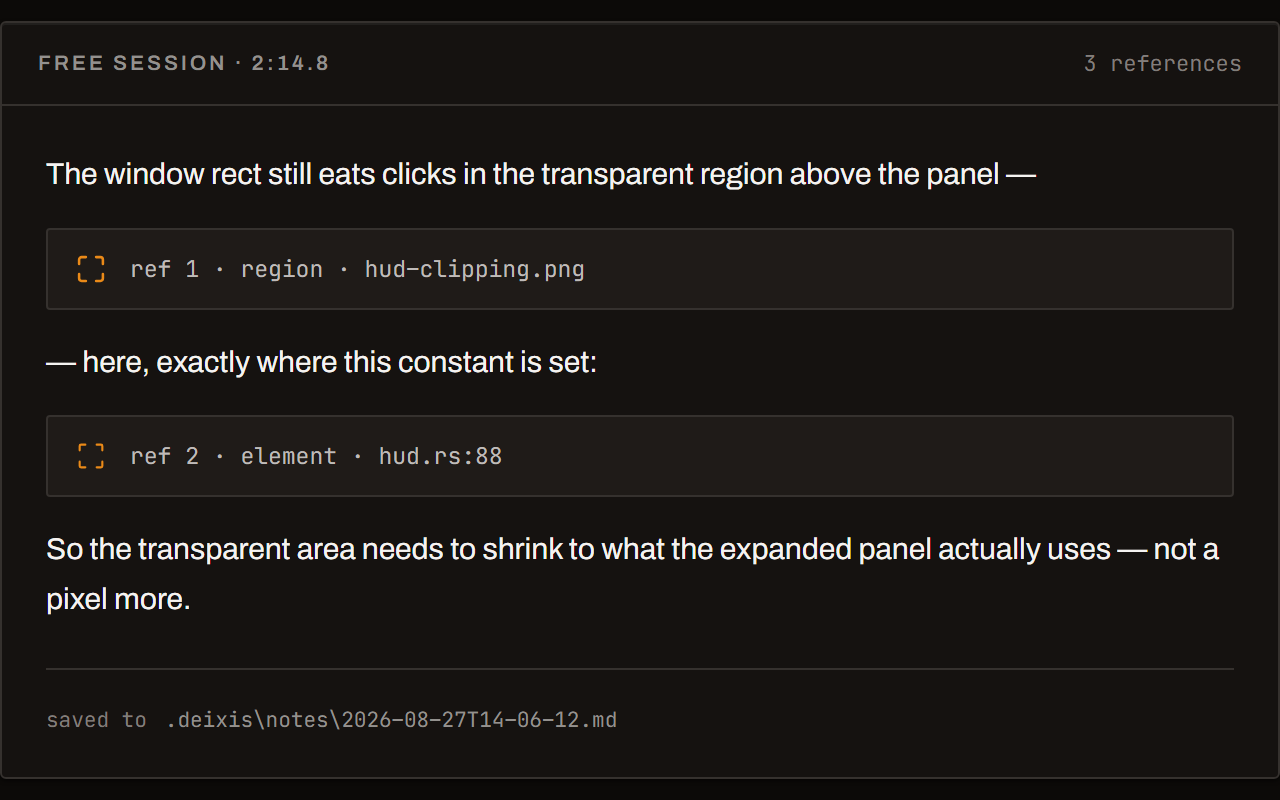
Free mode: talk and point
Narrate for as long as you like while you grab a region, pick a button on screen or take a selection. One note, what you said interleaved with what you pointed at, pasted where you finish and saved as Markdown.
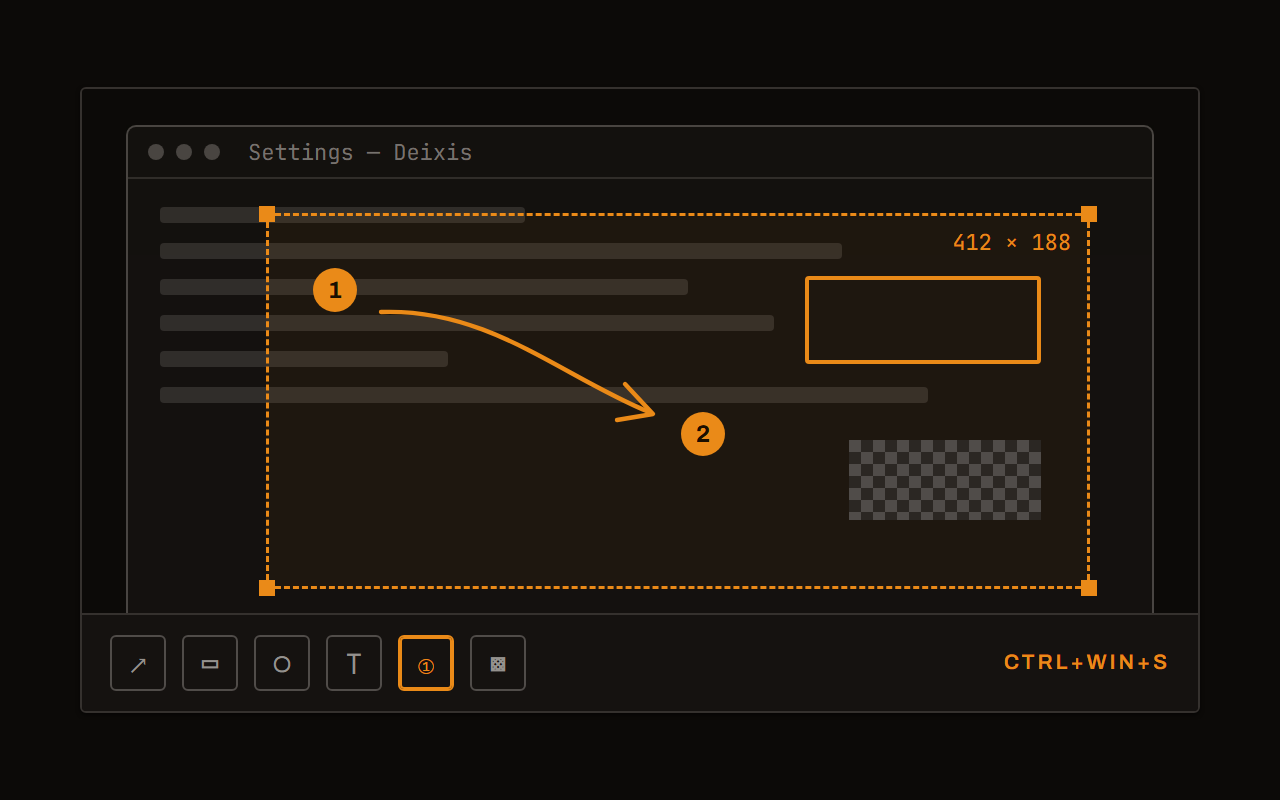
Screen grabs, annotated
Freeze every screen at the keypress, drag a region, add arrows, boxes, text and numbered steps, and pixelate what is private. Saved as a PNG that stays editable.
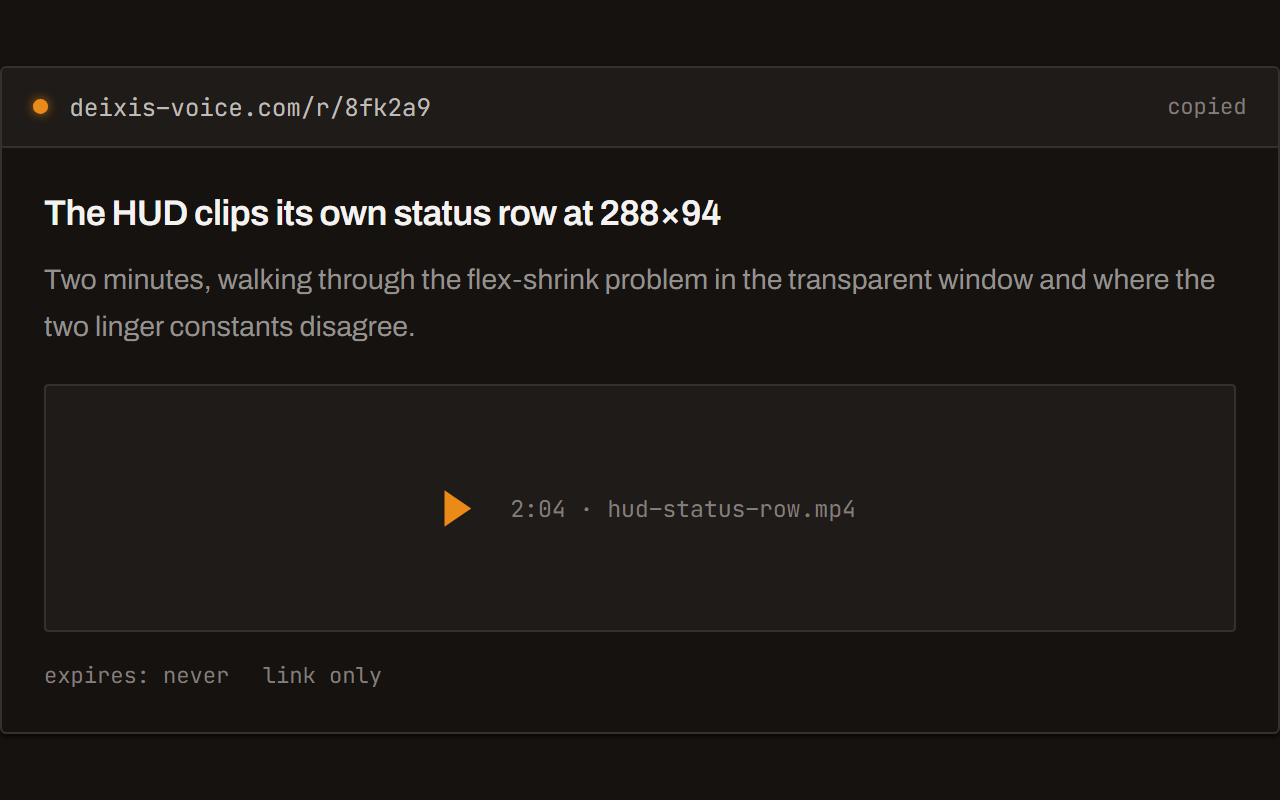
Screen recording, shared as a link
Record the screen with your narration. The recording writes itself up with a title, chapters and a summary, and from your Deixis account it shares as a link anyone can open without one. The Loom you can stop paying for.
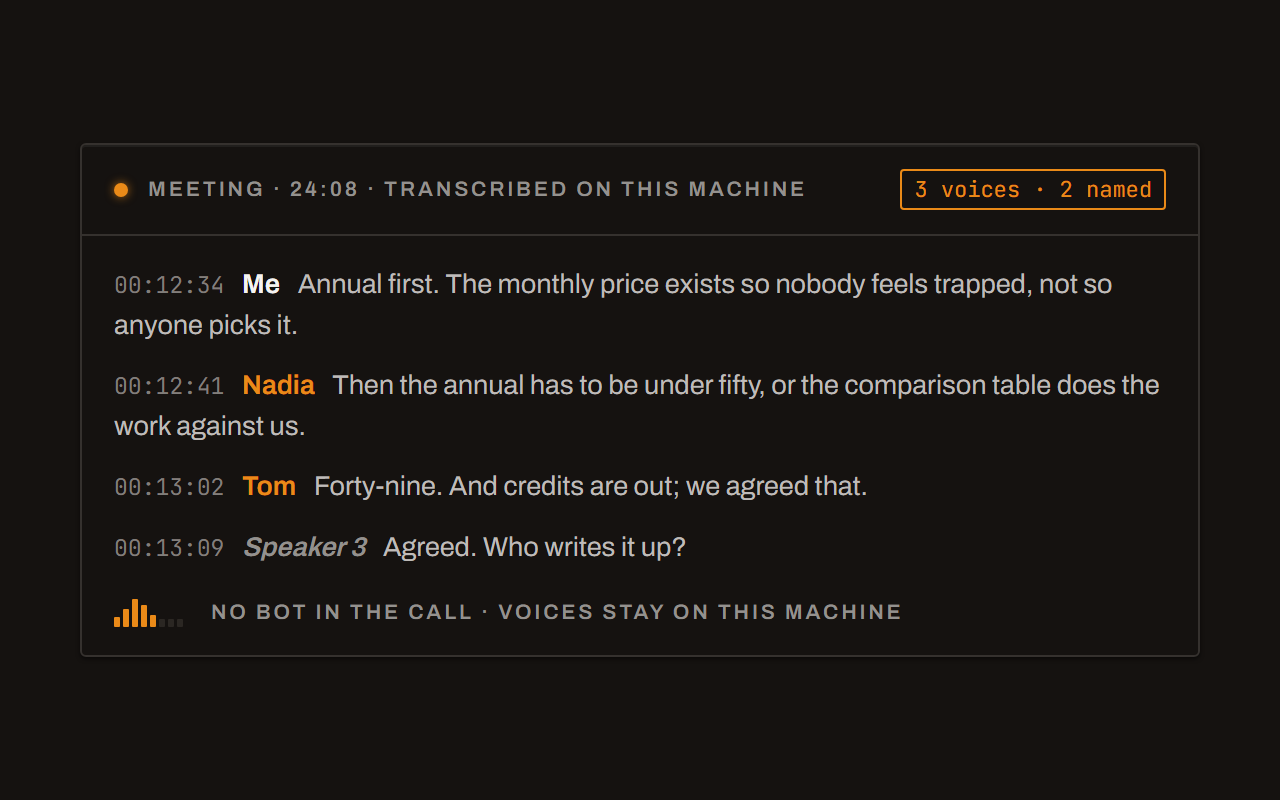
Meetings, no bot, names included
Your microphone and the other side, transcribed on your machine while the call runs. Deixis tells the voices apart and remembers the ones you name, and never uploads a voice.
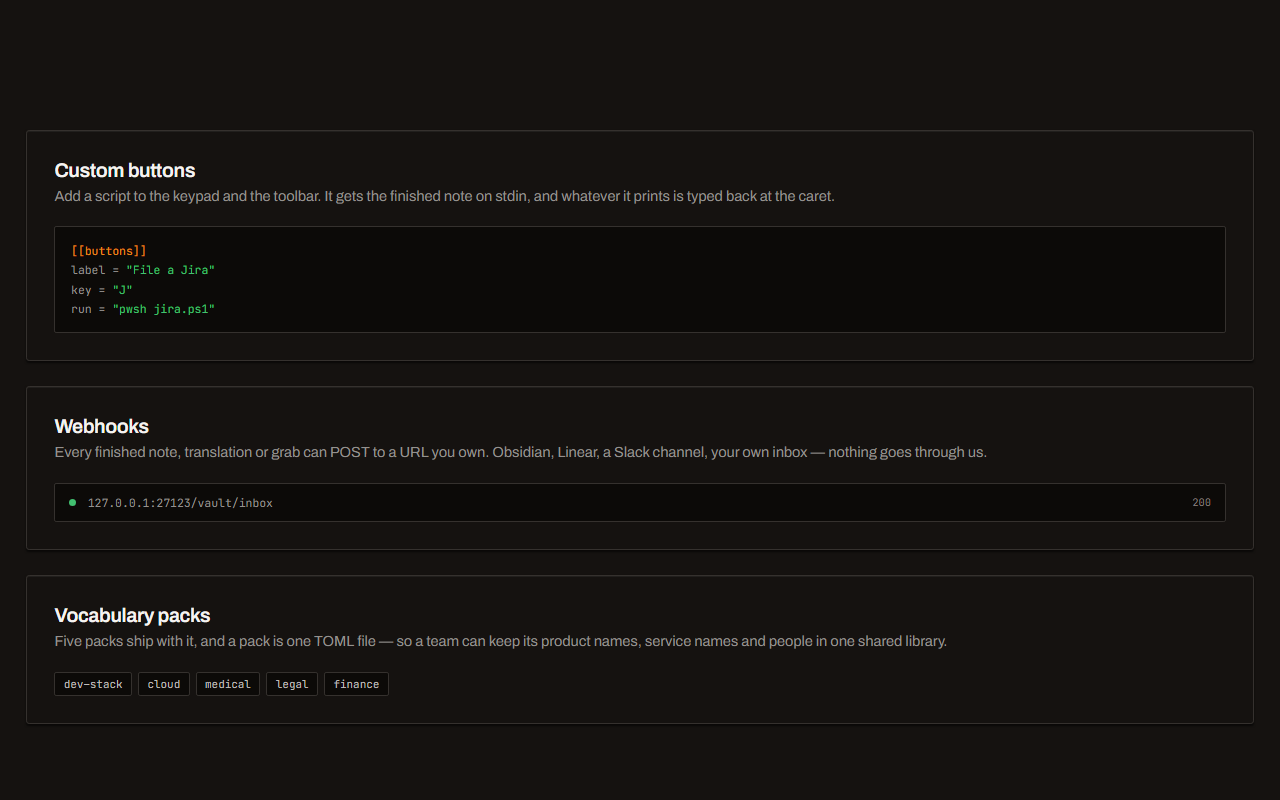
Your own buttons and workflows
Add a button to the palette: it gets the note on stdin and types back whatever it prints. Send finished notes to any URL you own. Chain steps: read the text off a screenshot, translate it, summarise it, post it.
Side by side
Loom and Deixis, side by side
| Row | Deixis | Loom |
|---|---|---|
| Runs on | Windows 10 and 11 (64-bit, on a CPU with AVX2: 2013 and later), Mac (Apple Silicon) and Android (a dictation bubble in any app, plus meetings), with an iPhone keyboard in beta on TestFlight and not yet in the App Store. One engine on all of them, and dictation audio never leaves the device. | Chrome extension, Desktop app |
| Speech recognition happens | On your own device, inside the app, on every platform. Your audio never leaves it. | In the cloud |
| AI cleanup happens | On your device, with no provider at all. Or, if you want more, Deixis's cloud, your own Ollama, or your own key. Your choice, in one setting. | In the cloud |
| Leaves your machine | Text only, and only once you switch a cloud feature on — plus, if you press the Claude usage key, the Claude Code sign-in already stored on your machine. Never audio, never screenshots, never window titles. | Video, audio, text |
| Account needed | None, ever, for anything that runs on your device. The cloud extras have a seven-day trial you start with an email code. No card. | Required |
| Price | Free forever for everything local, meetings included. Pro is $49 a year for the cloud extras with nothing to set up. | Free tier: Starter: up to 25 videos a person, five minutes per recording, video quality up to 720p; $18 a month; Per user. Business buys unlimited videos, unlimited recording length, video up to 4K, trim and stitch, a custom thumbnail and removing Loom branding. Business + AI is $24 per user a month, the tier that carries the AI editing, the video-to-text automation and the automatic meeting notes. Paying annually is offered at a saving of up to 17%. |
| Your transcripts live | In plain files, in one folder you own and can back up. Uninstall Deixis and every note is still readable. | In the cloud |
| Make it yours | Add your own buttons that run a script, send finished notes to any URL you own, and switch on vocabulary packs for your field. | Slack; Jira, Jira Service Management and Confluence; GitHub; Gmail; embeds into FigJam, Notion, Intercom, Zendesk, Dropbox and GitLab. The embeds are on the free Starter tier; removing Loom's branding from the video page and from the embedded player is a Business feature. |
Loom facts from loom.com, download and its privacy policy, read on 14 September 2026. “Not documented” means those pages did not say.
Loom is a screen recorder whose product is the hosted link: you record, the video goes to Loom, and what you send someone is a page on loom.com. That is the whole difference from Deixis, where the recording is an MP4 in a folder on your disk and a link is something you choose to make afterwards. Loom's free Starter tier stops a recording at five minutes and holds 25 videos a person; the tier that lifts both is $18 a user a month, and the automatic summaries, chapters and transcript-driven editing are $24 a user a month, though auto titles are on every tier. Loom is now part of Atlassian: loom.com/privacy and loom.com/security both redirect to Atlassian's own privacy policy and security page, so a Loom recording is governed by Atlassian's policy. The comparison runs the other way in two places worth saying plainly: transcription in more than fifty languages, closed captions, comments, emoji reactions and viewer insights are all on Loom's free tier, and Deixis's speech model is English-only.
What leaves your machine, and what leaves theirs
Deixis publishes every byte it sends, as a table, because there is so little of it. Here is that table beside what Loom's own pages say.
| What | Deixis | Loom |
|---|---|---|
| Audio | Never. Recognition happens inside the app on your device; the recording, the model and the transcript stay there. | The microphone and system audio recorded with the video, as part of the recordingLoom, and so Atlassian · every recording: the video is uploaded to your Loom library, which is where the link you share points |
| The dictated text | The sentence you just dictated, your vocabulary, and your previous sentence in that fieldthe endpoint you chose · only with a cloud endpoint set, and by default only when the local rules are not enough | The transcript and closed captions Loom generates from your recording, in more than fifty languages, plus anything the AI tier writes from it — automatic notes and the video-to-text automationLoom, and so Atlassian — and OpenAI for the AI titles and summaries · transcription and captions are on the free tier; the AI writing is the $24 a user a month tier |
| Context around the text | The names of the app and the field the text is going into. Never the window title, never a screenshot.the same endpoint · with that request | The recording is whatever you pointed it at — a screen, a window or a tab — so whatever was on it goes up with the videoLoom, and so Atlassian · every recording |
| Telemetry and analytics | None. No account, no telemetry, no analytics, no crash reports. | Atlassian's privacy policy says it collects "information about your computer, phone, tablet, or other devices you use to access the Services". Viewer insights — who watched a video and how far they got — are a product feature, on the free tierAtlassian · while you use the service, and every time somebody watches one of your videos |
| Update check | Nothing but the request; the version check happens on your PCapi.deixis-voice.com · every launch, and when you ask in Settings | not documented |
| Model download | Nothing but the requesthuggingface.co · once, when you press Download on first run | The transcript. Loom's pricing FAQ says "OpenAI receives transcript data as text files in order to generate titles and summaries. OpenAI does not receive full videos or audio."OpenAI, as a processor for Loom · when Loom's AI writes a title or a summary — auto titles are on every tier, auto summaries and auto chapters are the $24 a user a month tier |
| Account and sign-in | An email address, only if you choose to start the trial, plus the partner tag from a partner download link and the first partner website that connected to Deixis on this computer, if there are anythe Deixis endpoint · when you start the trial | You sign in to record: the Chrome extension and the desktop app both record into a Loom workspace, and a plan is priced per userLoom, and so Atlassian · before you can record at all |
| Integrations | The finished note, and for a screenshot its file name, never the imagea URL you added yourself · on finish, only for destinations you added | The video, or a link to it, to the service you connect: Slack, Jira, Confluence, GitHub, Gmail, and embeds in FigJam, Notion, Intercom, Zendesk, Dropbox and GitLabthe service you connect · only once you connect one |
Before you switch
Before you switch
Who should not switch
If your recordings are not in English, stay on Loom — the language row is not close, and no amount of local processing makes up for a model that does not speak the language. Stay too if the viewing page is the point: if people comment on your videos, if you need captions for accessibility as a matter of policy, or if someone asks each month who watched the quarterly update, Loom's free tier already does all three and Deixis does none of them. The same goes for anyone recording from a Chromebook, a borrowed machine or a browser tab on a PC they cannot install software on, and for teams whose work depends on a shared library with folders and an administrator over it. And if you edit after recording as a matter of habit — trims, stitches, a branded thumbnail — Loom's paid tiers do that in the browser, and Deixis expects you to open the MP4 in something else.
Making the switch
Where the recordings land
Recordings go to %USERPROFILE%\.deixis\recordings\ as <stamp>.mp4. Beside each one sit its
audio, its transcript as both .transcript.md and .transcript.jsonl, and a .notes.json holding
the title and the summary. The Library lists them with Play, Show in folder, Transcript, Rename
and Share a link. Nothing here is a database: back up that folder and you have backed up every
recording you have ever made.
There is no import path from Loom, and no honest way to build one — your Loom videos live in your Loom workspace. Download the ones that matter before you cancel a plan, because the free tier's twenty-five-video limit is a limit on what the workspace holds, not only on what you may add to it.
The keys
Ctrl+Win+V starts and stops a screen recording. The screen freezes first so you can choose what
to record: drag a region, click a window, press Enter for the whole screen, or Esc to cancel. While
it runs, a small bar sits beside the recorded area with a red dot, the elapsed time, Pause and
Stop — drag it out of the way by its body and the next recording starts where you left it. The tray
icon carries a red badge and its menu counts the time, so you can always tell a recording is
rolling, and Pause genuinely pauses: the paused stretch is not in the finished file.
The microphone
A recording is silent unless a microphone is chosen, and a silent recording has no transcript,
title or summary, because there is nothing to transcribe. There is no picker for the recording
device yet — it is named by the DEIXIS_RECORD_MIC environment variable. This is the setting most
worth getting right before your first real take, and the one most likely to surprise someone
arriving from a tool that simply used the default device.
Sharing, when you want it
Share a link uploads the recording and hands you a URL. It needs a Deixis account, it always carries an expiry between one and ninety days, and it can be revoked from the Library's Shared filter, which lists every link you have made, how much room it is using and when it dies. The audience and the recipient list are fixed when the link is made: a different audience is a different link, because the URL is stored only as a hash, so nothing on our side can re-mail it to somebody added later and nothing can take it back from somebody who already has it.
Before you ask
Questions people search for
Is there a free Loom alternative for Windows?
Deixis records the screen on Windows with no limit on length and no limit on how many recordings you keep, and that costs nothing and needs no account. The paid tier, $49 a year, is for the optional cloud extras; recording, transcribing and summarising on your own machine are free.
Does Loom upload my recordings?
Yes — that is Loom's design. The recording goes to your Loom workspace, and the link you send is a page on loom.com. Loom is now part of Atlassian, and both loom.com/privacy and loom.com/security redirect to Atlassian's own privacy policy and security page, so a Loom recording is governed by that policy.
Can I record my screen without uploading it anywhere?
With Deixis, yes. The recorder writes an MP4 to a folder on your own disk and makes no network call of its own, and the transcript is produced on your own processor. Uploading happens only when you press Share a link, and then only for that one file.
How long can a recording be?
As long as you like. Loom's free tier stops at five minutes a recording and twenty-five videos a person, and lifting either is $18 a user a month. Deixis has no ceiling on either, at any tier.
Do I need an account to record?
No. Recording, the transcript, the chapters and the title and summary need no account. Share a link is the one feature that does, because it uploads the file to be hosted for the person you send it to.
Does it work on a Mac?
Yes. Screen recording runs on Apple Silicon Macs as well as on Windows PCs, from the same app and the same chord, and the recognition is on the device on both.
Keep reading
Related pages
A free screen recorder that keeps the file
Record your screen free, with no watermark, no time limit and no account. The file is an ordinary MP4 in your own folder, and it writes its own transcript.
Screen grabs, annotated, for nothing
A free screenshot and annotation tool: freeze the screen, drag a region, add arrows, boxes, text and numbered steps, and pixelate what is private.
Screen capture
Freeze the screen, drag a region, and annotate it with arrows, boxes, text, redaction and numbered steps. Every save stays re-editable afterwards.
Hold a key. Speak. Keep working.
Deixis is free, needs no account, and runs on your own device. Everything on this page is in the current release.
v1.2.2 · 64‑bit Windows 10/11 · macOS 13 on Apple silicon · 51 MB · nothing else to install · also for Windows