Wispr Flow, or dictation your Mac keeps to itself
Deixis does the job you use Wispr Flow for, on the Mac you already have: hold Ctrl+Option,
speak, let go, and clean, punctuated text lands at the cursor in whatever app has focus, with your
clipboard handed back. The difference is where the listening happens. Deixis recognises your speech
on the Mac itself, on Apple Silicon, so your voice never leaves it. There is no account to create, no
weekly word count, and everything that runs on your Mac is free.
Wispr Flow is built the other way round, and its own pages say so. Its privacy page says transcription always happens in the cloud. Its Context Awareness help page says the feature is on by default and lists what can go along with a dictation, a screenshot included; on a Mac it is the full list, because conversation context and element descriptions are named as Mac-only today. Its setup guide puts signing in before your first word, and the free plan stops at 2,000 words a week on desktop.
Wispr Flow is ahead in a few places, and this page names them first: a hundred-plus languages, meeting notes on the Mac, and Intel Macs. If none of those is why you use it, Deixis is the better fit for your Mac, and here is the case.
Why switch
What you gain, and what you give up
Why Deixis
- Your voice stays on your Mac. Speech recognition happens inside the app, on Apple Silicon. Wispr Flow's privacy page is direct about its own approach: "Transcription always happens in the cloud." Its security overview adds that the service is not end-to-end encrypted, because it has to process the audio to produce a transcript, and that it processes and stores customer data in the United States. Deixis has no audio to process anywhere else, because none is sent.
- Context without a screenshot. Wispr's Context Awareness is on by default. While it is on, its help page lists what can accompany a dictation: app information, the text in the box before, selected and after your cursor, on-screen text, file and variable names in coding apps, your user identifier in the app, the apps in your session, a screenshot, and conversation history, messages included. It skips banking apps and standard macOS password fields, though it warns that custom or web-based password fields may be read like any other text, and it clears the captured text when the dictation ends. Its data-controls page adds that the app name and the surrounding text box are always used for formatting, whatever that setting says. Deixis is field-aware too, and what leaves is short and named: the sentence, your vocabulary, the names of the app and the field, and the last thing you dictated into that field, only once you have switched cloud cleanup on. Never the window title, never the text on your screen, never a screenshot.
- Nothing trains on you, and nothing counts you. Wispr's help centre says Improve the model for everyone is on by default for Free and Pro, and its data-controls page that with it on your audio, transcripts and edits may be used to train its models. The same page says it may collect usage statistics, such as how many words you dictate, whatever your data settings. Deixis keeps no training data, sends no telemetry, no analytics and no crash reports, and has no account to attach any of it to.
- No account and no word count. Wispr's setup guide puts signing in, with Google, Apple, Microsoft, SSO or an email and password, before your first dictation, and the free plan then stops at 2,000 words a week on desktop. Past that it is $15 a month, or $12 a month billed yearly. Deixis never asks you to sign in and never counts: dictation, free mode, screen grabs, screen recording, your history and your dictionary are free for as long as you use them. Pro, at $49 a year, is cloud cleanup with nothing to set up.
- It dictates on a plane. With no cloud endpoint set, Deixis dictates with the Wi-Fi off, because the recognition never used the network. Wispr Flow's transcription is in the cloud, so offline, its hands-free guide says, all it can do is warn you and save the audio to retry the transcription later.
- More than dictation, on the same chord. Double-tap
Ctrl+Optionfor free mode: talk for as long as you like while you grab a region or take a selection, and get back one note with what you said and what you pointed at, in order.Ctrl+Option+Sfreezes the screen for a grab you can mark up with arrows, boxes, text and numbered steps, or pixelate where it is private.Ctrl+Option+Vrecords the screen to a video, narrated when a microphone is set up for it. None of that is on Wispr Flow's pricing page. - Everything is a file on your Mac. Notes, grabs, recordings and settings sit in one folder as ordinary files, and your dictation history has a window of its own. Back the folder up, search it, uninstall Deixis tomorrow, and every word is still there and still readable.
Where Wispr Flow still wins
- A hundred-plus languages. Its pricing page lists speech-to-text in more than 100 languages on every plan, the free one included. Deixis ships English speech models; if you dictate in another language, Wispr Flow is the one that will understand you.
- Older Macs. Its requirements page lists macOS 12 Monterey or later, on Apple Silicon or Intel. Deixis needs an Apple Silicon Mac on macOS 13 or later, and does not run on an Intel Mac at all.
- Meeting notes on the Mac. Wispr's Notetaker runs on Mac and Windows, per its pricing page, and identifies speakers without sending a bot into the call. Deixis records and transcribes meetings on Windows and on Android, on the device, but not yet on the Mac.
- A dictionary that fills itself in. Its data-controls page describes Auto-add to Dictionary, which watches the text box after a paste and adds a word when you correct its spelling. Dictionary and snippets are on every plan, and Pro shares them across a team. In Deixis you add words yourself, in the Dictionary window, and nothing is shared.
- It reads the screen for spellings. The Context Awareness this page argues against is also a feature: its help page says Wispr uses names visible on screen, such as an email's recipients, to get proper nouns right. Deixis never reads what is on your screen to dictate, so a name it has not met needs to go into your dictionary first.
What you get
More than dictation, on your Mac.
Hold Ctrl+Option and speak, or press a letter while you hold it: free mode, a grab, a screen recording. All of it on your Mac, all of it free, none of it behind an account.
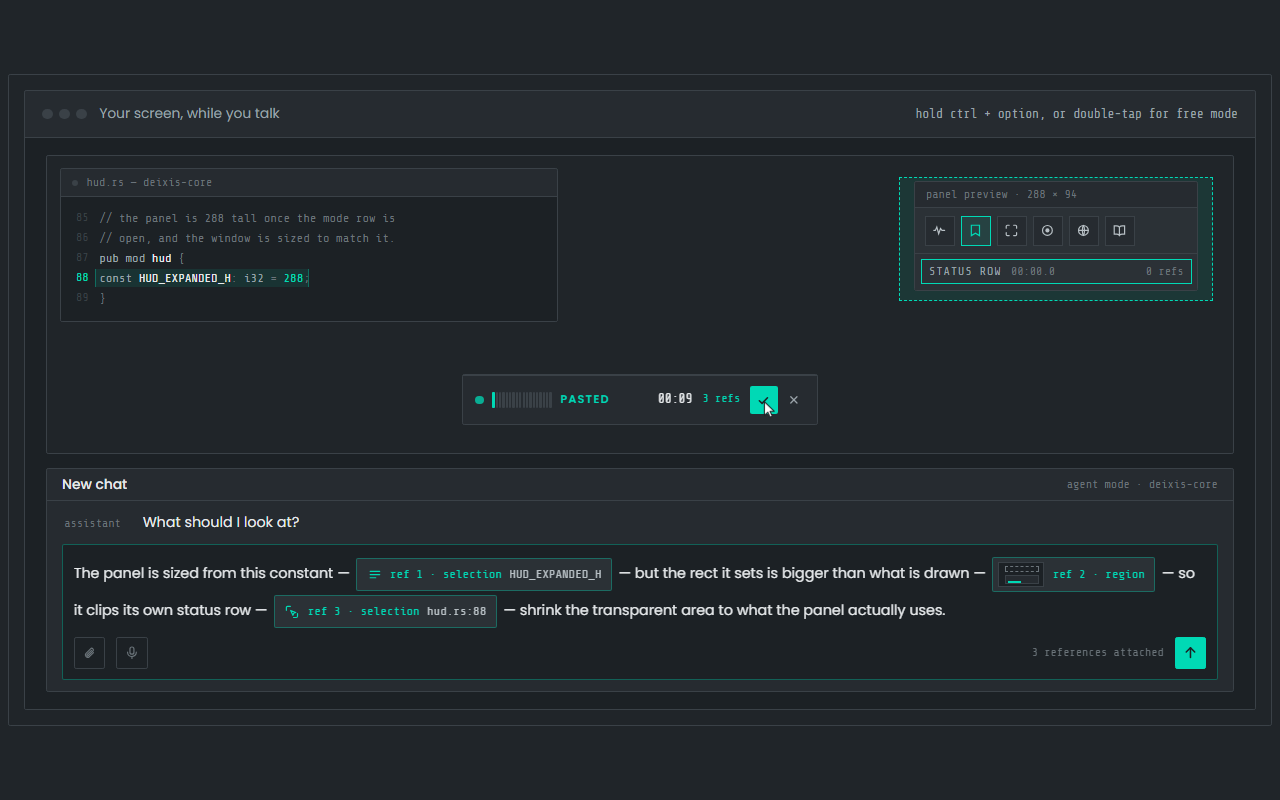
Dictation, where your cursor is
Hold Ctrl+Option, speak, release. Clean, punctuated text lands in whatever app has focus on your Mac, with your clipboard handed back.
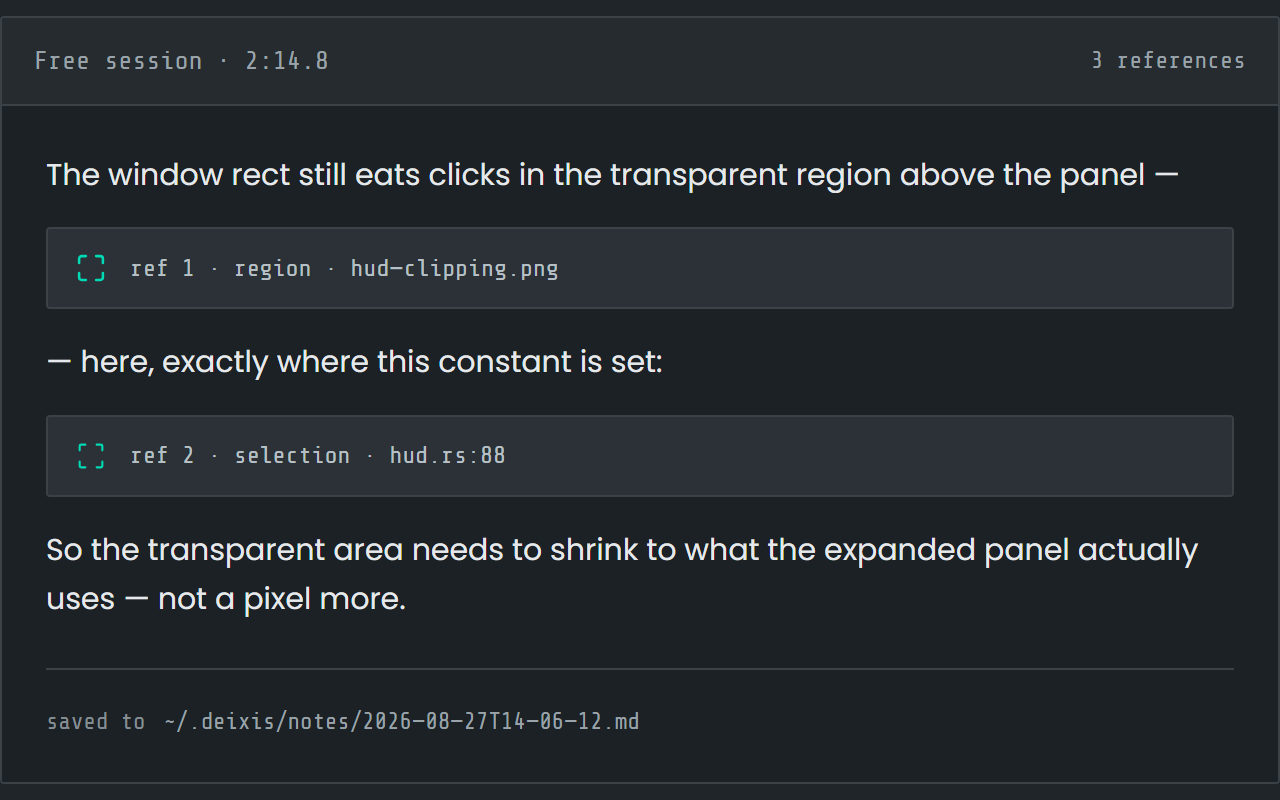
Free mode: talk and point
Double-tap the chord and narrate for as long as you like while you grab a region or take a selection. One note, what you said interleaved with what you pointed at, pasted where you finish and saved as Markdown.
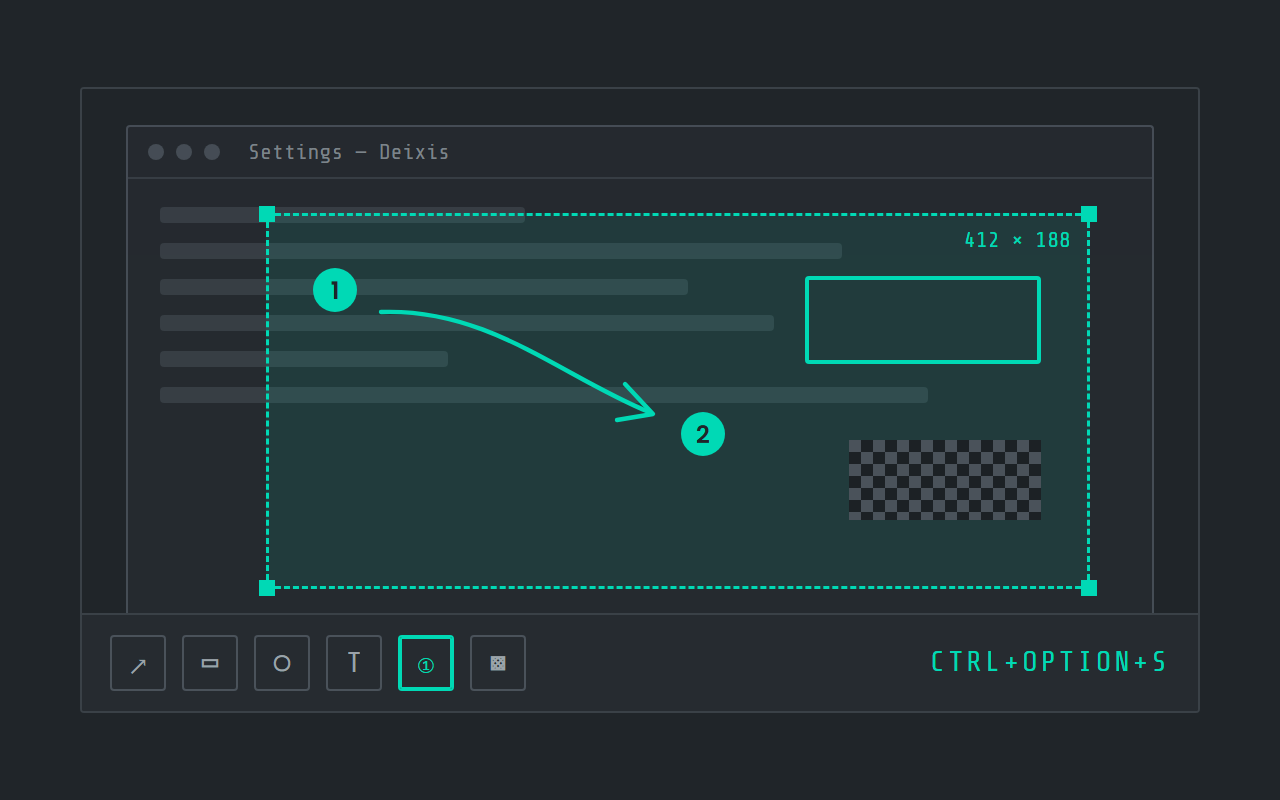
Screen grabs, annotated
Freeze the screen at the keypress, drag a region, add arrows, boxes, text and numbered steps, and pixelate what is private. Saved as a PNG in a folder you own.
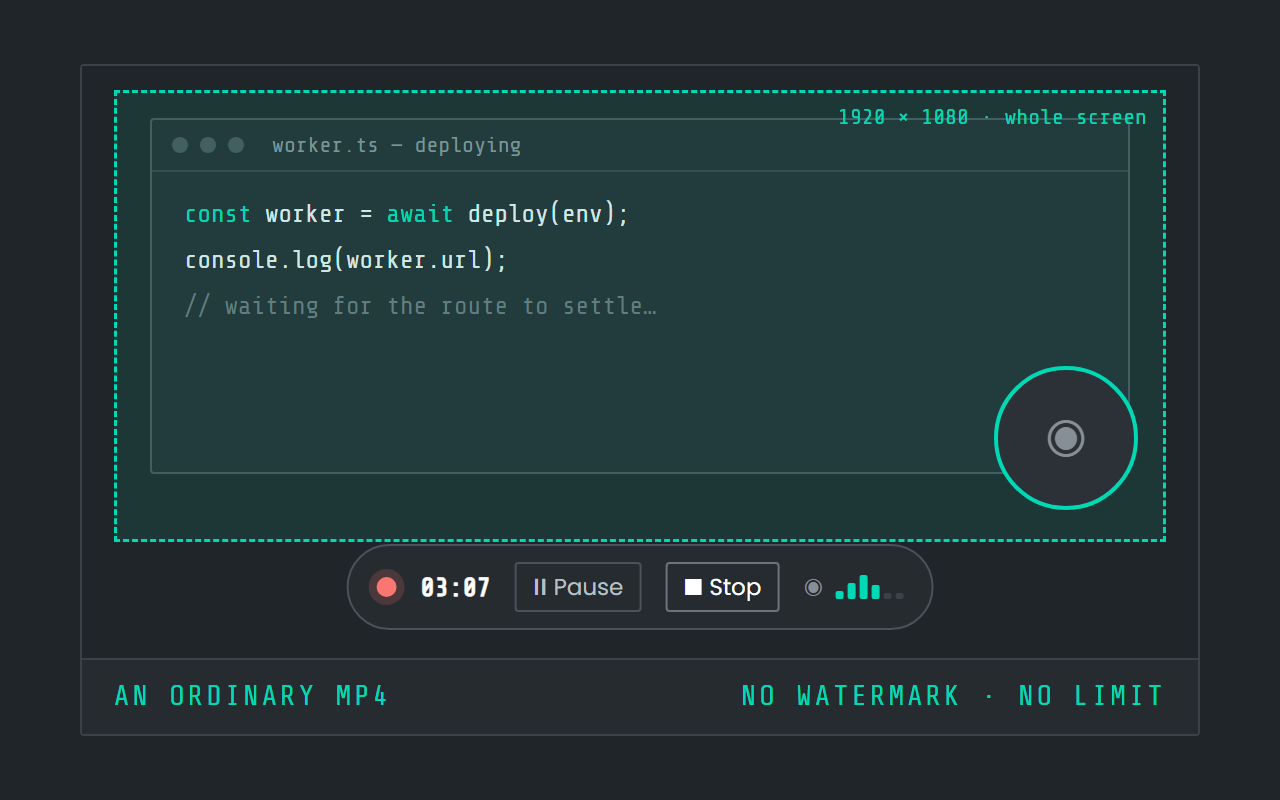
Screen recording
Record the screen, pause when you need to, and stop. The video is a file in a folder on your Mac, not in somebody else's cloud.
Side by side
Wispr Flow and Deixis, side by side
| Row | Deixis | Wispr Flow |
|---|---|---|
| Runs on | Mac, on Apple Silicon with macOS 13 or later, and the same app on Windows 10 and 11 and on Android, with an iPhone keyboard in beta on TestFlight. One engine on all of them, and dictation audio never leaves the device. | Windows 10 or 11 (x64 only, no ARM), macOS 12 or later, on Apple Silicon or Intel, iOS, Android |
| Speech recognition happens | On your own device, inside the app, on every platform. Your audio never leaves it. | In the cloud |
| AI cleanup happens | On your device, with no provider at all. Or, if you want more, Deixis's cloud, your own Ollama, or your own key. Your choice, in one setting. | In the cloud |
| Leaves your machine | Text only, and only once you switch a cloud feature on. Never audio, never screenshots, never window titles. | Audio, text, screenshots |
| Account needed | None, ever, for anything that runs on your device. The cloud extras have a seven-day trial you start with an email code. No card. | Required |
| Price | Free forever for everything that runs on your Mac. Pro is $49 a year for the cloud extras with nothing to set up; on a Mac, that is cloud cleanup. | Free tier: 2,000 words a week on desktop, 1,000 a week on mobile; $15 a month; $144 a year |
| Your transcripts live | In plain files, in one folder you own and can back up. Uninstall Deixis and every note is still readable. | On your device and in the cloud |
| Make it yours | Your own dictionary of the names and jargon you use, in its own window. Custom buttons and webhooks are on Windows today, not yet on the Mac. | A personal dictionary and snippets, an auto-add-to-dictionary option that learns from your edits, and meeting notes from its Notetaker that you can use in Claude, ChatGPT and other AI tools over MCP. Pro adds a shared dictionary and snippets for a team. |
Wispr Flow facts from wisprflow.ai, its privacy policy, policy, security, context, storage, controls, setup, requirements, app, handsfree and shortcuts, read on 27 September 2026. “Not documented” means those pages did not say.
Two settings decide what Wispr keeps. Dictation Cloud Storage, a setting under Data and Privacy, stores dictation transcripts, audio and history on Wispr's servers when it is on; the help centre says Notetaker transcripts and summaries are stored in Wispr's cloud with no setting to opt out of that storage, though the data-controls page says their retention can be configured. Improve the model for everyone is on by default for Free and Pro, with the choice shown during onboarding; on, dictation audio, transcripts and edits may be used to train its models. Context Awareness is on by default and can be switched off under Settings → Data and Privacy; its help page lists a screenshot among the context that can accompany a dictation, and names conversation context and element descriptions as Mac-only today. The data-controls page adds that Wispr always uses the name of the app and the surrounding text box content to format a dictation, and may collect usage statistics such as words dictated whatever your data settings. The Notetaker runs on Mac and Windows, per the pricing page. Offline, the hands-free guide says desktop dictation is not blocked: Flow warns and keeps the audio to retry the transcription. The annual figure is the pricing page's $12 per user per month on annual billing, multiplied by twelve and quoted here as the yearly total; monthly billing is $15.
What leaves your machine, and what leaves theirs
Deixis publishes every byte it sends, as a table, because there is so little of it. Here is that table beside what Wispr Flow's own pages say.
| What | Deixis | Wispr Flow |
|---|---|---|
| Audio | Never. Recognition happens inside the app on your device; the recording, the model and the transcript stay there. | Your dictation audio. The privacy page and the data-controls page both say transcription always happens in the cloud; the security overview says the service is not end-to-end encrypted, because it must process the audio to produce a transcript, and that it processes and stores customer data in the United States.Wispr's cloud · every dictation |
| The dictated text | The sentence you just dictated, your vocabulary, and your previous sentence in that fieldthe endpoint you chose · only with a cloud endpoint set, and by default only when the local rules are not enough | The transcript comes back from the cloud. With Dictation Cloud Storage on, dictation transcripts, audio and history are stored on Wispr's servers; with Improve the model for everyone on, audio, transcripts and edits may be used to train its models.Wispr's servers · every dictation; model training is on by default for Free and Pro, shown during onboarding, and cloud storage is a setting under Data and Privacy |
| Context around the text | The names of the app and the field the text is going into. Never the window title, never a screenshot.the same endpoint · with that request | With Context Awareness on, which is the default, the help page says context can accompany your dictation: app info, the text in the box before, selected and after the cursor, on-screen text, variable and file names in coding apps, your user identifier within the app, the apps in your current session, a screenshot, and conversation history. Standard macOS password fields, sensitive and numeric-only fields, browser URL bars and banking apps are excluded, though custom or web-based password fields may be read like normal text, and captured text is cleared when the dictation ends. On Windows, conversation context and element descriptions are Mac-only today.Wispr, with the dictation · with each dictation, unless you turn Context Awareness off under Settings → Data and Privacy |
| Telemetry and analytics | None. No account, no telemetry, no analytics, no crash reports. | Usage statistics such as the number of words you have dictated, which the data-controls page says Wispr may collect whatever your data settings. The privacy policy adds that third-party web analytics such as Google Analytics may be used on its Services.Wispr, and Google Analytics on its Services · regardless of your data controls |
| Update check | Nothing but the request; the version check happens on your Macapi.deixis-voice.com · every launch, and when you ask in Settings | not documented |
| Model download | Nothing but the requesthuggingface.co · once, when you press Download on first run | Nothing to download: transcription always happens in the cloud, so no speech model lives on your computer.— · — |
| Account and sign-in | An email address, only if you choose to start the trial, plus the partner tag from a partner download link and the first partner website that connected to Deixis on this computer, if there are anythe Deixis endpoint · when you start the trial | An account is required: signing in with Google, Apple, Microsoft, SSO, or email and password is a setup step on desktop and mobile. The privacy policy lists email address, first and last name and phone number as account information.Wispr · at sign-up, before the first dictation |
| Integrations | Nothing: webhooks are on Windows today, not yet on the Mac | Calendar, contact and directory data from Google, if you connect those, per the privacy policy. The pricing page lists meeting notes you can use in Claude, ChatGPT and other AI tools over MCP.Wispr, and the services you connect · only when you connect them |
Before you switch
Before you switch
Who should not switch
If you dictate in a language other than English, stay with Wispr Flow: Deixis's speech models are English models. If your Mac has an Intel processor, or is on macOS 12, Deixis will not run on it. If Wispr's Notetaker writes up your meetings, keep it for that; Deixis records meetings on Windows and on Android, not yet on the Mac. And if your team works from a shared dictionary and snippets, Deixis has nothing shared to offer.
Making the switch
Five minutes, and most of it is one download.
Installing
Deixis comes as a disk image: open it and drag Deixis to Applications, the way Wispr Flow went in. The first time you dictate, macOS asks for microphone and Accessibility permission; grant both in System Settings → Privacy & Security. Wispr's setup guide asks for the same two. Updates arrive through the app, in Settings → Updates.
The key
Wispr Flow's setup guide says a Mac with an fn key defaults to fn, and a Mac without one to
Ctrl+Opt. Deixis's chord is Ctrl+Option: hold, speak, release. If your Wispr shortcut is the same
chord, quit Wispr Flow while you try Deixis, or give it another key in its settings, so that only one
app answers. Wispr's double-tap turns on Hands-free; Deixis's double-tap is free mode, which keeps
listening until you double-tap again, then pastes the whole note at the cursor and saves it.
The speech model
First launch shows one Download button. Press it, wait for a file about the size of a short video, and you are dictating. It is fetched once and kept on your Mac. Beyond that download, the two calls a fresh install makes on its own are an update check at launch and, when you open the Settings window, a check for an announcement from us, and neither sends anything but the request.
Your words
There is no importer for a Wispr Flow dictionary, so bring your words across by hand. The Dictionary window takes the names and terms you want recognised, and fixes for the ones it keeps mishearing; a fix applies every time, so a name corrected once stays corrected. It is a plain text file underneath, so a long list can go in at once.
Cleanup
Out of the box, Deixis tidies dictation on the Mac with rules, filler words, punctuation and casing, with no provider and no key. If you liked the polish Wispr's model gave every sentence, Settings → Cleanup is one choice: Deixis's cloud, which is Pro or a seven-day trial you start with an emailed code, a model on your own machine, or your own key. You also choose how often: When it helps, which is the default, Every time, or Never. Whichever you pick, nothing on the list of what leaves is audio.
What stays with Wispr
Your Wispr account, its subscription and anything Dictation Cloud Storage kept are managed on Wispr's side, under Settings → Data and Privacy; its security overview says you can ask for an export or for the account to be deleted. Deixis has nothing to cancel, because there was never an account.
Before you ask
Questions people search for
Does Wispr Flow work offline on a Mac?
Not to turn speech into text. Its privacy page and its data-controls page both say transcription always happens in the cloud; offline, its hands-free guide says, Flow warns you and saves the audio to retry the transcription. Deixis recognises speech on your Mac, so with no cloud endpoint set it dictates, grabs and records the screen with no connection at all.
Does Wispr Flow take screenshots on a Mac?
Its Context Awareness help page lists a screenshot among the context that can accompany a dictation while the feature is on, and the feature is on by default; you can turn it off under Settings → Data and Privacy. The page says captured text is cleared when the dictation ends, and that banking apps and standard macOS password fields are skipped. Deixis never sends a screenshot or the text on your screen: its cleanup sends the names of the app and the field, and only once you switch cloud cleanup on.
Is Wispr Flow free on a Mac?
There is a free plan of 2,000 words a week on desktop, then Pro at $15 a month, or $12 a month billed yearly. Deixis is free for everything that runs on your Mac, with no cap and no account; Pro is $49 a year, or $10 a month, for cloud cleanup with nothing to set up.
Does Wispr Flow work on Intel Macs?
Yes: its requirements page lists macOS 12 Monterey or later, on Apple Silicon or Intel. Deixis does not. It needs an Apple Silicon Mac on macOS 13 or later, and if yours is older, Wispr Flow is the one of the two that will run on it.
Does Deixis record meetings on a Mac?
Not yet. Meeting recording, transcribed on the device as it runs, ships on Windows and on Android. On the Mac today Deixis dictates, runs free mode, grabs and annotates the screen, and records it. If meeting notes on your Mac are what you use Wispr Flow for, keep it for that.
What is the best Wispr Flow alternative for Mac?
If what you want to change is where your voice goes, Deixis: the same hold-a-key dictation with the recognition on your Mac, no account, no word cap, and grabs and screen recording on the same chord. If you need a hundred languages, an Intel Mac or meeting notes on the Mac, Wispr Flow still wins, and this page says so above.
Keep reading
Related pages
How to type by voice in any app on a Mac, with the speech recognised on the Mac itself
How to type by voice in any app on a Mac: hold Ctrl+Option, speak, let go. Speech recognition runs on your Mac, free and with no account.
Here is every byte that leaves your machine, for each tool
Every byte Deixis sends off your machine in one table, and the same table filled in for other dictation tools from their own documentation, dated.
VoiceInk or Deixis, two local dictation apps for your Mac
VoiceInk and Deixis both recognise speech on your Mac. VoiceInk is $25 and needs macOS 14.4; Deixis is free for everything local and runs on macOS 13.
Apple Dictation, and what Deixis adds on the same Mac
Apple Dictation is free and built into your Mac. Deixis adds tidier text on any Apple silicon Mac, your own words, and grabs and recording on one key.
Willow Voice, or the same hotkey with the cloud left out
Willow Voice dictates through its cloud unless you pay for offline mode. Deixis recognises speech on your Mac for free, with no account and no weekly cap.
Aqua Voice, or dictation that works with the Wi-Fi off
Aqua Voice says it has no offline mode and gives you 1,000 free words. Deixis recognises speech on your Mac itself, free, with no account and no meter.
Hold a key. Speak. Keep working.
Deixis is free, needs no account, and runs on your own device. Everything on this page is in the current release.
v1.2.2 · 64‑bit Windows 10/11 · macOS 13 on Apple silicon · 51 MB · nothing else to install · also for Windows
Facts about Wispr Flow checked on 2026-09-27 against wisprflow.ai. Deixis facts are from its README for the current release. Something out of date? Tell us.