Parakeet v3 against Whisper, language by language
In Deixis 1.6, NVIDIA's Parakeet v3 does the speech recognition for German, Dutch, French, Italian, Spanish and Portuguese, and Whisper keeps English. This page is the reason. On the same 80 clips per language, Parakeet v3 got fewer words wrong than the multilingual Whisper small model Deixis shipped before 1.6 in every one of the six, and it decoded a typical clip in under half a second on our test machine. In English the order flips: Whisper small.en gets fewer words wrong, and it spells the names in your dictionary far more often.
Free, with no account and no sign-in.
Every figure here comes from one set of runs on one desktop PC, with the method written out below so that anyone can repeat it. The audio is read speech from a public dataset, which is easier than the way people talk to a computer. Read the figures as a comparison of two engines on the same audio, not as a promise of what you will see on your own desk.
The figures
| Language | FLEURS split | Parakeet v3: words wrong | Whisper small (multilingual): words wrong | Parakeet v3: median decode |
|---|---|---|---|---|
| German | de_de |
7.4% | 11.1% | 0.39 s |
| Dutch | nl_nl |
9.2% | 20.5% | 0.31 s |
| French | fr_fr |
9.2% | 18.1% | 0.44 s |
| Italian | it_it |
3.4% | 9.9% | 0.48 s |
| Spanish | es_419 (Latin American) |
3.1% | 5.5% | 0.48 s |
| Portuguese | pt_br (Brazilian) |
5.6% | 9.6% | 0.41 s |
"Words wrong" is the word error rate: every word the engine swapped for another, left out or added, counted against the number of words in the sentence that was actually read, across all 80 clips. So 7.4% in German means a little over seven words in every hundred came out wrong.
The gap is widest where Whisper small struggled most. In Dutch and French it got about one word in five wrong, and Parakeet v3 roughly halves that. In Italian Parakeet gets about a third as many words wrong. In German, Spanish and Portuguese the improvement is smaller but still there: about a third fewer mistakes in German, and about two in five fewer in Spanish and Portuguese.
The time column is the median time Parakeet v3 took to decode one clip on that machine: half the clips were quicker, half were slower. It is the decode alone. It does not include recording, the moment between letting go of the key and the engine starting, or typing the text into your app.
The Spanish figures are for Latin American Spanish, because that is FLEURS's Spanish split, and the Portuguese figures are for Brazilian Portuguese for the same reason. Neither says anything about Spain's Spanish or European Portuguese.
English stays on Whisper
| Engine | Words wrong | Median decode |
|---|---|---|
| Whisper small.en | 6.0% | 0.58 s |
| Parakeet v3 | 7.8% | 0.28 s |
Parakeet v3 is twice as fast in English, and that was tempting. But it gets more words wrong, and it loses badly on the thing English users of Deixis lean on most, which is the dictionary. Whisper reads your list of words before it starts decoding, so a product name, a colleague's surname or a library you have taught it is likely to come out spelled your way. Parakeet hears a dictionary term only by its sound. In a check on 34 names from the Deixis owner's own dictionary, Whisper spelled 20 of them right and Parakeet 10. That check is small and is not a benchmark, but the direction is clear enough that English stays where it was.
The same weakness applies to the six other languages: Parakeet will get unusual names right less often than Whisper does in English. We chose it anyway, because the alternative in those languages was a model that got far more of the ordinary words wrong.
How it was measured
- The audio. Google's FLEURS dataset, test split, which is sentences read aloud. Each language
uses the dataset's own regional split, named in the table:
de_de,nl_nl,fr_fr,it_it,es_419andpt_br. - The clips. 80 per language: the 20 shortest clips in the split, plus 60 drawn at random with a fixed seed of 7, so the same 80 can be drawn again.
- The scoring. Words wrong, counted after lower-casing both the engine's text and the reference and dropping punctuation. A missing comma or capital letter is not counted; a wrong word is.
- The machine. The processor of one 12-core desktop PC, an AMD Ryzen 7900X, running the engines on 11 threads, on 3 and 4 November 2026. Not a graphics card, and not a laptop.
- Parakeet v3. Run through sherpa-onnx 2.0.1, then run again on 4 November through the Deixis app's own core, the code that does the work when you dictate, which agreed with these figures to within 0.4 points.
- Whisper. The multilingual small model, measured again on 4 November after two fixes to the way Deixis decodes with it, so the comparison is with Whisper as it runs now rather than an earlier, weaker run. English uses small.en, the English-only model.
The one-in-ten rule
Deixis offers a language for speech to text only when an engine gets fewer than one word in ten wrong on this test. Past that point you spend more time correcting than you saved by speaking. The six languages above clear it with Parakeet v3, and English clears it with Whisper.
We measured three more and do not offer them. The best figure we measured for Afrikaans was 36% of words wrong, for Zulu 46%, and for Xhosa 42%. That is somewhere between one word in three and one word in two, which is not something we would ask anyone to dictate with.
What was not measured
These are gaps in the evidence, and the pages that quote these figures say so too.
- Regional accents. Swiss German, Flemish, Quebec and Belgian French, Spain's Spanish and European Portuguese were not measured. The figures are for the FLEURS split named beside each language and nothing wider.
- Free speech. FLEURS is read aloud from written sentences. The way people dictate an email, with hesitations, restarts and half-sentences, is harder, and it was not measured.
- Noisy rooms. Nothing here tested background noise, other voices or a poor microphone.
- Mixed languages. Deixis dictates in one language at a time, the one you choose. Switching language inside a sentence was not measured, and no page claims it.
- Laptops and the Mac. Every time on this page comes from one desktop PC running Windows. A laptop is slower, and nothing here was measured on a Mac.
- End-to-end latency. Only the decode was timed. How long it takes from letting go of the key to seeing text in your app was not measured on this page.
- Everything after recognition. Cleanup, the dictionary, the vocabulary packs and the punctuation Deixis adjusts to the field you type into are tuned for English, and nothing here measures them in the other six languages.
What you get
More than dictation. One key, and everything behind it.
Hold the key and press a letter: free mode, a grab, a meeting, a recording, a translation, your own buttons. All of it on your own device, all of it free, none of it behind an account.
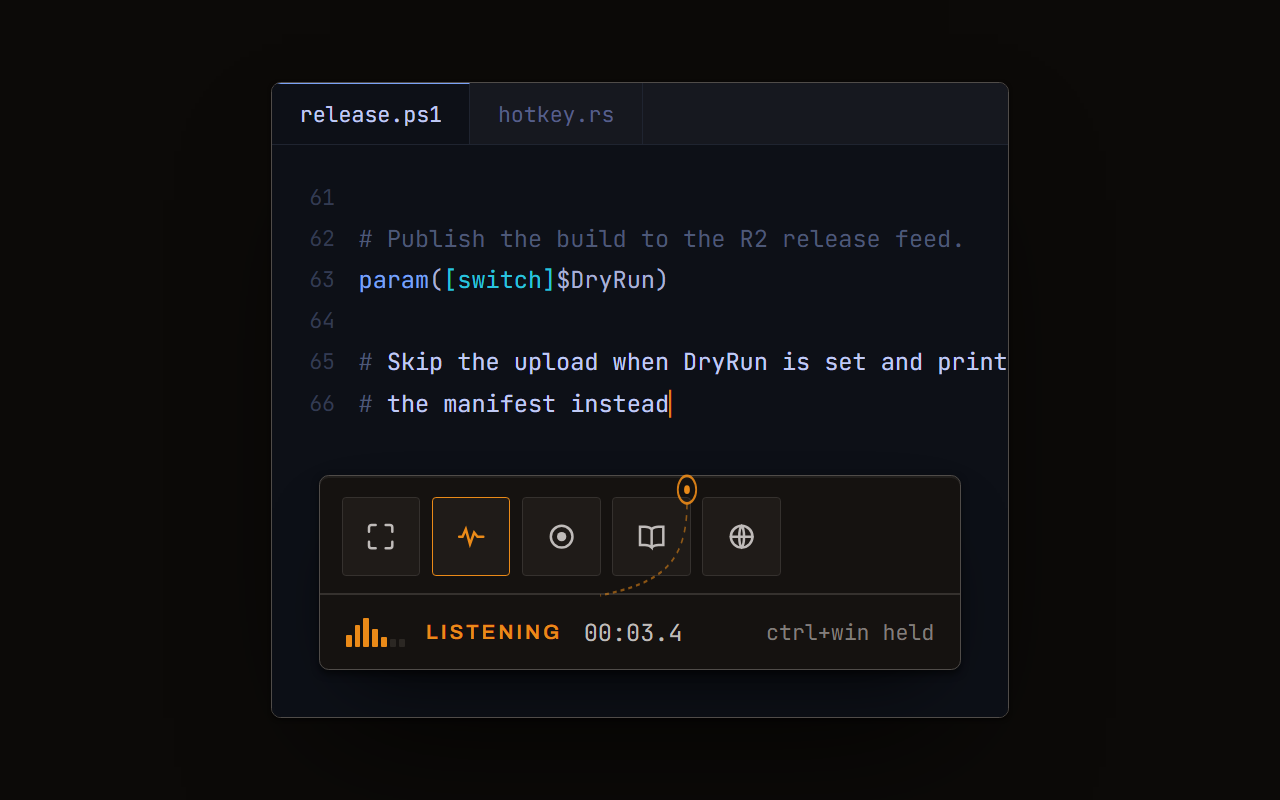
Dictation, where your cursor is
Hold a key, speak, release. Clean, punctuated text lands in whatever has focus, on your PC, your Mac and your phone, with your clipboard handed back.
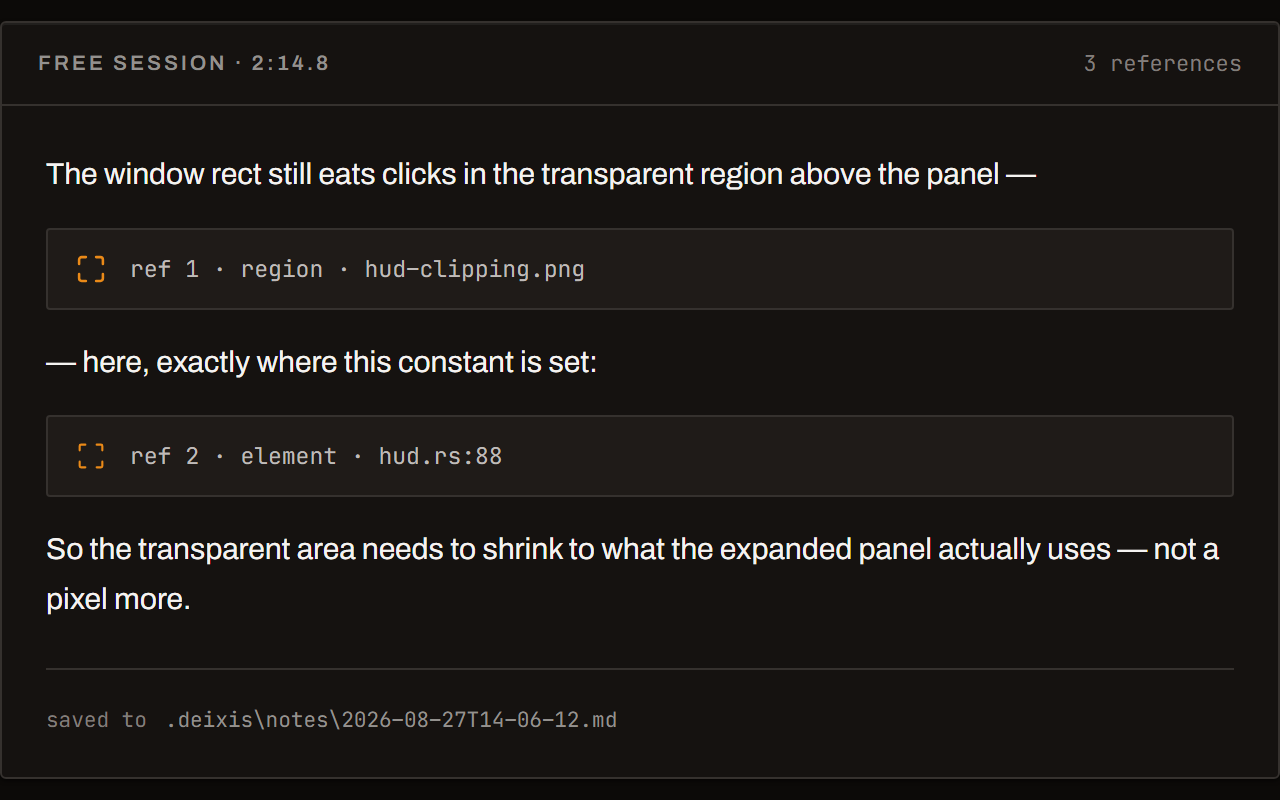
Free mode: talk and point
Narrate for as long as you like while you grab a region, pick a button on screen or take a selection. One note, what you said interleaved with what you pointed at, pasted where you finish and saved as Markdown.
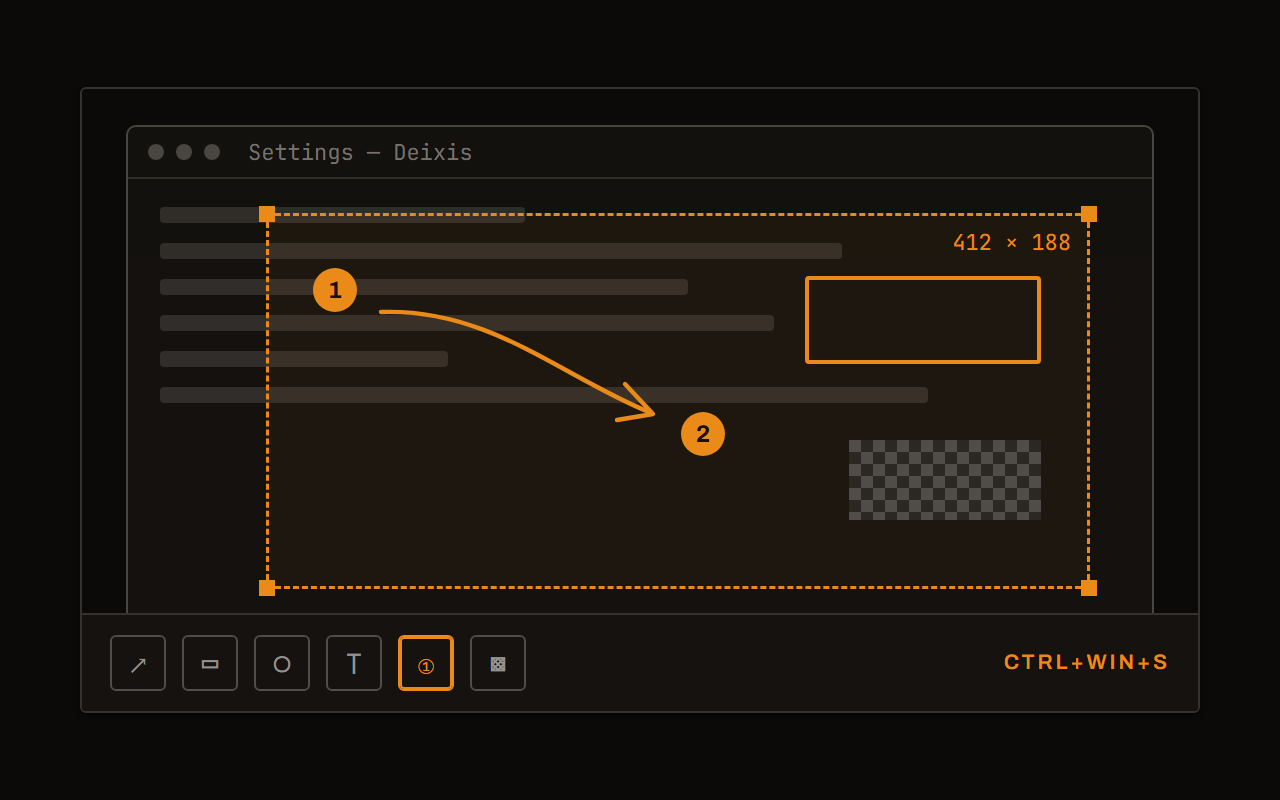
Screen grabs, annotated
Freeze every screen at the keypress, drag a region, add arrows, boxes, text and numbered steps, and pixelate what is private. Saved as a PNG that stays editable.
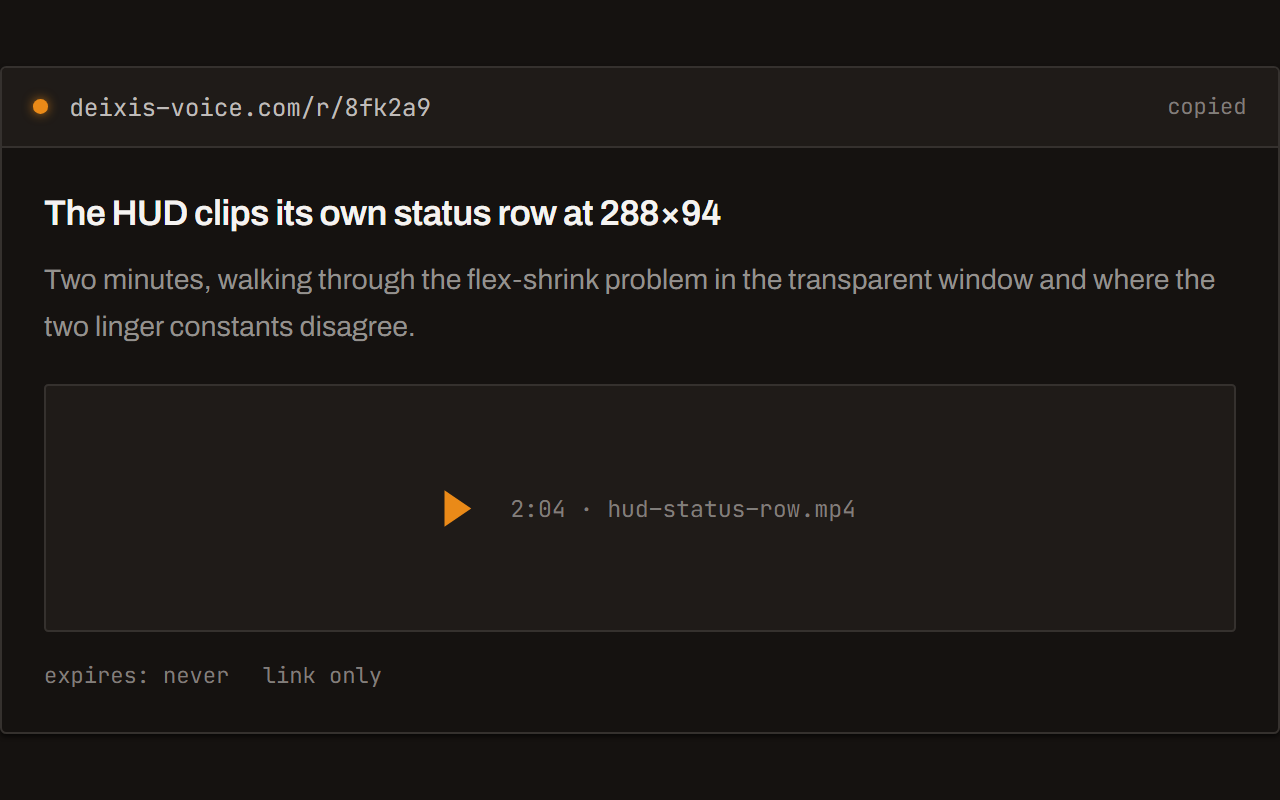
Screen recording, shared as a link
Record the screen with your narration. The recording writes itself up with a title, chapters and a summary, and from your Deixis account it shares as a link anyone can open without one. The Loom you can stop paying for.
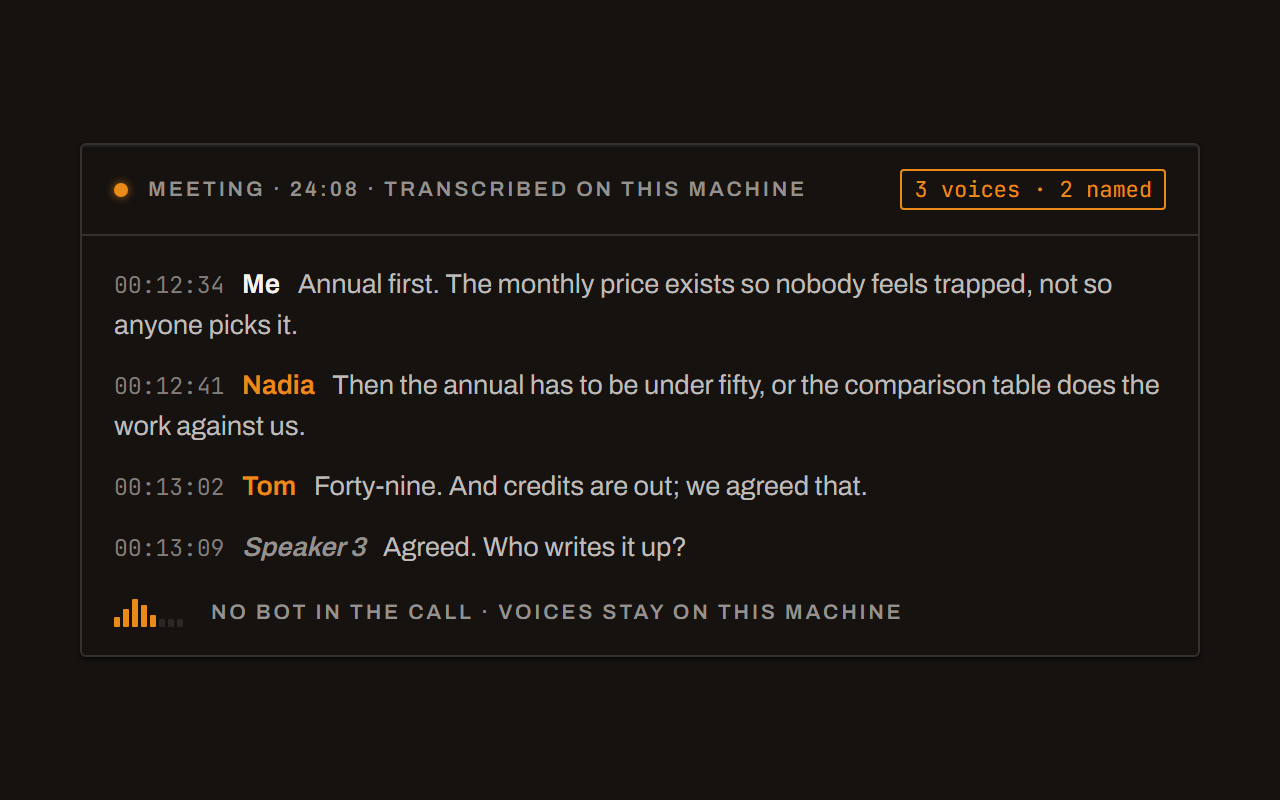
Meetings, no bot, names included
Your microphone and the other side, transcribed on your machine while the call runs. Deixis tells the voices apart and remembers the ones you name, and never uploads a voice.
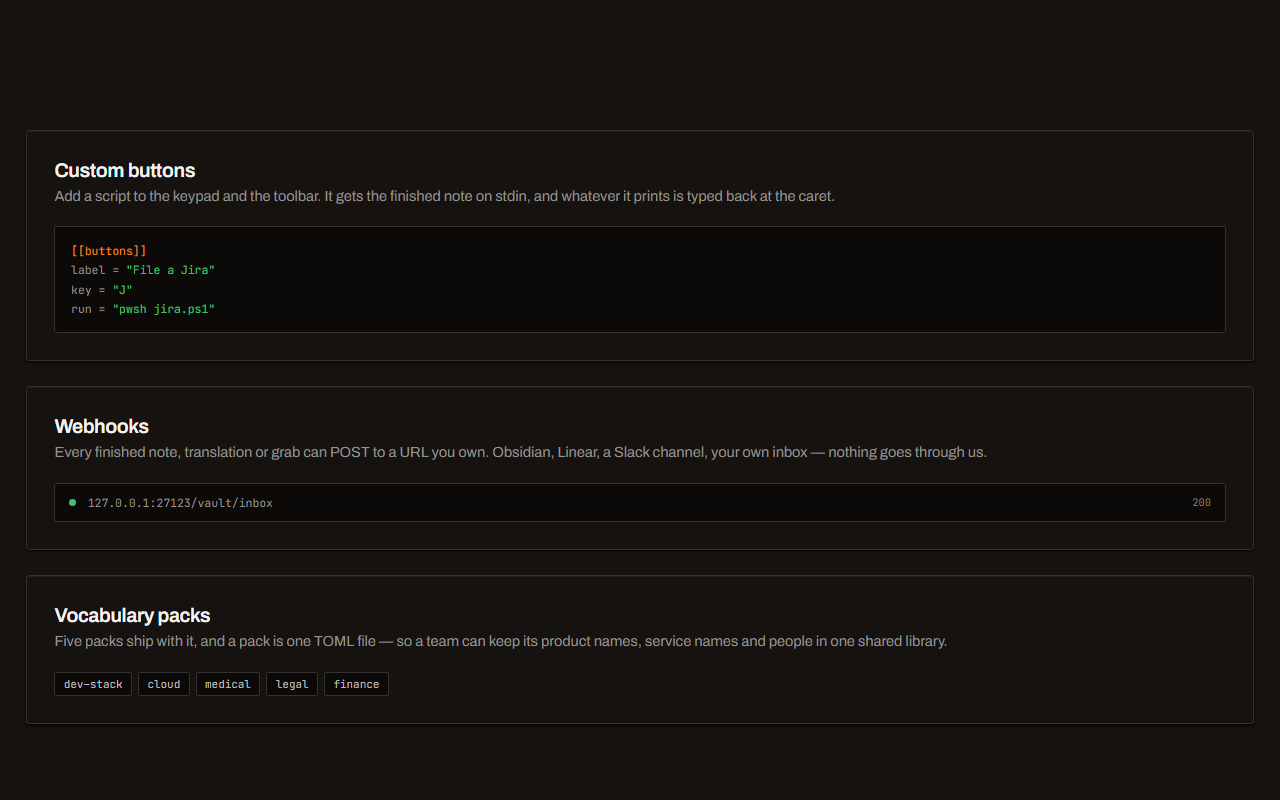
Your own buttons and workflows
Add a button to the palette: it gets the note on stdin and types back whatever it prints. Send finished notes to any URL you own. Chain steps: read the text off a screenshot, translate it, summarise it, post it.
Before you ask
Questions people search for
Is Parakeet v3 better than Whisper?
On this test, in German, Dutch, French, Italian, Spanish and Portuguese, Parakeet v3 got fewer words wrong than the multilingual Whisper small model, often far fewer. In English, Whisper small.en got fewer words wrong and spelled dictionary names right twice as often. This page compares those two models only, not Whisper's larger ones.
Which languages does Parakeet v3 support?
NVIDIA publishes Parakeet v3 for more European languages than these six, and its model card has the list. Deixis offers the six that it measured at fewer than one word in ten wrong, and English, which it keeps on Whisper.
Does Parakeet v3 run offline in Deixis?
Yes. It is a one-time download of about 670 MB the first time you choose one of the six languages. After that, the recognition runs on your own computer and dictation works with the internet off. The audio of a dictation never leaves the machine once its speech model is in, under any setting.
Will my speech to text be this fast?
Probably not exactly. The times are medians for the decode alone on a 12-core desktop processor. A laptop is slower, and the time you notice also includes recording and typing the text in. They are there to compare the two engines, not to promise a speed.
Can I repeat the test?
Yes. FLEURS is public, the clip choice is the 20 shortest plus 60 at random with seed 7, and the scoring is words wrong after lower-casing and dropping punctuation. Parakeet v3 ran through sherpa-onnx 2.0.1; your figures will differ a little with other software and hardware.
Keep reading
Related pages
Speech to text in seven languages, on your own computer
Deixis types in English, German, Dutch, French, Italian, Spanish and Portuguese, recognised on your own computer. What we measured, and what others say.
German speech to text that stays on your computer
German voice typing that runs on your own computer: hold a key, speak German, and the text lands at your cursor in any app. Measured, free, no account.
Here is every byte that leaves your machine, for each tool
Every byte Deixis sends off your machine in one table, and the same table filled in for other dictation tools from their own documentation, dated.
What you are downloading
This is Deixis, a desktop app for Windows.
The Download button hands you a signed Windows installer, Deixis_<version>_x64-setup.exe, published by Dappit — Windows names the publisher before it runs. There is no bundled extra software and no toolbar. Deixis needs no account to install, and none of what it does on your own PC is behind a sign-up. What it runs on.
It installs for your account alone, with no administrator prompt, and starts with Windows until you switch that off in Settings → Startup. On a PC without Microsoft’s WebView2 runtime, which Windows 11 already has, the installer fetches it from Microsoft. How to uninstall it · The licence · Privacy policy · Terms of service · support@deixis-voice.com
Hold a key. Speak. Keep working.
Deixis is free, needs no account, and runs on your own device. Everything on this page is in the current release.
v1.3.2 · 64‑bit Windows 10/11 on Intel or AMD · macOS 13 on Apple silicon · 51 MB · nothing else to install · also for Windows · Android on Google Play
Everything on this page about Deixis is from its documentation for the current release. Something out of date? Tell us.