The Windows voice typing alternative that works offline, on your own PC
Windows already has voice typing built in: press Win+H, talk, and text appears. It costs nothing
and it is a fair place to start. It also, in Microsoft's own words, uses online speech recognition
powered by Azure Speech services, and needs an internet connection to work at all. Every sentence
you dictate is sent to Microsoft to be turned into text. If that is fine for you and you never need
more than punctuation, keep it. If you want the same gesture with the recognition on your own
processor, plus a dictionary, cleanup and a few things Win+H does not do, this page is for you.
Deixis is one small installer for Windows 10 or 11 on an Intel or AMD processor with AVX2, and one
download of the speech model on first run. After that, hold Ctrl+Win, speak, release, and clean text is typed at your cursor in
whatever app has focus, with the clipboard put back afterwards. No account, no connection needed,
and everything that runs on your PC is free for good.
This page is honest in both directions. Windows voice typing wins on languages, on being already there, and on Microsoft maintaining it. Everywhere else, the case for Deixis is short and it starts with where your voice goes.
Why switch
What you gain, and what you give up
Why Deixis
- Your voice stays on your PC. Microsoft's privacy page says online speech recognition sends voice data to Microsoft to provide the service and create the transcription, and its voice typing page says the feature needs an internet connection. Deixis recognises speech inside the app, on your processor; the recording, the model and the transcript never leave the machine. So it works offline: dictation, hands-free notes, meeting recording and transcription, screen grabs and screen recording all run with the network off, where voice typing stops working the moment the connection does.
- One tool, on every device you own.
Win+Hlives on Windows and nowhere else. Deixis runs on Windows, Mac and Android, and as an iPhone keyboard in beta, with the same on-device speech recognition on each; your dictation audio never leaves any of them. On the iPhone it is a keyboard, on Android a floating microphone bubble that dictates into any app, and everything that runs on the device is free there too. - It learns your words. Microsoft's voice typing page lists settings for automatic punctuation, a
profanity filter, the microphone and the launcher, and nothing for adding a word of your own.
Deixis has a dictionary you add to without leaving what you are doing, select a word and press
Ctrl+Win+D, plus five vocabulary packs for software, finance, business, medicine and law, plus replacement rules for anything it keeps mishearing. - It cleans up what you said. Voice typing gives you the words and, if you switch it on, automatic punctuation. Deixis strips filler words, punctuates and cases the text with rules on your PC, and can hand a sentence to a language model when the rules are not enough, in Deixis's cloud, on your own machine, or with your own key, as often as you choose.
- It knows what you are typing into. A commit message, a chat reply and a ticket read differently. Deixis knows which app and which field the text is going into and punctuates accordingly, and the only context that ever leaves is the name of the app and the field, with your last utterance in that field so a name stays spelled the way you dictated it; never the window title, never a screenshot, and only if you turned cloud cleanup on.
- A hold, not a toggle.
Win+Hopens a listening bar you switch on and off. Deixis is hold to talk: holdCtrl+Win, say the sentence, let go, and it is typed. Double-tap for hands-free when you have a paragraph in you. - Meetings that know who is talking, grabs and recording, on the same key.
Ctrl+Win+Mrecords a meeting, your microphone and the other side, and transcribes it on your PC as it runs. You name the people in it, and voice identification tells the remote voices apart; once you have named a voice, Deixis recognises that person in later meetings, from a voiceprint that stays on your machine, is never uploaded, and can be deleted per person.Sfreezes the screen for a grab you can annotate with arrows, boxes, numbered steps or a blur.Vrecords the screen to a video, narrated when a microphone is set up for it. Voice typing types; that is all it does. - Everything is a file you own. Every note, transcript, grab and recording sits in one folder as ordinary files, and the history is yours to search and export. Microsoft's page describes no history for voice typing: what you said is typed, and that is the end of it.
Where Windows Voice Typing still wins
- It is already installed. Nothing to download, nothing to trust. Press
Win+Hon any Windows 10 or 11 PC with a microphone and an internet connection and it works. Deixis is one installer and one model download, which is still two more steps than none. - Forty-odd languages. Microsoft's support page lists voice typing languages from Bulgarian to Vietnamese, with several regional variants of English, Spanish, French, Portuguese and Chinese. Deixis ships English speech models only.
- Microsoft maintains it. It ships with Windows and is patched with Windows, and its page asks for nothing beyond Windows 10 or 11, a microphone and a connection. Deixis needs an Intel or AMD processor with AVX2, from 2013 or later, and has no build for Windows on ARM.
- Voice commands for editing. Microsoft's page documents commands such as "delete that" and "select that", and pressing keys by voice. Deixis is built around dictating and pointing rather than driving the cursor by voice.
What you get
More than dictation. One key, and everything behind it.
Hold the key and press a letter: free mode, a grab, a meeting, a recording, a translation, your own buttons. All of it on your own device, all of it free, none of it behind an account.
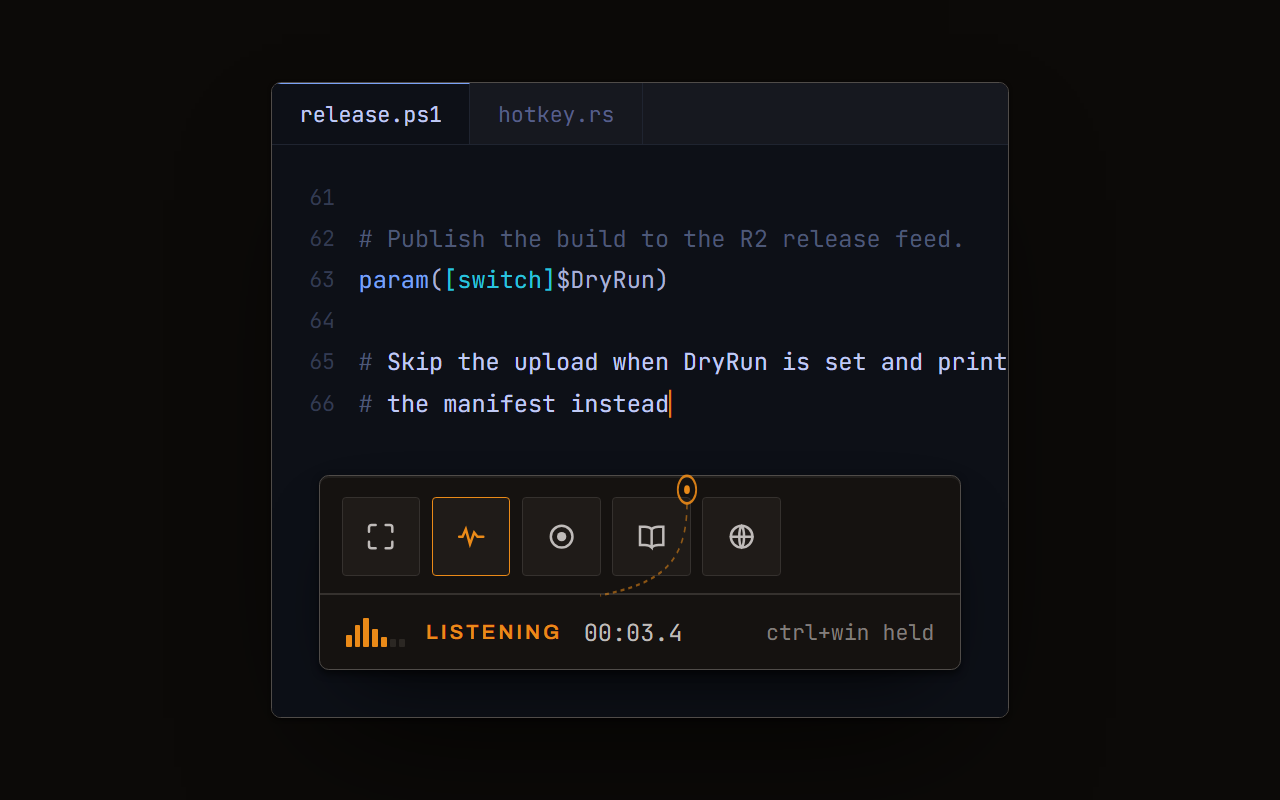
Dictation, where your cursor is
Hold a key, speak, release. Clean, punctuated text lands in whatever has focus, on your PC, your Mac and your phone, with your clipboard handed back.
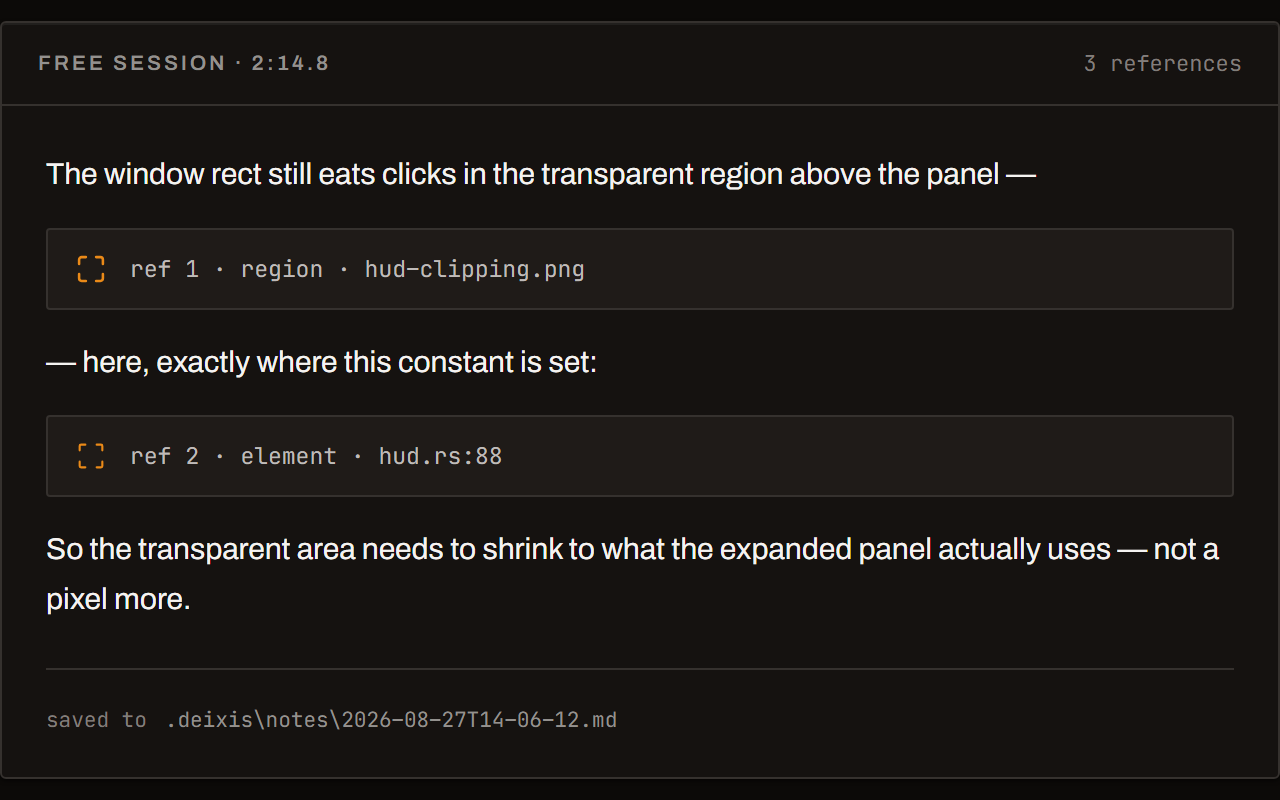
Free mode: talk and point
Narrate for as long as you like while you grab a region, pick a button on screen or take a selection. One note, what you said interleaved with what you pointed at, pasted where you finish and saved as Markdown.
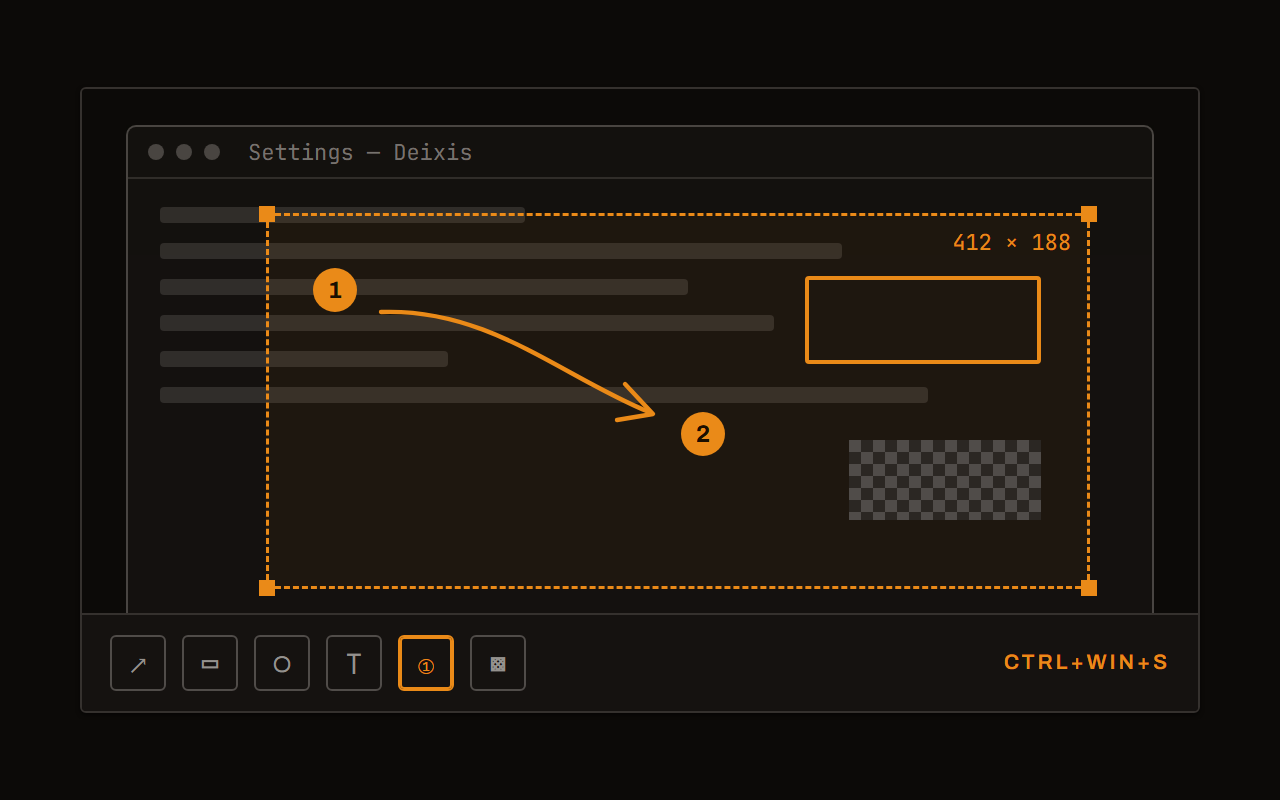
Screen grabs, annotated
Freeze every screen at the keypress, drag a region, add arrows, boxes, text and numbered steps, and pixelate what is private. Saved as a PNG that stays editable.
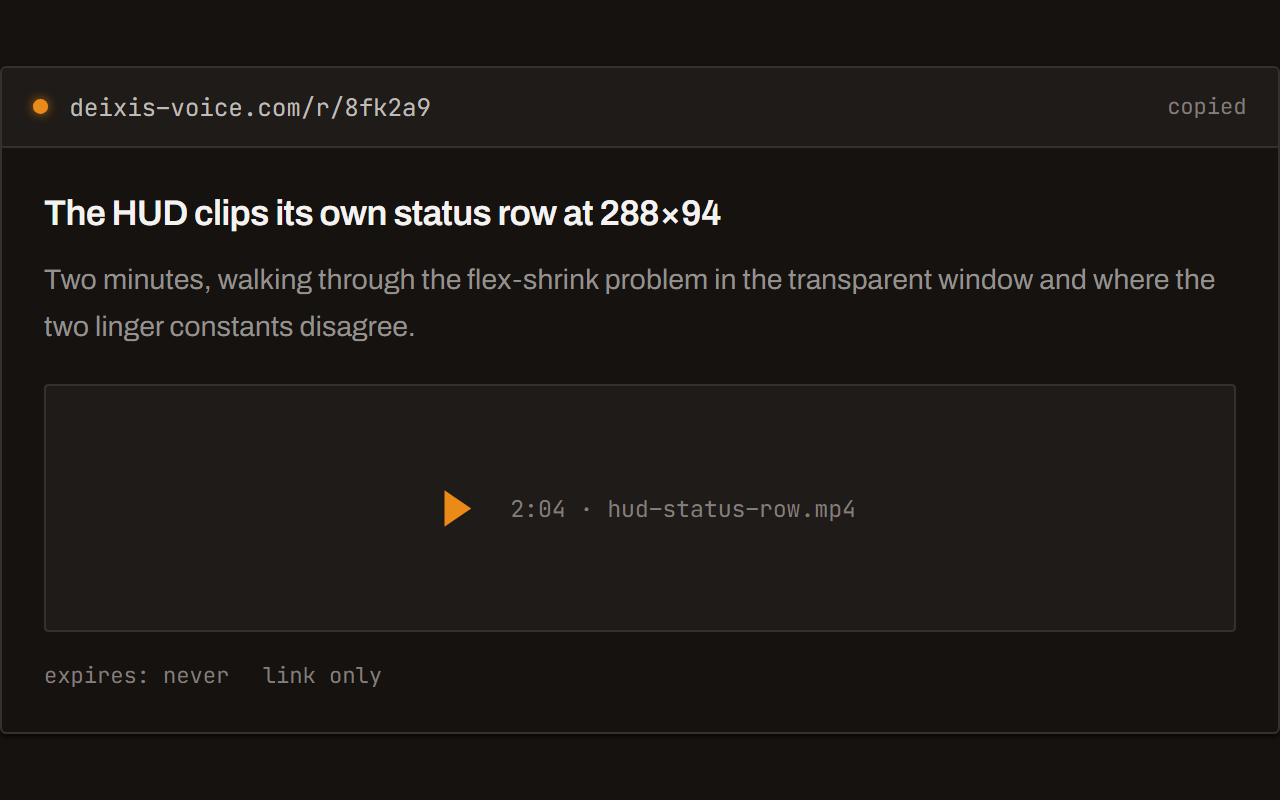
Screen recording, shared as a link
Record the screen with your narration. The recording writes itself up with a title, chapters and a summary, and from your Deixis account it shares as a link anyone can open without one. The Loom you can stop paying for.
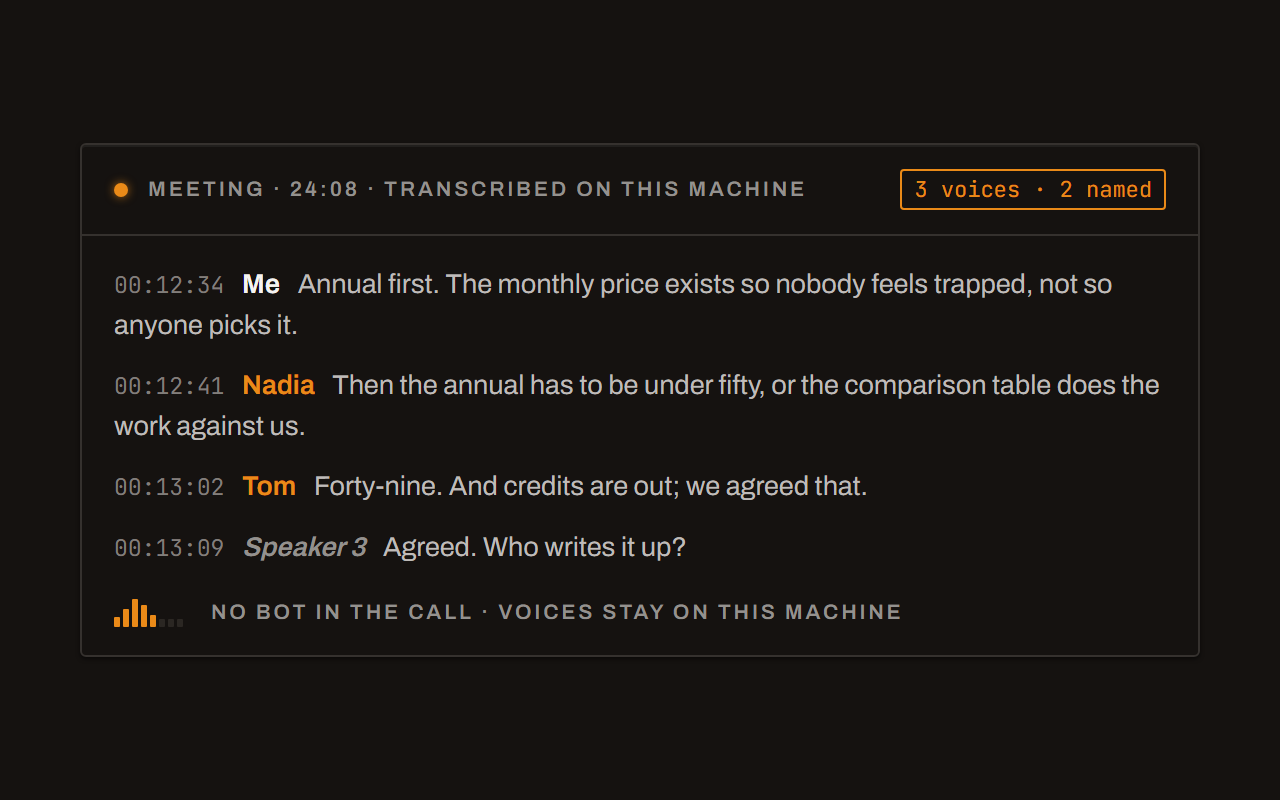
Meetings, no bot, names included
Your microphone and the other side, transcribed on your machine while the call runs. Deixis tells the voices apart and remembers the ones you name, and never uploads a voice.
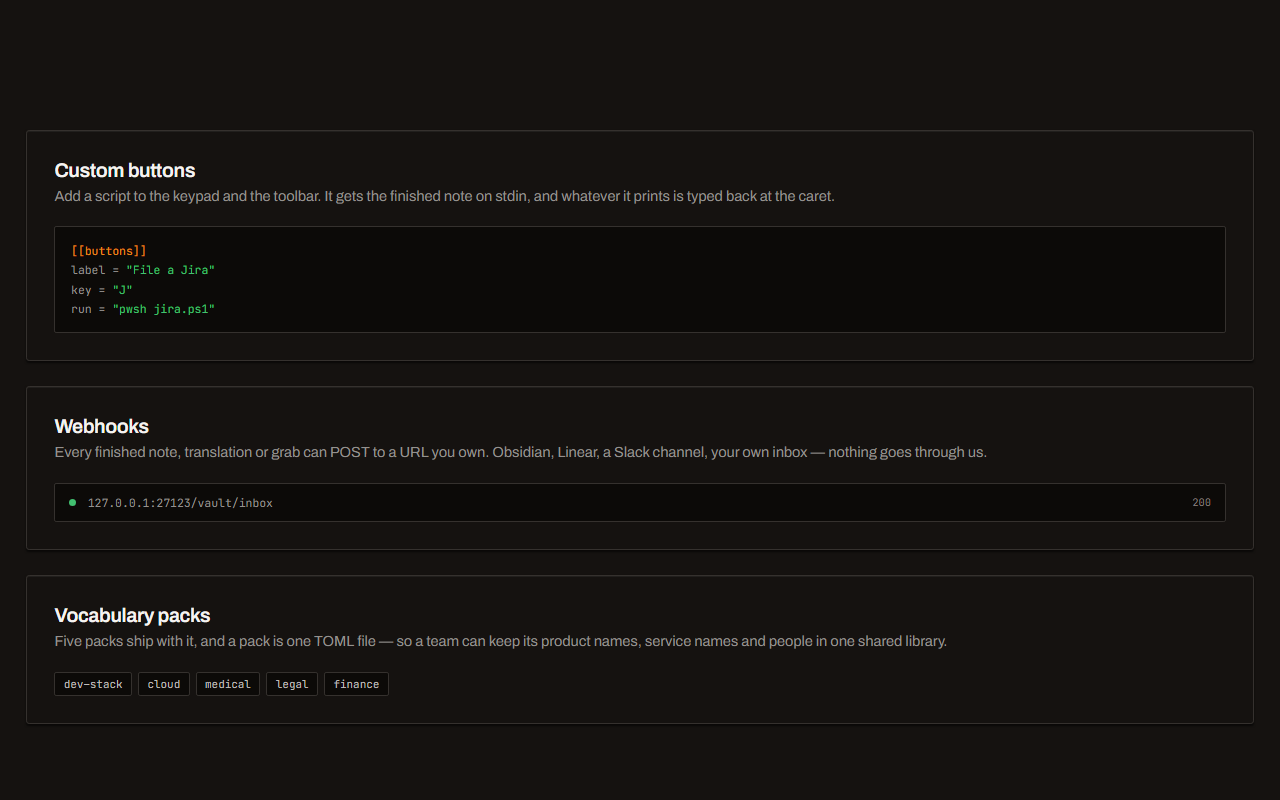
Your own buttons and workflows
Add a button to the palette: it gets the note on stdin and types back whatever it prints. Send finished notes to any URL you own. Chain steps: read the text off a screenshot, translate it, summarise it, post it.
Side by side
Windows Voice Typing and Deixis, side by side
| Row | Deixis | Windows Voice Typing |
|---|---|---|
| Runs on | Windows 10 and 11 (64-bit, on an Intel or AMD processor with AVX2: 2013 and later; no build for Windows on ARM), Mac (Apple Silicon) and Android (a dictation bubble in any app, plus meetings), with an iPhone keyboard in beta on TestFlight and not yet in the App Store. Meetings run on Windows and Android. One engine on all of them, and dictation audio never leaves the device. | Windows 11, Windows 10 |
| Speech recognition happens | On your own device, inside the app, on every platform. Dictation audio never leaves it; a meeting's, only if you turn on cloud processing on Android. | In the cloud |
| AI cleanup happens | On your device, with no provider at all. Or, if you want more, Deixis's cloud, your own Ollama, or your own key. Your choice, in one setting. | None |
| Leaves your machine | Text, and only once you switch a cloud feature on, plus, on Windows, one key you press to check your own Claude plan, and, on Android, a meeting's audio if you turn on cloud processing for meetings. Never a dictation's audio, never screenshots, never window titles. | Audio |
| Account needed | None, ever, for anything that runs on your device. The cloud extras have a seven-day trial you start with an email code. No card. | not documented |
| Price | Free forever for everything local, meetings included. Pro is $49 a year for the cloud extras with nothing to set up. | Free tier: included with Windows |
| Your transcripts live | In plain files, in one folder you own and can back up. Uninstall Deixis and every note is still readable. | not documented |
| Make it yours | Add your own buttons that run a script, send finished notes to any URL you own, and switch on vocabulary packs for your field. | Settings for automatic punctuation, a profanity filter, the default microphone and the launcher. Microsoft's page lists no way to add your own words, no custom commands and no integrations. |
Windows Voice Typing facts from its docs, its privacy policy, clips, dashboard, voiceaccess and troubleshooting, read on 5 September 2026. “Not documented” means those pages did not say.
Voice typing is the Win+H feature, and it is online only: Microsoft's support page says it uses online speech recognition powered by Azure Speech services and needs an internet connection. Microsoft's separate Voice access works offline, but in four languages only, and it controls the computer rather than dictating. Sharing voice clips with Microsoft is opt-in.
What leaves your machine, and what leaves theirs
Deixis publishes every byte it sends, as a table, because there is so little of it. Here is that table beside what Windows Voice Typing's own pages say.
| What | Deixis | Windows Voice Typing |
|---|---|---|
| Audio | A dictation's, never: recognition happens inside the app on your device, and the recording, the model and the transcript stay there. A meeting's, only if you turn on Deixis cloud processing for meetings on Android: its audio, in pieces, each its own request, and Deixis stores and logs none of itapi.deixis-voice.com, then Whisper on Cloudflare Workers AI · only on Android, after a meeting ends, with cloud processing switched on in Settings › Meetings — on Wi-Fi, or on mobile data only if you choose | Your voice. Voice typing uses online speech recognition, and Microsoft's privacy page says voice data is sent to Microsoft to provide the service and create the text transcription. Microsoft says it does not store, sample or listen to voice recordings without your permission.Microsoft's Azure Speech services · every time you dictate; an internet connection is required |
| The dictated text | The sentence you just dictated, your vocabulary, and your previous sentence in that fieldthe endpoint you chose · only with a cloud endpoint set, and by default only when the local rules are not enough | not documented |
| Context around the text | The names of the app and the field the text is going into. Never the window title, never a screenshot.the same endpoint · with that request | not documented |
| Telemetry and analytics | None. No account, no telemetry, no analytics, no crash reports. | Nothing unless you opt in to contributing voice clips. If you do, clips are stored de-identified, not associated with your Microsoft account or any other Microsoft ID, kept for up to two years, and may be reviewed by Microsoft employees and vendors to improve speech recognition.Microsoft · only if you turn on contributing voice clips |
| Update check | Nothing but the request; the version check happens on your PCapi.deixis-voice.com · every launch, and when you ask in Settings | not documented |
| Model download | Nothing but the requesthuggingface.co · once, when you press Download on first run | Nothing to download: voice typing recognises speech online rather than with a model on your PC, which is why it needs an internet connection.— · — |
| Account and sign-in | An email address, only if you choose to start the trial, plus the partner tag from a partner download link and the first partner website that connected to Deixis on this computer, if there are anythe Deixis endpoint · when you start the trial | not documented |
| Integrations | The finished note, and for a screenshot its file name, never the imagea URL you added yourself · on finish, only for destinations you added | not documented |
Before you switch
Before you switch
Who should not switch
If you dictate in a language other than English, keep voice typing: Microsoft's list is long and Deixis's speech models are English. If your PC is from before 2013, or a processor without the AVX2 instructions Deixis is compiled for, it will not start, and on Windows on ARM there is no build; voice typing asks for nothing beyond Windows 10 or 11. There is no Linux build either. If you only ever need a sentence or two, punctuated, and you are comfortable with it going to Microsoft's servers, the built-in feature is the right choice: it costs nothing, it is already there, and it asks nothing of you. And if you rely on voice commands to edit and move the cursor, that is not what Deixis is for.
Making the switch
Nothing to migrate: Microsoft's page describes no dictionary and no history to carry over. Here is what changes.
The key
Win+H becomes Ctrl+Win, held rather than toggled: hold, speak, release. Double-tap it for
hands-free mode, which listens until you double-tap again and then pastes the finished note. You
can rebind the chord in Settings if something else on your machine uses it. Voice typing keeps
working alongside; nothing is replaced or disabled.
The speech model
The installer is small. On first launch Deixis shows one Download button for the speech model, a file about the size of a short video, fetched once. Until it finishes there is no model and Deixis says so. Settings offers a second, larger model that is more accurate and slower to decode, swapped in without a restart.
Punctuation and cleanup
Voice typing's automatic punctuation becomes Deixis's rules, on by default and running on your PC: filler words dropped, sentences punctuated and cased. If you want a language model to polish the prose, Settings → Cleanup is one choice, Deixis's cloud, a model on your own machine, or your own key, and what leaves your PC for it is the short list in the table on this page.
Your words
The first thing worth doing. Select any word Deixis got wrong, press Ctrl+Win+D, and it is in your
dictionary. Switch on the vocabulary pack for your field. The dictionary is a plain file in your home
folder, so a list of names can go in all at once.
The rest
Ctrl+Win+M for a meeting, S for a screen grab, V for a screen recording, T to translate a
selection once you have given it a cloud endpoint, your own key or a model on your own machine.
All of it lands in one folder as files you can open with anything.
Before you ask
Questions people search for
Is Windows voice typing private?
Microsoft's privacy page says that online speech recognition, which voice typing uses, sends your voice data to Microsoft to provide the service and create the text, and that Microsoft does not store, sample or listen to recordings without your permission; contributing voice clips for people to review is a separate opt-in. So your voice is sent, and by default it is not kept. Deixis never sends it in the first place: recognition happens on your PC, under every setting.
Does Windows voice typing work offline?
No. Microsoft's support page says you need to be connected to the internet, because voice typing uses online speech recognition. Deixis recognises speech on your own processor, so it dictates, records and transcribes with no connection at all.
Can I add custom words to Windows voice typing?
Microsoft's voice typing page documents settings for automatic punctuation, a profanity filter, the microphone and the launcher, and no way to add your own vocabulary. Deixis has a dictionary you add to with one key press, five vocabulary packs, and replacement rules for words it keeps mishearing.
Why is Windows voice typing not working?
Microsoft's troubleshooting page points at the microphone: which one is selected, whether voice typing has permission to use it, its input level and the noise around you, and whether your language is on the supported list. Its voice typing page names the other requirement, an internet connection, because the recognition happens online. If that is the one you keep hitting, Deixis is the fix, because it needs none.
Is Deixis free like Windows voice typing?
Yes, for everything that runs on your PC: dictation, hands-free notes, the dictionary and all the vocabulary packs, screen grabs, screen recording and meetings, with no account and no cap. Pro, at $49 a year or $10 a month, adds the managed cloud extras; with your own provider key, those cost nothing from Deixis either.
What does Deixis send that voice typing does not?
Less: voice typing sends your voice to Microsoft every time you dictate, and Deixis sends nothing on its own except an update check and, when you open the Settings window, a check for an announcement from us — both of which carry only the request. Only if you switch on a cloud feature does text leave, and the full list, every byte, is in the table on this page.
Keep reading
Related pages
Best dictation software for Windows
Fifteen Windows dictation tools compared, every fact dated from the maker's own pages — including what our own tool cannot do. Read the disclosure.
Offline dictation on Windows
Dictation that works with no internet: speech recognition on your own device, free, no account. Which Windows speech-to-text tools genuinely run offline.
The Typeless alternative that never uploads your dictation
Typeless processes your voice on its cloud servers and needs a sign-in. Deixis recognises speech on your PC, Mac or phone, free, no account, no cap.
The Dragon alternative without the price tag
Dragon Professional has no price on its page and needs activation, a profile and 12 GB. Deixis dictates on your PC for free, with no account and no upload.
The Talon alternative, if all you want is to dictate
Talon is hands-free control of the whole computer, and right if you need that. If you only want to dictate, Deixis needs no scripts and no learning.
The Otter.ai alternative without the bot
Otter puts a bot in your call and your audio in its cloud, with minute limits. Deixis records both sides locally, names the voices, free, no account.
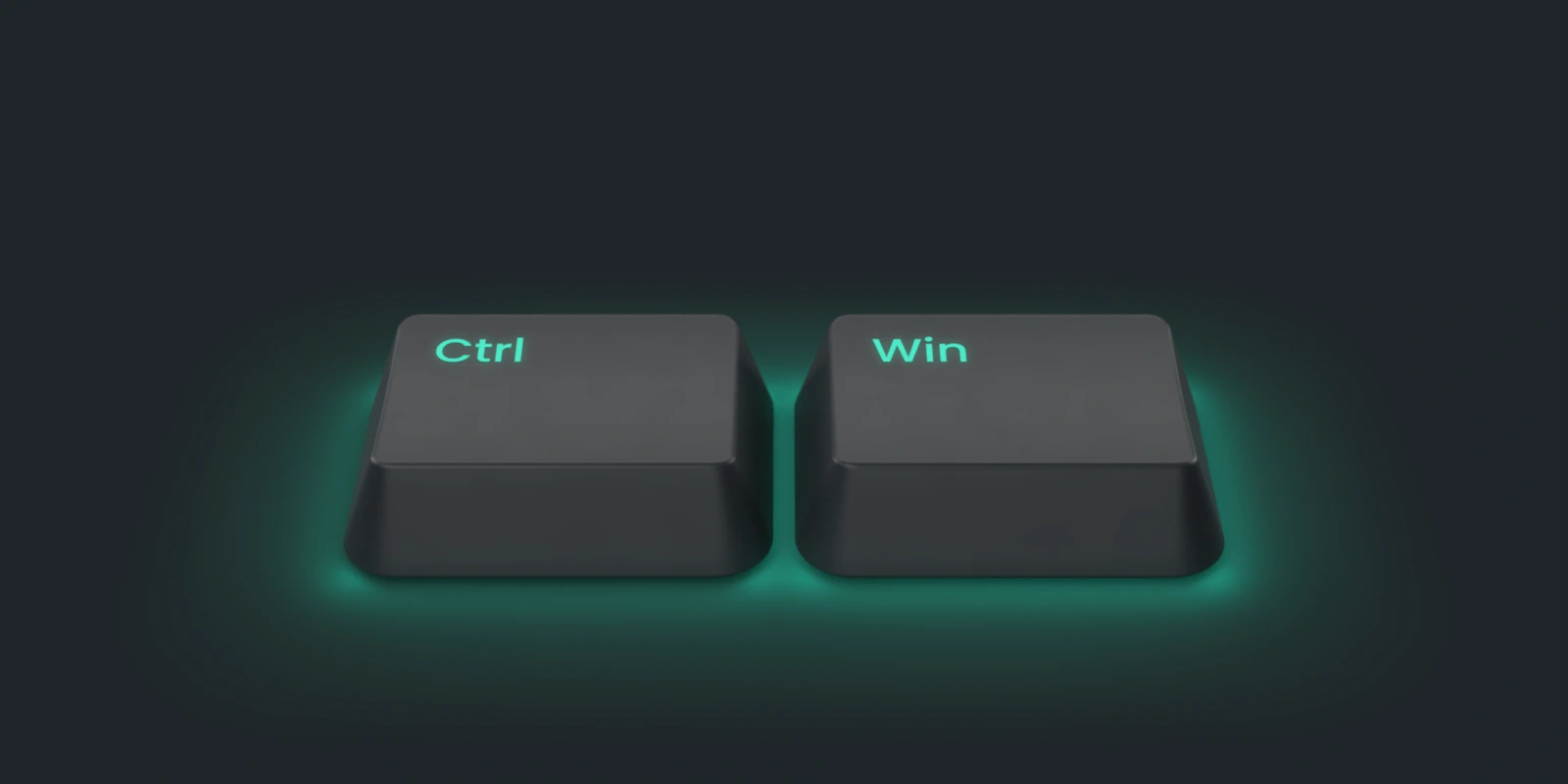
Hold a key. Speak. Keep working.
Deixis is free, needs no account, and runs on your own device. Everything on this page is in the current release.
v1.3.2 · 64‑bit Windows 10/11 on Intel or AMD · macOS 13 on Apple silicon · 51 MB · nothing else to install · also for Windows · Android on Google Play
Facts about Windows Voice Typing checked on against support.microsoft.com. Deixis facts are from its documentation for the current release. Something out of date? Tell us.