The Otter.ai alternative without the bot
Otter.ai and Deixis both turn a meeting into a transcript, and that is where the resemblance ends. Otter's Notetaker joins your Zoom, Google Meet or Microsoft Teams call as a guest participant named after you; its help centre says plainly that it "cannot join a meeting anonymously or without appearing to other participants". The audio goes to Otter's servers to be transcribed and stored, you sign in to use any of it, and the free plan is 300 minutes a month at 30 minutes a conversation.
Deixis records the meeting from your own PC. Press Ctrl+Win+M and it captures your microphone and
what your speakers are playing, so both sides of the call are transcribed, on this machine. The
remote voices are told apart on the device, you name them, and a named voice is recognised in the
next meeting, from a voiceprint that never leaves your machine. Nothing joins the call, nothing is
uploaded, nobody is asked to sign in, there is no minute count, and the transcript is a file in a
folder you own. It is free, meetings included, and stays free. Deixis meetings run on Windows and
Android; the Mac and the iPhone do not record meetings yet.
That trade has a cost, and the page says so below: Otter can attend a meeting you cannot, and it keeps every meeting in one shared workspace on the web. If those are the reasons you use Otter, keep it. If you use it because a transcript is useful and you would rather the recording never left your desk, this page is for you.
Otter.ai is also searched for as “Otter AI” or “Otter”.
Why switch
What you gain, and what you give up
Why Deixis
- Nothing joins the call. No guest participant, no name in the attendee list, no host setting to allow, and no bot to explain. Deixis records from your side of the call, on your PC, and the people you are talking to see exactly what they would see anyway.
- Who said what, without a bot and without uploading a single voice. Deixis tells the remote voices apart on your PC and lets you name them; once a voice has a name, that person is recognised in later meetings. The voiceprint is a mathematical fingerprint that stays on the machine, is never uploaded, and can be deleted per person. Otter names speakers too, from audio that has already gone to its servers.
- One tool, on every device you own. Windows, Mac and Android, and an iPhone keyboard in beta, with the same on-device speech recognition on each; your dictation audio never leaves any of them. On Android, meetings are recorded from the phone's microphone and transcribed on the phone as they run, and a meeting's audio leaves the phone only if you turn on Deixis cloud processing for meetings. And the same key that records a meeting dictates into any app with field-aware cleanup, grabs and annotates screenshots, and records the screen. Otter transcribes meetings.
- On a PC, the audio never leaves your machine. Otter's desktop app, even in its bot-free mode, "will automatically start uploading and transcribing the file once a connection is detected", to servers on Amazon Web Services in the United States. Deixis on a PC transcribes on your CPU; the recording and the transcript stay where they were made, always.
- No account, no plan, no minutes. Otter asks for a name, email, phone number and password, and the free plan stops at 300 minutes a month and 30 minutes a conversation. Deixis never asks you to sign in for anything local, and meeting recording and transcription are free with no ceiling.
- Nothing trains on your meetings. Otter's privacy policy allows training its AI on de-identified recordings and on transcriptions "which may contain Personal Information"; its security page says the data is de-identified first and not read by a human. Deixis has no model to train and no server to train it on.
- The transcript is a file you own, and notes are on your terms. Timestamped, readable, in a folder on your PC, beside the audio. Back it up, search it, drop it in a ticket, or uninstall Deixis and it is all still there; no export step and no retention policy to set. A summary with decisions and action items is the one optional step, and it only runs against an endpoint you configure: Deixis's cloud, a model on your own machine, or your own key. Until you set one, nothing about a meeting leaves.
- It works with headphones the way you would expect. Otter's help says a headset stops its browser recorder hearing the meeting. Deixis captures the system output directly, so wear headphones; it is the recommended way to keep the other side out of your own microphone.
Where Otter.ai still wins
- It can attend without you, or start on its own. Connect a Google or Microsoft calendar and the Notetaker joins every meeting with a video link, or only the ones you host or pick, and you can send it to a meeting you cannot make. On the desktop app, Otter can also detect a live Zoom, Teams, Meet or Slack huddle and record it automatically. Deixis records only where you are, when you press the key.
- A cloud workspace. Every meeting in one place on the web, with AI chat "within and across meetings", sharing, and unlimited storage on Pro. Deixis keeps each meeting as files in a folder on the device that recorded it, and has no cloud copy.
- A browser tab and a Chrome extension. Otter runs in a web browser and as a Chrome extension, with nothing to install, as well as in its apps. Deixis is a program you install on each device.
- Six languages. Otter's paid plans transcribe English, Spanish, French, German, Japanese and Chinese. Deixis's speech models are English models.
- It transcribes files you already have. Pro includes ten file imports a month, and a Dropbox folder that transcribes what you drop in. Deixis transcribes what it records and will not take a file you hand it.
- It posts to Slack and reads your calendar. Real-time updates to teammates in Slack, calendar sync from Google or Microsoft, and SSO, SCIM and an API on Enterprise. Deixis's integrations are webhooks to URLs you own.
What you get
More than dictation. One key, and everything behind it.
Hold the key and press a letter: free mode, a grab, a meeting, a recording, a translation, your own buttons. All of it on your own device, all of it free, none of it behind an account.
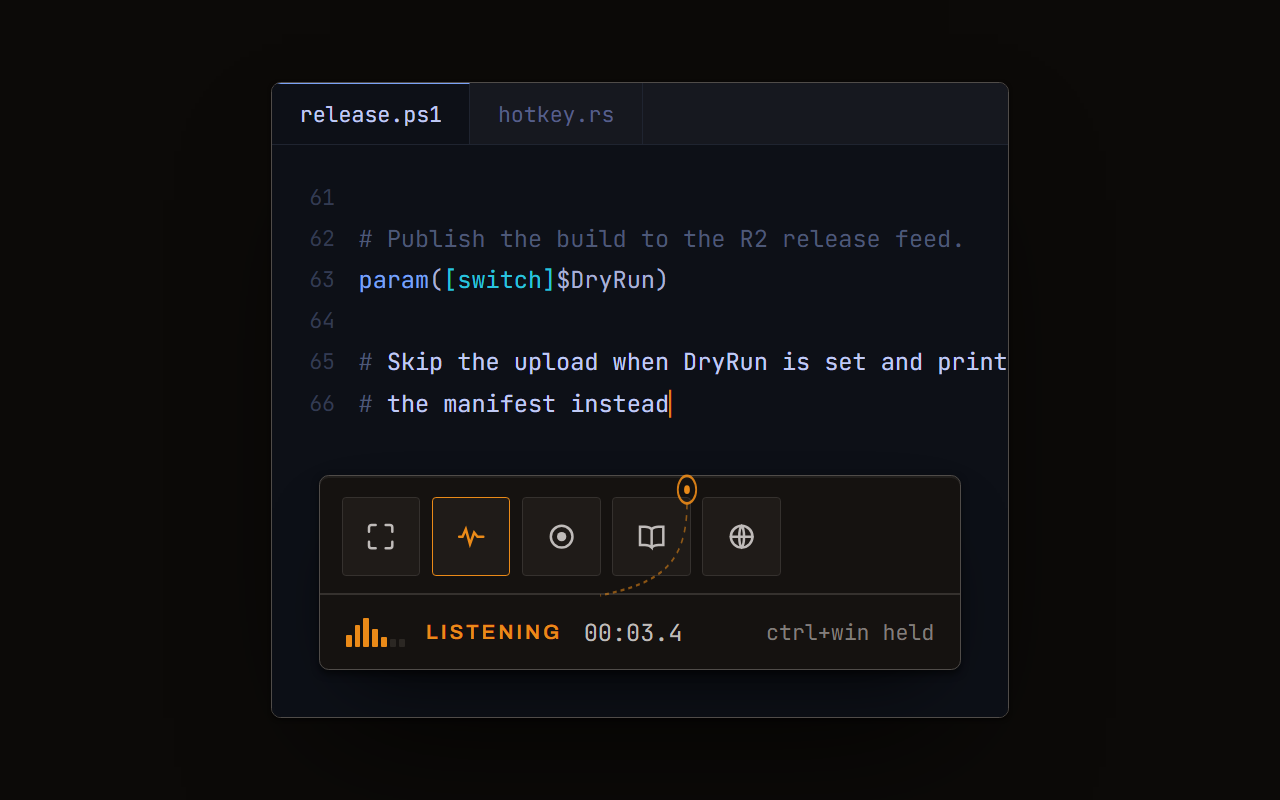
Dictation, where your cursor is
Hold a key, speak, release. Clean, punctuated text lands in whatever has focus, on your PC, your Mac and your phone, with your clipboard handed back.
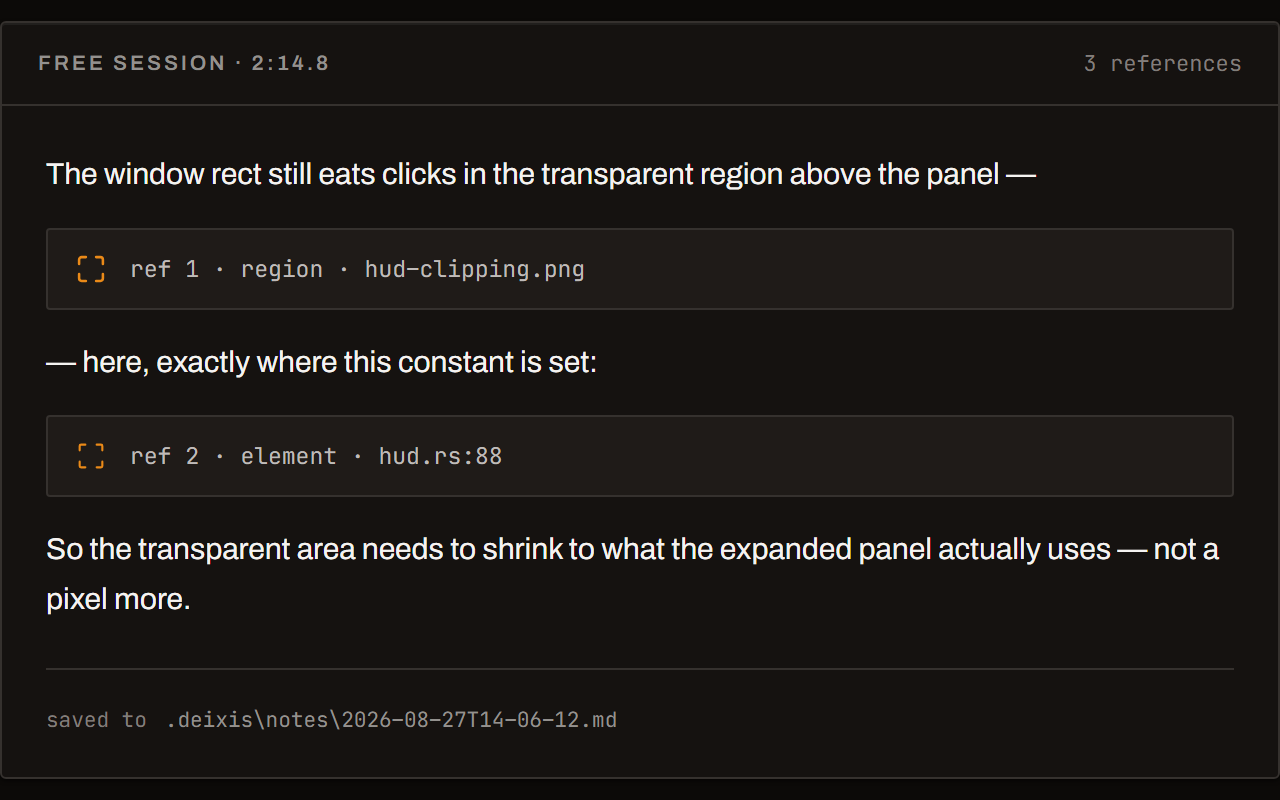
Free mode: talk and point
Narrate for as long as you like while you grab a region, pick a button on screen or take a selection. One note, what you said interleaved with what you pointed at, pasted where you finish and saved as Markdown.
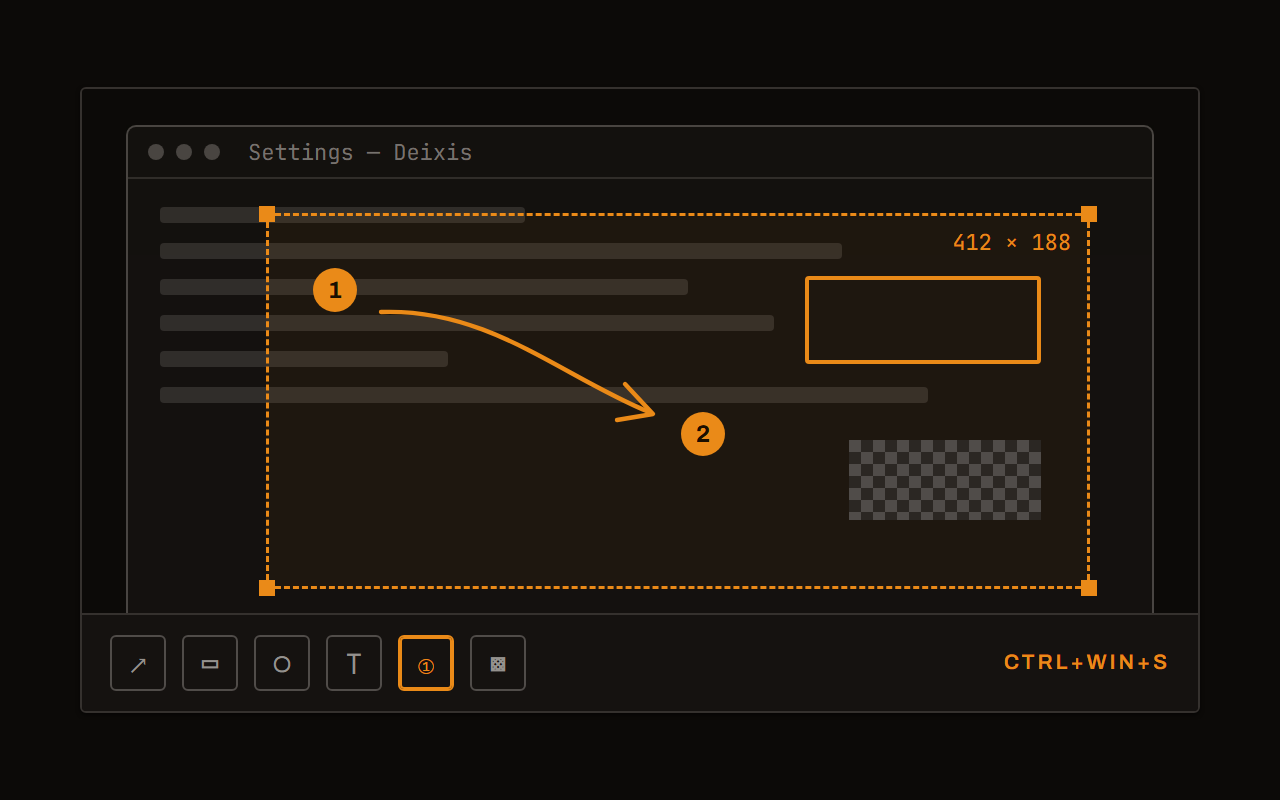
Screen grabs, annotated
Freeze every screen at the keypress, drag a region, add arrows, boxes, text and numbered steps, and pixelate what is private. Saved as a PNG that stays editable.
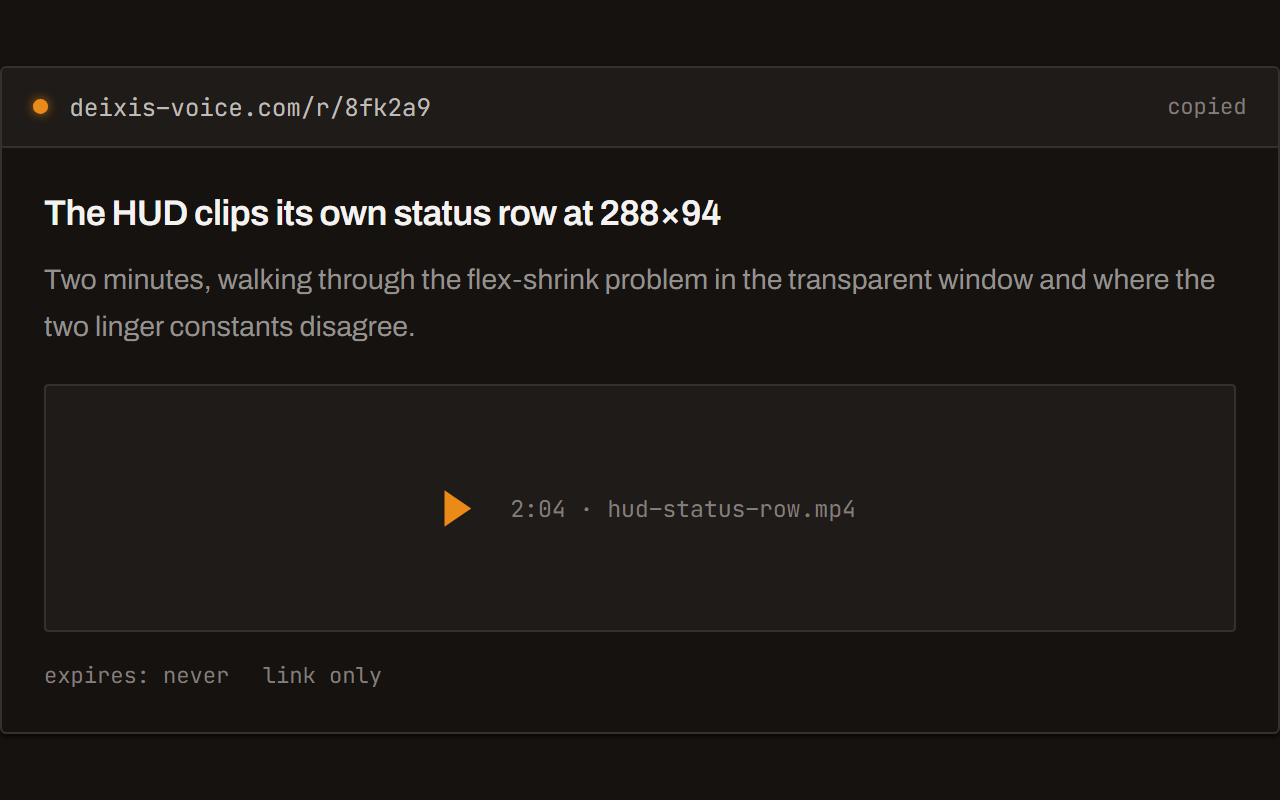
Screen recording, shared as a link
Record the screen with your narration. The recording writes itself up with a title, chapters and a summary, and from your Deixis account it shares as a link anyone can open without one. The Loom you can stop paying for.
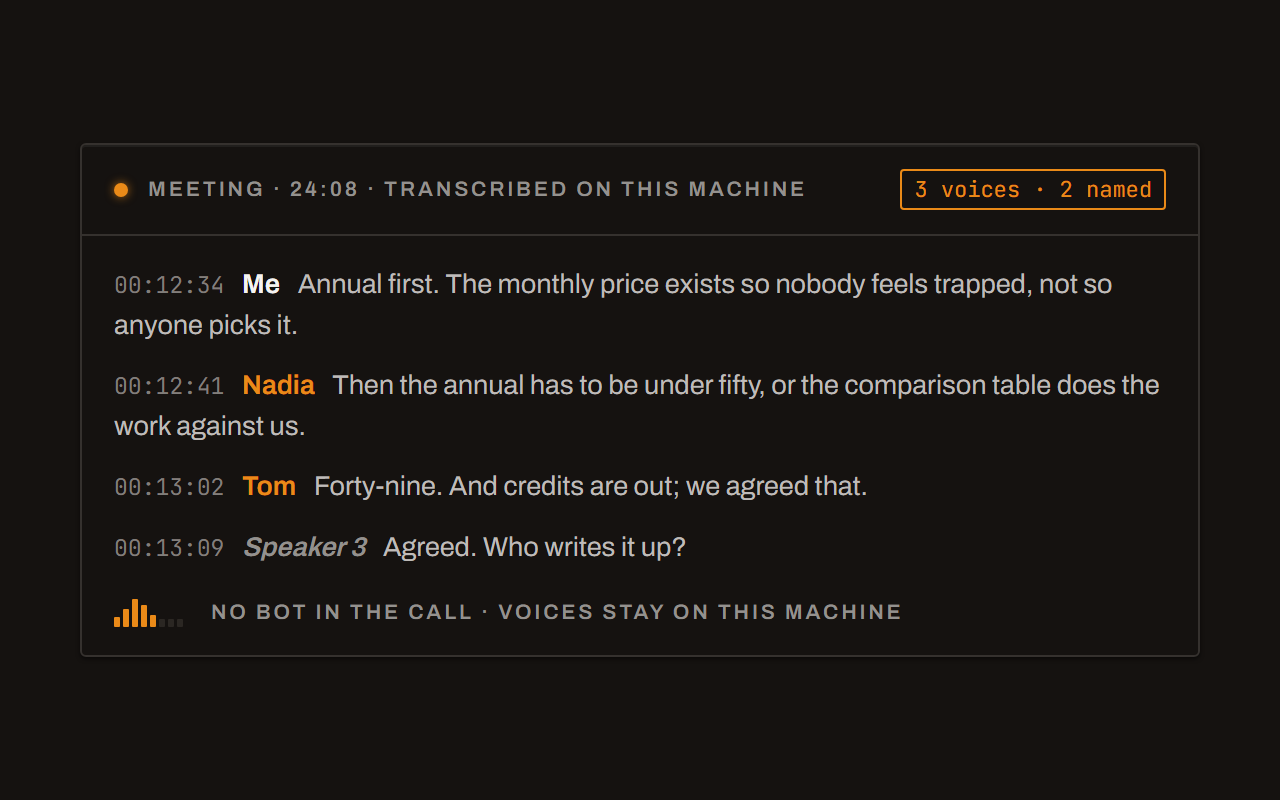
Meetings, no bot, names included
Your microphone and the other side, transcribed on your machine while the call runs. Deixis tells the voices apart and remembers the ones you name, and never uploads a voice.
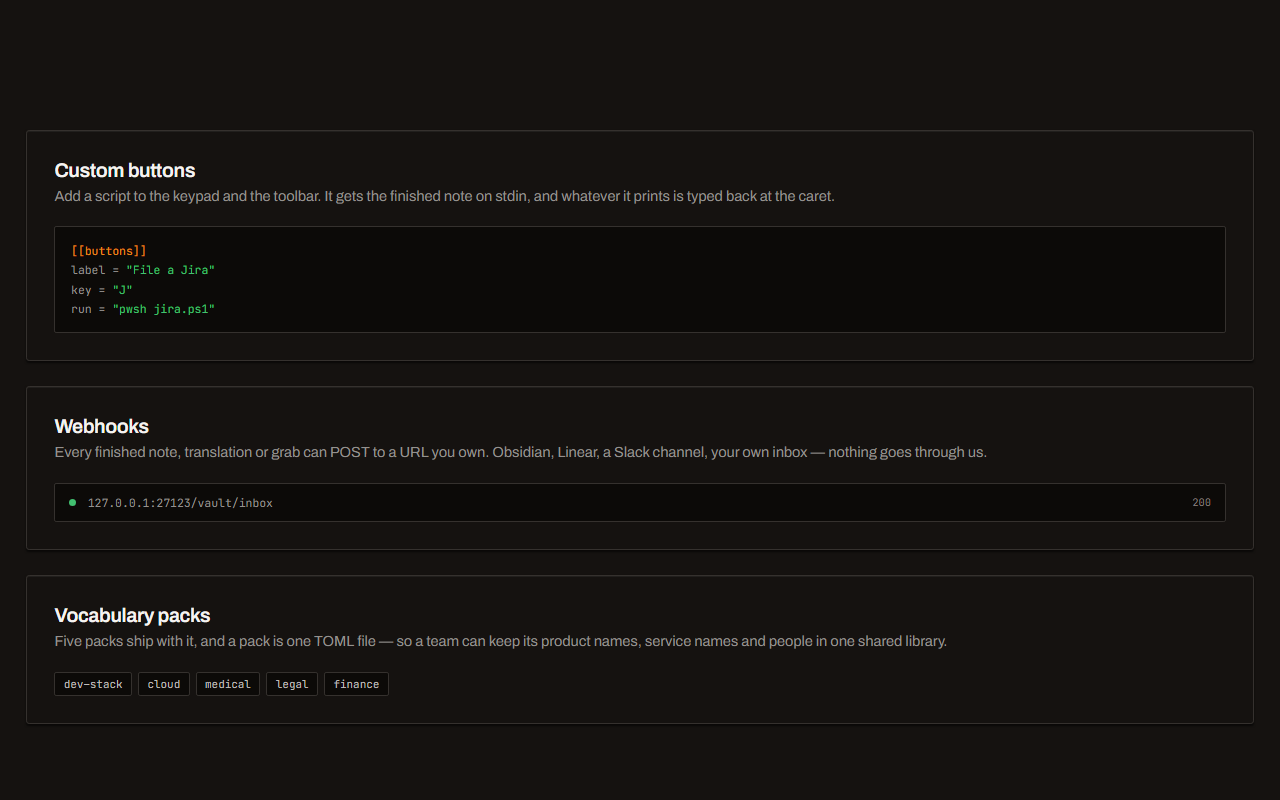
Your own buttons and workflows
Add a button to the palette: it gets the note on stdin and types back whatever it prints. Send finished notes to any URL you own. Chain steps: read the text off a screenshot, translate it, summarise it, post it.
Side by side
Otter.ai and Deixis, side by side
| Row | Deixis | Otter.ai |
|---|---|---|
| Runs on | Windows 10 and 11 (64-bit, on an Intel or AMD processor with AVX2: 2013 and later; no build for Windows on ARM), Mac (Apple Silicon) and Android (a dictation bubble in any app, plus meetings), with an iPhone keyboard in beta on TestFlight and not yet in the App Store. Meetings run on Windows and Android. One engine on all of them, and dictation audio never leaves the device. | Web browser, Windows and macOS (12.3 or later) desktop app, iOS 15 or later, Android 5.0 or later, Chrome extension |
| Speech recognition happens | On your own device, inside the app, on every platform. Dictation audio never leaves it; a meeting's, only if you turn on cloud processing on Android. | In the cloud |
| AI cleanup happens | On your device, with no provider at all. Or, if you want more, Deixis's cloud, your own Ollama, or your own key. Your choice, in one setting. | In the cloud |
| Leaves your machine | Text, and only once you switch a cloud feature on, plus, on Windows, one key you press to check your own Claude plan, and, on Android, a meeting's audio if you turn on cloud processing for meetings. Never a dictation's audio, never screenshots, never window titles. | Audio, text |
| Account needed | None, ever, for anything that runs on your device. The cloud extras have a seven-day trial you start with an email code. No card. | Required |
| Price | Free forever for everything local, meetings included. Pro is $49 a year for the cloud extras with nothing to set up. | Free tier: Basic: 300 transcription minutes a month, 30 minutes per conversation; $16.99 a month; Pro's annual plan is quoted as $8.33 a month billed annually; Business is $30 a month or $19.99 a month billed annually |
| Your transcripts live | In plain files, in one folder you own and can back up. Uninstall Deixis and every note is still readable. | In the cloud |
| Make it yours | Add your own buttons that run a script, send finished notes to any URL you own, and switch on vocabulary packs for your field. | Calendar auto-join for Zoom, Google Meet and Microsoft Teams; sharing to Slack; a Dropbox folder that transcribes what you drop in; SSO, SCIM and API access on Enterprise |
Otter.ai facts from otter.ai, its privacy policy, security, notetaker, autojoin, desktop, storage, requirements and apps, read on 5 September 2026. “Not documented” means those pages did not say.
Otter is a meeting-transcription service, not a dictation tool. Its Notetaker joins Zoom, Google Meet and Microsoft Teams calls as a visible participant named after you. The desktop app can record without the bot, but it still uploads the recording to Otter and needs you to sign in. Its privacy policy allows training its AI on de-identified recordings and transcripts.
What leaves your machine, and what leaves theirs
Deixis publishes every byte it sends, as a table, because there is so little of it. Here is that table beside what Otter.ai's own pages say.
| What | Deixis | Otter.ai |
|---|---|---|
| Audio | A dictation's, never: recognition happens inside the app on your device, and the recording, the model and the transcript stay there. A meeting's, only if you turn on Deixis cloud processing for meetings on Android: its audio, in pieces, each its own request, and Deixis stores and logs none of itapi.deixis-voice.com, then Whisper on Cloudflare Workers AI · only on Android, after a meeting ends, with cloud processing switched on in Settings › Meetings — on Wi-Fi, or on mobile data only if you choose | Your recordings: what the Notetaker hears in the call, or what the desktop app captures from your microphone and speakers. The desktop app says it 'will automatically start uploading and transcribing the file once a connection is detected'.Otter's servers on Amazon Web Services in the United States · every recording |
| The dictated text | The sentence you just dictated, your vocabulary, and your previous sentence in that fieldthe endpoint you chose · only with a cloud endpoint set, and by default only when the local rules are not enough | Transcripts, summaries, chat and anything you upload; de-identified recordings and transcriptions 'which may contain Personal Information' may be used to train Otter's AIOtter, and its AI and data-labelling service providers · always; summaries and AI chat run in Otter's cloud |
| Context around the text | The names of the app and the field the text is going into. Never the window title, never a screenshot.the same endpoint · with that request | Calendar events and contacts when you connect Google or Microsoft, and in virtual meetings the Notetaker 'may take automatic screenshots' of the meeting it is sitting in, not of your desktopOtter · with a calendar connected, and during meetings the bot records |
| Telemetry and analytics | None. No account, no telemetry, no analytics, no crash reports. | Usage and device information: your IP address, device identifiers and 'web beacons'Otter, its analytics providers and advertising partners · while you use the service |
| Update check | Nothing but the request; the version check happens on your PCapi.deixis-voice.com · every launch, and when you ask in Settings | not documented |
| Model download | Nothing but the requesthuggingface.co · once, when you press Download on first run | not documented |
| Account and sign-in | An email address, only if you choose to start the trial, plus the partner tag from a partner download link and the first partner website that connected to Deixis on this computer, if there are anythe Deixis endpoint · when you start the trial | Your name, email, phone number and a passwordOtter · at sign-up; the desktop app asks you to sign in before it records |
| Integrations | The finished note, and for a screenshot its file name, never the imagea URL you added yourself · on finish, only for destinations you added | Real-time updates to Slack, files you drop in an Otter folder on Dropbox, and calendar access for auto-jointhe service you connect · only once you connect one |
Before you switch
Before you switch
Who should not switch
Keep Otter if you need a recorder in meetings you do not attend, if your team lives in a shared workspace, if you record from a browser tab with nothing installed, or if your meetings happen on a Mac, where Deixis does not record them yet. Keep it for meetings in languages other than English; Deixis's speech models are English models. And keep it if you transcribe files you already have, because Deixis will not take one. On a PC, Deixis needs Windows 10 or 11 on an Intel or AMD processor with AVX2, from 2013 or later, with no build for Windows on ARM, and on a few audio devices it cannot capture the speaker output, in which case it records your microphone only and tells you so.
Making the switch
Moving from a service to a program means a few habits change. None of them take long.
Recording a meeting
Join the call however you normally do, then hold Ctrl+Win and press M, or use the tray menu or
the record button on the Meetings tab. Deixis records your microphone and, when it can, the system
output, so both sides are captured. Press again to stop. Wear headphones if you can: the speakers
otherwise play the other side into your own microphone. If loopback is unavailable on your device,
Deixis falls back to microphone only and says so rather than failing the meeting.
What you get
A folder per meeting on your PC: the audio, a transcript with timestamps, and a merged readable transcript with a speaker on every line. Your microphone is you; the voices on the other side are told apart on the device, and you can give each one a name, which Deixis recognises again in the next meeting. Every voiceprint stays on the machine and can be deleted per person. A crash costs at most a minute, because the audio is written a minute at a time.
Notes and action items
Summary, decisions, action items and open questions are written at the end of a meeting, and only if you have set a cleanup endpoint: Deixis's cloud, a model on your own machine, or your own provider key. With none set, the meeting still records and transcribes, and a Regenerate notes button retries later.
Dictation while a meeting runs
Dictation always wins. If you hold Ctrl+Win to type a reply during a long recording, the
transcription yields so push-to-talk stays fast.
Sending it somewhere
Webhook integrations post a finished note to any URL you own, and custom buttons can run a script of yours. Nothing is posted anywhere until you add a destination.
Before you ask
Questions people search for
Does Otter join meetings as a bot?
Yes: its Notetaker joins Zoom, Google Meet and Microsoft Teams calls as a guest participant, visible to everyone, under a name like "[Your Name]'s Notetaker (Otter.ai)". Otter's own help says it cannot join anonymously. Deixis records from your PC and nothing joins the call.
Can I record a Teams or Zoom meeting without a bot?
Yes. Deixis captures your microphone and your system audio at the same time, so both sides of a Teams, Zoom or Meet call are transcribed on your PC without anything joining the meeting. Otter's desktop app also records without its bot, but it still uploads the audio to Otter to transcribe.
Is Otter free?
There is a free plan: 300 transcription minutes a month, 30 minutes per conversation, with an account. Pro was $16.99 a month, or $8.33 a month billed annually, when we checked. Deixis meeting recording and transcription are free with no minute limit and no account; Pro at $49 a year covers only the optional cloud extras such as generated notes.
Does Otter use my recordings to train its AI?
Its privacy policy says it may train its own AI on de-identified audio recordings and on transcriptions, and its security page says recordings and transcripts are de-identified first and not manually reviewed by a human. Deixis has no cloud transcription, so there is nothing of yours on a server to train on.
Does Deixis identify who is speaking?
Yes, on your PC. Your microphone is you, and the voices on the other side of the call are told apart on the device by voice identification; name one and Deixis recognises that person in later meetings. The voiceprint is a mathematical fingerprint that stays on the machine, is never uploaded, and can be deleted per person. Otter identifies speakers too, from audio it has already uploaded to its servers.
Where are my Deixis meeting transcripts stored?
In a folder per meeting on your PC, as plain files: the audio, the per-side transcripts with timestamps, the merged transcript, and the notes if you generated them. There is no cloud copy unless you send one somewhere yourself.
Keep reading
Related pages
Best dictation software for Windows
Fifteen Windows dictation tools compared, every fact dated from the maker's own pages — including what our own tool cannot do. Read the disclosure.
Offline dictation on Windows
Dictation that works with no internet: speech recognition on your own device, free, no account. Which Windows speech-to-text tools genuinely run offline.
The Whisperstream alternative that is free, and does more than dictate
Both dictate on your PC, no upload, no account. Deixis is free, knows which field you are in, records meetings and the screen, and runs on Mac and phone.
The Handy alternative that does more than fill a text box
Handy and Deixis both dictate on your own computer, free, with no account. Deixis also knows the field you type in, records meetings and runs on Android.
The OpenWhispr alternative with no cloud switch to get wrong
OpenWhispr is open source and goes local or cloud. The Deixis app recognises only on your PC, Mac or phone: free, no account, no switch to get wrong.
The Wispr Flow alternative that keeps your voice on your PC
Wispr Flow transcribes in the cloud and needs an account. Deixis recognises speech on your PC, Mac or phone, free, no sign-in, no dictation audio sent.
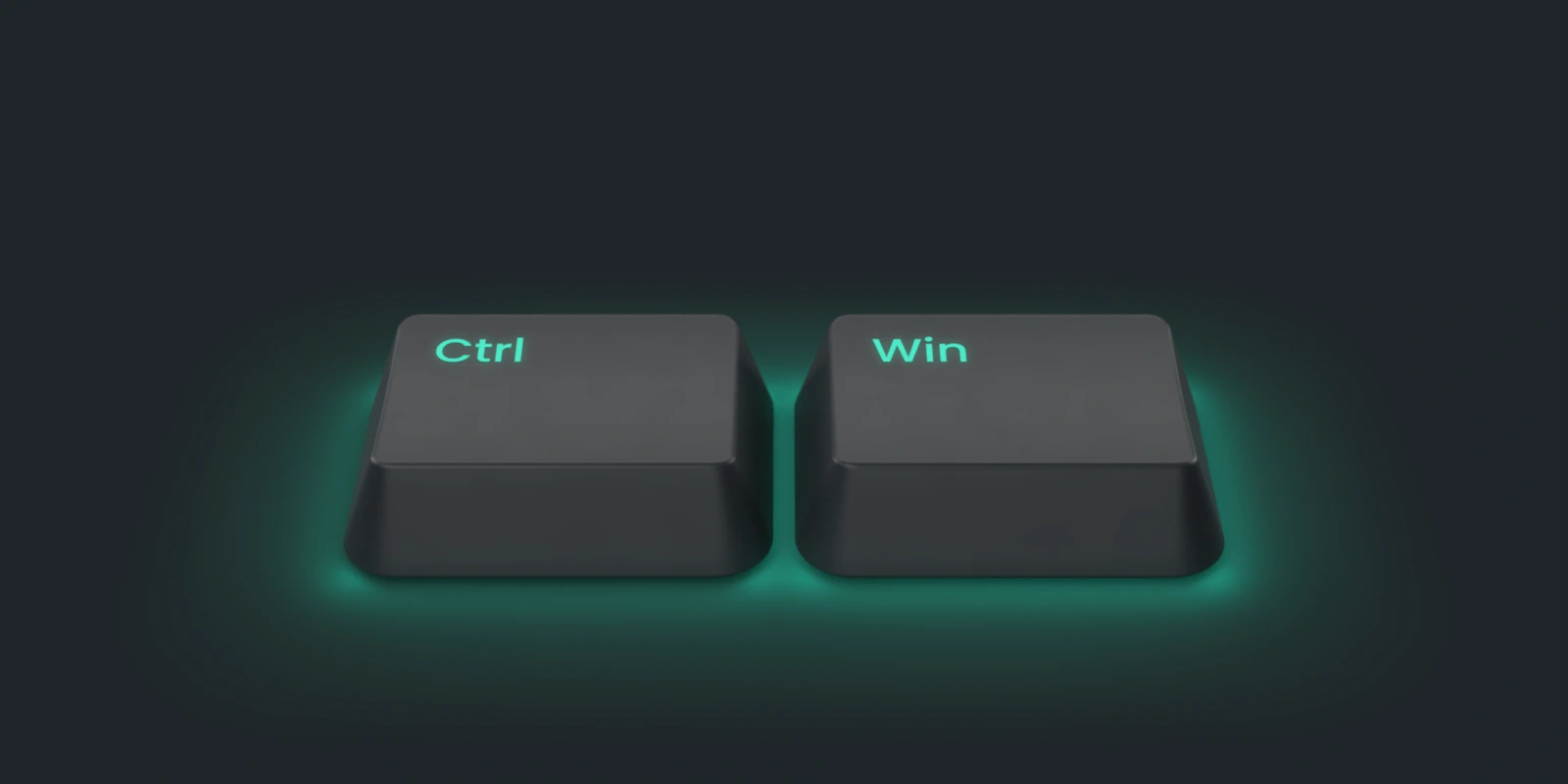
Hold a key. Speak. Keep working.
Deixis is free, needs no account, and runs on your own device. Everything on this page is in the current release.
v1.3.2 · 64‑bit Windows 10/11 on Intel or AMD · macOS 13 on Apple silicon · 51 MB · nothing else to install · also for Windows · Android on Google Play
Facts about Otter.ai checked on against otter.ai. Deixis facts are from its documentation for the current release. Something out of date? Tell us.