The Handy alternative that does more than fill a text box
Deixis is a Handy alternative that keeps what Handy gets right, speech recognised on your own computer, free, with no account, and adds what Handy leaves out on purpose: cleanup that knows which field you are typing into, a vocabulary that steers recognition, meetings recorded from both sides of the call, screen grabs, and an app on your phone. Handy is free and open source under the MIT licence, and runs on Windows, macOS and Linux; Deixis is free for everything that runs on your device too, but it is not open source.
Handy is a good program, and if you are choosing between it and a cloud dictation service, choose Handy. Its privacy policy says speech recognition runs on your device, it needs no account, and it carries no user-tracking telemetry. Its creator says plainly that it is not trying to be the best speech-to-text app but "the most forkable one", and its home page sums it up as one tool, one job: transcribe what you say and put it into a text box. That is the real difference. Deixis does the same job with the same hold-a-key gesture, then reads where the words are going, records your meetings on your PC, grabs and annotates the screen, records it, and dictates on Android.
Handy wins real things back, and the list is below: dozens of languages, Linux, Intel Macs and Windows on ARM, a choice of models with graphics-card speed, and source you can read and change. If you dictate in French or you live on Linux, stay with Handy. Otherwise, read on.
Why switch
What you gain, and what you give up
Why Deixis
- Cleanup that knows where the words are going, with nothing to set up. A commit message, a chat reply and an email are punctuated differently, and Deixis does that by itself because it knows which app and which field the text is going into. Out of the box, rules on your PC drop filler words, apply your dictionary and close the sentence. Add a language model, through Deixis Pro with nothing to configure, your own key, or a model server on your machine, and it steps in when rules are not enough. Only the names of the app and the field ride along, never the window title and never a screenshot. In Handy, cleanup by a language model is an experimental feature you switch on, point at a provider, give a key and a prompt, and trigger with a separate shortcut; its post-processing guide describes a prompt wrapped around the transcript and nothing about which app you are in.
- Your words heard right the first time. Handy's custom words correct similar-sounding words
after recognition, and its own docs call the feature "very imperfect", pointing you at
post-processing instead. Deixis puts your terms into the speech model's prompt, so a product name
or a colleague's surname is heard correctly in the first place, keeps replacement rules for the
rest, and ships five vocabulary packs, for software, finance, business, medicine and law. Select a
word anywhere, press
Ctrl+Win+D, and it is in. - Meetings, from both sides of the call. Handy's FAQ says it transcribes microphone input only,
not system audio or video calls, and advises keeping recordings under three to five minutes.
Ctrl+Win+Mrecords your microphone and what your speakers play, transcribes both on your PC as the meeting runs, and writes a timestamped transcript to a folder, an hour-long call included. The remote voices are told apart on the device; name one and it is recognised in later meetings, from a voiceprint that stays on your machine, is never uploaded and can be deleted per person. No bot joins, and nothing uploads. Deixis meetings run on Windows and on Android. - Screenshots, screen recording, and talking while you point.
Ctrl+Win+Sfreezes the screen, you drag a region and add arrows, boxes, numbered steps or a pixelated redaction, and the PNG stays re-editable.Ctrl+Win+Vrecords the screen to a video, narrated when a microphone is set up for it. Free mode lets you talk for as long as you like while you grab a region, pick an element or take your selection, and hands you one note that interleaves what you said with what you pointed at. Handy, by its own description, does one job, and this is not it. - On your phone as well. Deixis runs on Android, as a floating microphone bubble that dictates into any app and records meetings, and on the iPhone as a keyboard in beta, with the same on-device recognition. Handy's downloads are for Windows, macOS and Linux only.
- Buttons and webhooks. Custom buttons on Windows run a script of yours or post to a URL you own, and can type the result back at the caret; chains string steps together. Handy can be driven from the command line, and on Linux it can hand each transcript to a script of yours in place of pasting it.
Where Handy still wins
- Source you can read, build and change. Handy is MIT-licensed, and its about page says the goal is to be forkable: take it, change it, and build something of your own on it. Deixis is proprietary. If your policy is open source or nothing, that settles it.
- Many languages, not one. Its models page lists Whisper models for 99-plus languages, Parakeet V3 for 25 European languages with automatic detection, and other models for Russian, Taiwanese Mandarin, Chinese, Japanese, Korean and Cantonese. Most of its Whisper models can also translate what you say into English, and the interface itself comes in 18-plus languages. Deixis's speech models are English models.
- Linux. Handy ships for Linux on x64 and ARM, as an AppImage, a .deb and an .rpm, with command-line flags and signals so a tiling window manager such as Hyprland or sway can drive it; its own README calls Wayland support limited. Deixis has no Linux build.
- More kinds of computer. Its download page carries an installer for Windows on ARM and a disk image for Intel Macs. Deixis needs a 64-bit Windows PC with an Intel or AMD processor with AVX2, from 2013 or later, and has no build for Windows on ARM; on a Mac it needs Apple Silicon.
- A choice of models, and your graphics card. Handy offers Parakeet, Whisper, Moonshine, Canary, SenseVoice and GigaAM models, from about 31 MB to 1.6 GB, plus any Whisper model you drop into its folder. Its Whisper models use the graphics card automatically, through Metal on a Mac and Vulkan on Windows and Linux. Deixis offers two English Whisper models, run on the processor.
- Cleanup prompts you write yourself. Handy's post-processing, an experimental feature with a shortcut of its own, runs the transcript through your prompt on OpenAI, Anthropic, OpenRouter, Groq, Cerebras, Z.AI, Apple Intelligence on an Apple Silicon Mac with macOS 26, or any OpenAI-compatible server, local ones included. Deixis's dictation cleanup has no prompt to edit; it reads the app and field for you instead. Its nearest thing is a custom button that applies your own instruction to selected text, with your own key or a local model.
- More ways to put the text in. Six paste methods, among them typing the words character by character without the clipboard and Shift+Insert for terminals, and an auto-submit option that presses Enter for you after the text lands. Deixis pastes at the caret and puts your clipboard back.
- A history you can listen to. Each entry in Handy's history has an audio player for the original recording, a star to keep it, and a retention setting. Deixis's history is a text file you can read and export.
What you get
More than dictation. One key, and everything behind it.
Hold the key and press a letter: free mode, a grab, a meeting, a recording, a translation, your own buttons. All of it on your own device, all of it free, none of it behind an account.
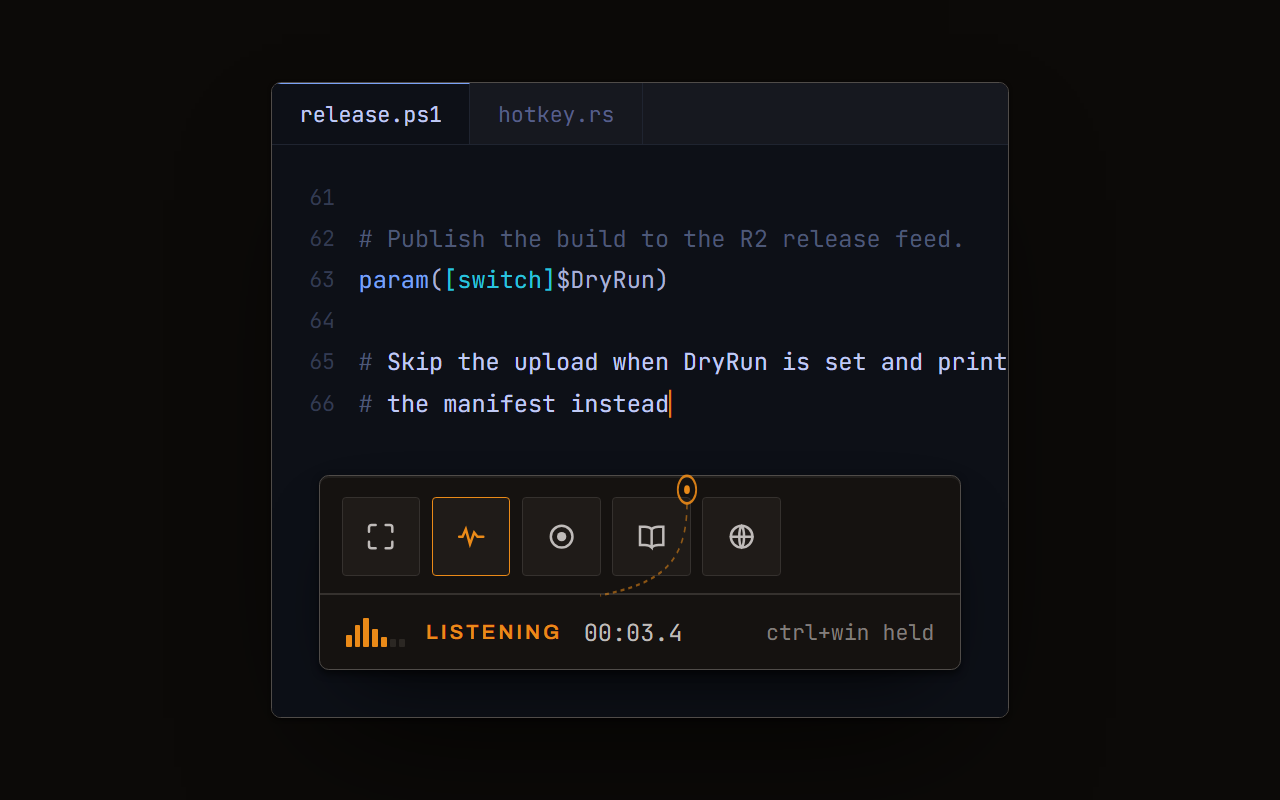
Dictation, where your cursor is
Hold a key, speak, release. Clean, punctuated text lands in whatever has focus, on your PC, your Mac and your phone, with your clipboard handed back.
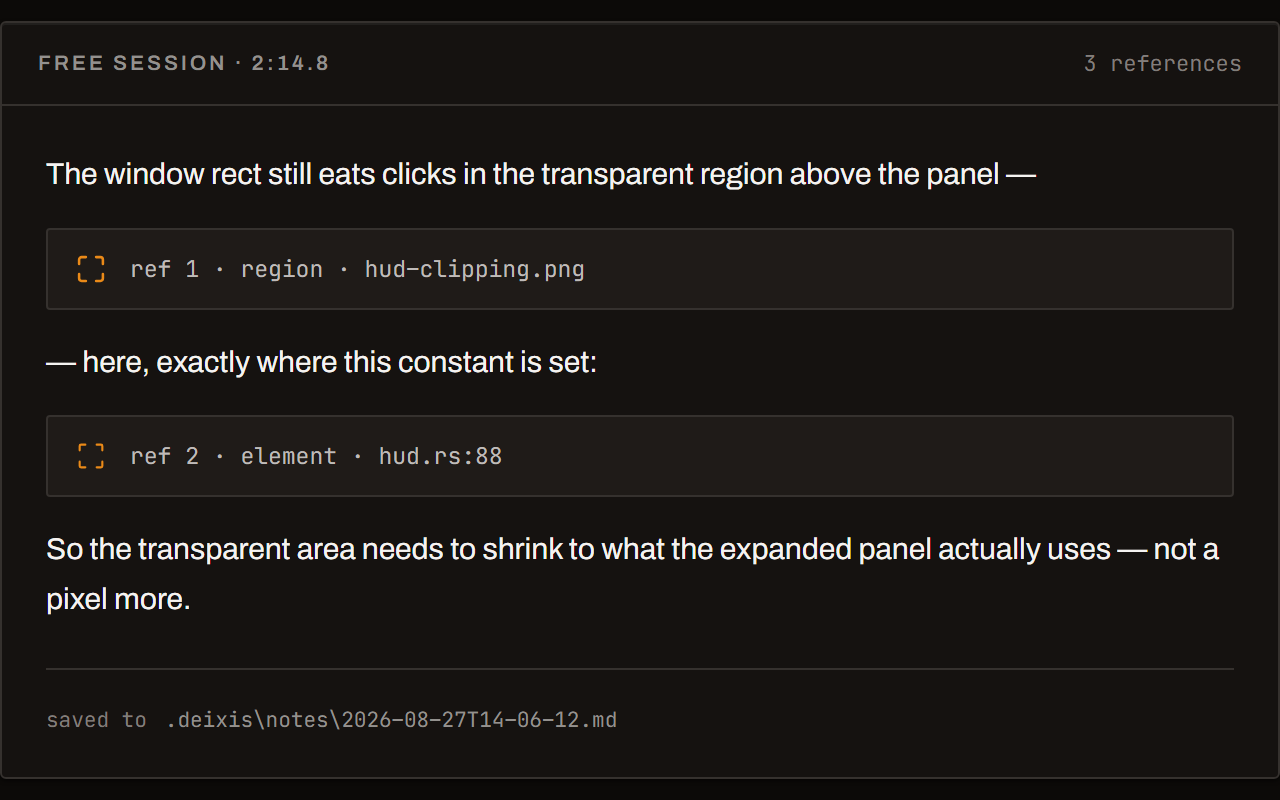
Free mode: talk and point
Narrate for as long as you like while you grab a region, pick a button on screen or take a selection. One note, what you said interleaved with what you pointed at, pasted where you finish and saved as Markdown.
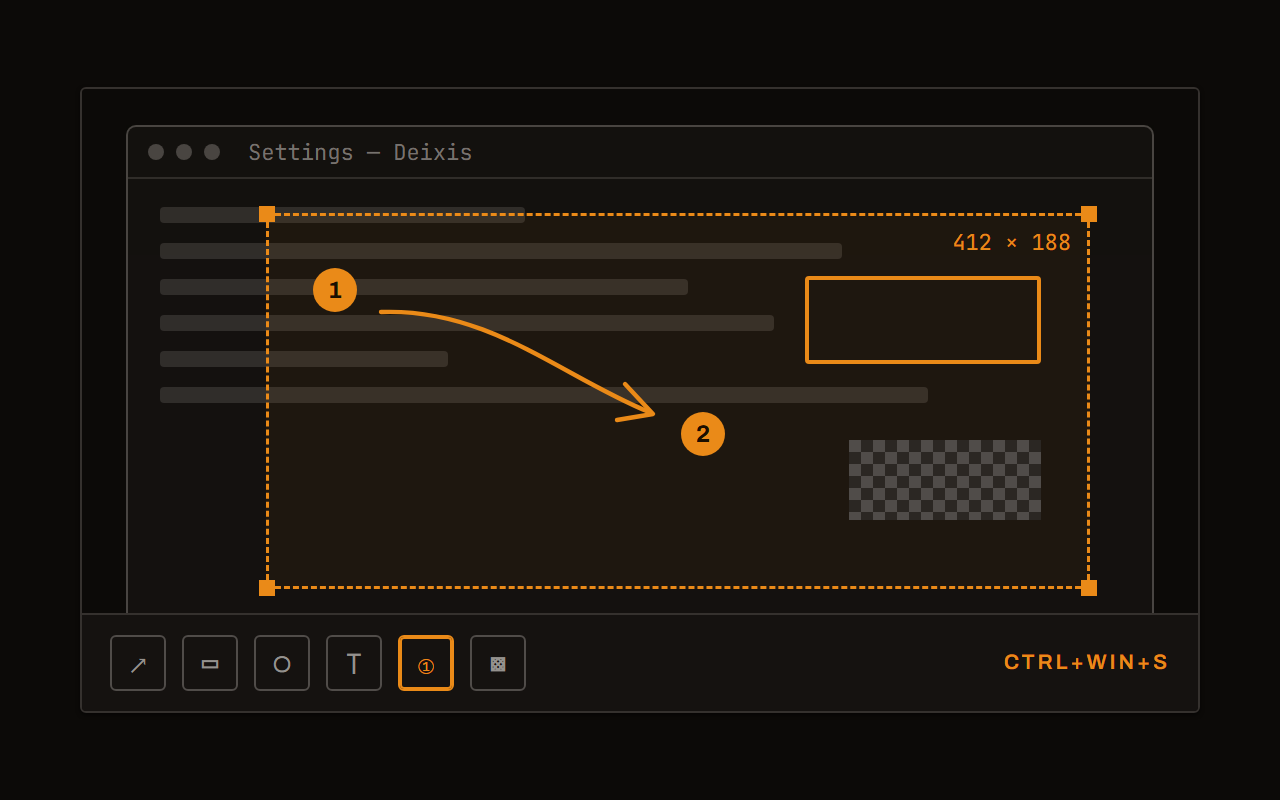
Screen grabs, annotated
Freeze every screen at the keypress, drag a region, add arrows, boxes, text and numbered steps, and pixelate what is private. Saved as a PNG that stays editable.
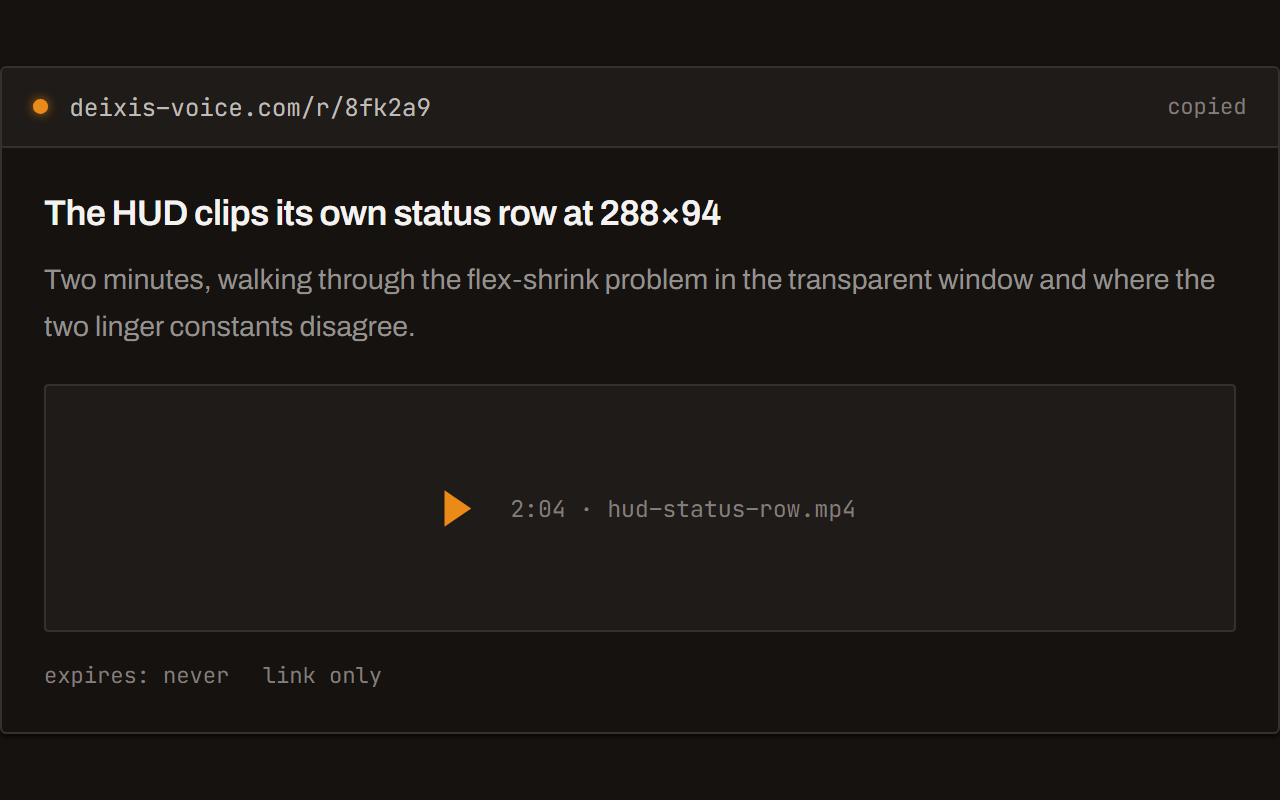
Screen recording, shared as a link
Record the screen with your narration. The recording writes itself up with a title, chapters and a summary, and from your Deixis account it shares as a link anyone can open without one. The Loom you can stop paying for.
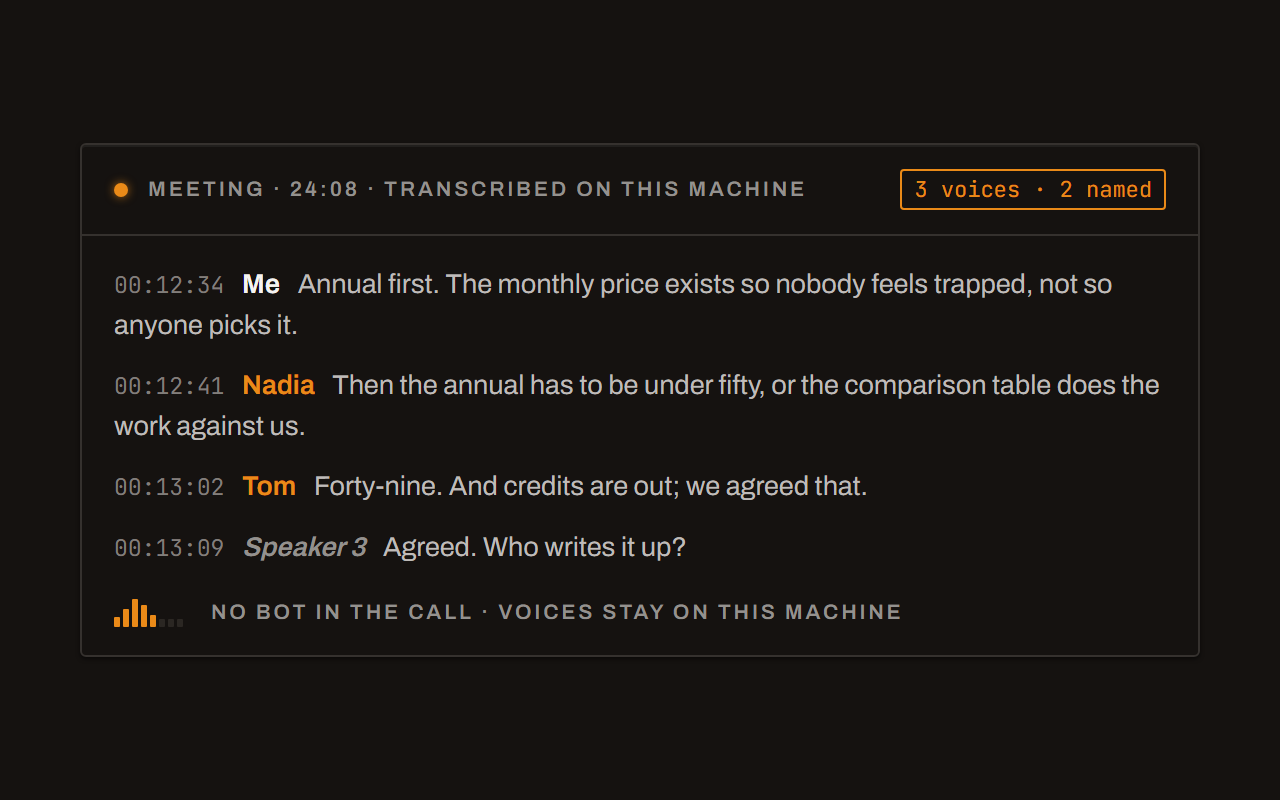
Meetings, no bot, names included
Your microphone and the other side, transcribed on your machine while the call runs. Deixis tells the voices apart and remembers the ones you name, and never uploads a voice.
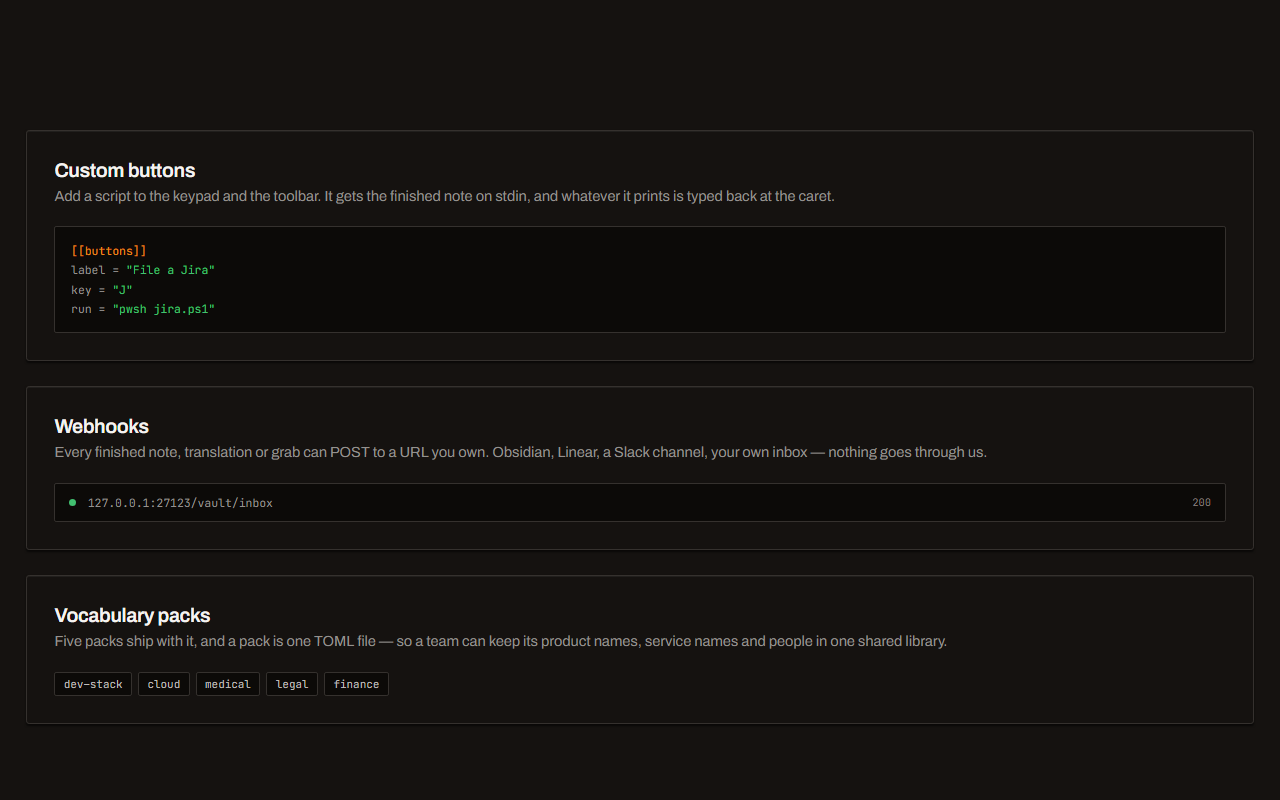
Your own buttons and workflows
Add a button to the palette: it gets the note on stdin and types back whatever it prints. Send finished notes to any URL you own. Chain steps: read the text off a screenshot, translate it, summarise it, post it.
Side by side
Handy and Deixis, side by side
| Row | Deixis | Handy |
|---|---|---|
| Runs on | Windows 10 and 11 (64-bit, on an Intel or AMD processor with AVX2: 2013 and later; no build for Windows on ARM), Mac (Apple Silicon) and Android (a dictation bubble in any app, plus meetings), with an iPhone keyboard in beta on TestFlight and not yet in the App Store. Meetings run on Windows and Android. One engine on all of them, and dictation audio never leaves the device. | Windows (x64 or ARM), macOS (Apple Silicon or Intel), Linux (x64 or ARM) |
| Speech recognition happens | On your own device, inside the app, on every platform. Your audio never leaves it. | On your device |
| AI cleanup happens | On your device, with no provider at all. Or, if you want more, Deixis's cloud, your own Ollama, or your own key. Your choice, in one setting. | On your device or in the cloud, your choice |
| Leaves your machine | Text only, and only once you switch a cloud feature on, plus, on Windows, one key you press to check your own Claude plan. Never audio, never screenshots, never window titles. | Nothing |
| Account needed | None, ever, for anything that runs on your device. The cloud extras have a seven-day trial you start with an email code. No card. | None |
| Price | Free forever for everything local, meetings included. Pro is $49 a year for the cloud extras with nothing to set up. | Free tier: all of it, free and open source under the MIT licence, with no paid plan |
| Your transcripts live | In plain files, in one folder you own and can back up. Uninstall Deixis and every note is still readable. | On your device |
| Make it yours | Add your own buttons that run a script, send finished notes to any URL you own, and switch on vocabulary packs for your field. | Post-processing, an experimental feature with its own shortcut, runs the transcript through a prompt you write, on OpenAI, Anthropic, OpenRouter, Groq, Cerebras, Z.AI, Apple Intelligence on an Apple Silicon Mac with macOS 26, or any OpenAI-compatible endpoint, local ones included. Custom words correct similar-sounding words after recognition. Parakeet, Whisper, Moonshine, Canary, SenseVoice and GigaAM speech models, your own Whisper models, command-line flags and signals to drive it from scripts, and MIT-licensed source you can fork. |
Handy facts from home, readme, license, about, download, its privacy policy, models, postprocessing, general, advanced, history, paste, faq and releases, read on 7 October 2026. “Not documented” means those pages did not say.
Handy is the free, open-source dictation app CJ Pais built after breaking a finger: press a shortcut, speak, and your words are pasted where you were typing, recognised on your own computer by a Parakeet, Whisper or other local model. It needs no account and its privacy policy says it carries no user-tracking telemetry. Cleanup by a language model is an experimental feature you switch on and point at a provider or a local server yourself, and Handy keeps the audio of recent dictations on your computer so you can play them back.
What leaves your machine, and what leaves theirs
Deixis publishes every byte it sends, as a table, because there is so little of it. Here is that table beside what Handy's own pages say.
| What | Deixis | Handy |
|---|---|---|
| Audio | Never. Recognition happens inside the app on your device; the recording, the model and the transcript stay there. | Nothing. Its privacy policy says speech recognition runs on your device and that during ordinary transcription Handy does not send your microphone audio or transcription content to its maintainers or to Handy servers. By default it keeps the recordings of recent dictations on your computer, in its history, until the history limit or your retention setting removes them.— · — |
| The dictated text | The sentence you just dictated, your vocabulary, and your previous sentence in that fieldthe endpoint you chose · only with a cloud endpoint set, and by default only when the local rules are not enough | Nothing by default. With post-processing set up on a cloud provider, the transcription, the prompt you selected, the model information and your API key go from your computer straight to that provider; the policy says Handy's maintainers do not receive or proxy it.the provider you chose: OpenAI, Anthropic, OpenRouter, Groq, Cerebras, Z.AI, AWS Bedrock, or a custom endpoint · only when you invoke post-processing, an experimental feature with a shortcut of its own; the ordinary shortcut never triggers it |
| Context around the text | The names of the app and the field the text is going into. Never the window title, never a screenshot.the same endpoint · with that request | None named. The privacy policy lists what post-processing sends as the transcription, the selected prompt, model information and your credential, and names no app, field, window or screen content.— · — |
| Telemetry and analytics | None. No account, no telemetry, no analytics, no crash reports. | None: the privacy policy says Handy does not contain advertising, behavioral analytics, or user-tracking telemetry, and that official builds redact transcription content from the diagnostic logs kept on your computer.— · — |
| Update check | Nothing but the request; the version check happens on your PCapi.deixis-voice.com · every launch, and when you ask in Settings | An update request, to see whether a new version exists and to download it; the policy says update requests do not include your audio or transcription content.GitHub Releases · on by default; update checking can be turned off in its settings |
| Model download | Nothing but the requesthuggingface.co · once, when you press Download on first run | A download request with ordinary technical information, such as your IP address, the model requested and what HTTP headers carry; never audio or transcription content.Hugging Face, or Handy's own download host on Cloudflare if Hugging Face fails · when you download a speech model |
| Account and sign-in | An email address, only if you choose to start the trial, plus the partner tag from a partner download link and the first partner website that connected to Deixis on this computer, if there are anythe Deixis endpoint · when you start the trial | No account: the privacy policy says Handy does not require one.— · — |
| Integrations | The finished note, and for a screenshot its file name, never the imagea URL you added yourself · on finish, only for destinations you added | not documented |
Before you switch
Before you switch
Who should not switch
If you dictate in a language other than English, stay with Handy: Deixis's speech models are English models, and that is the whole answer. Stay if you run Linux, an Intel Mac, or Windows on ARM, because Deixis has no build for any of them; on a PC, Deixis also needs an Intel or AMD processor with AVX2, from 2013 or later, and an older one will not start it. Stay if open-source code is a requirement rather than a preference, or if you want to change the program itself. Stay if you want to write your own cleanup prompt for every dictation, or to replay the audio of what you said. And if a text box is all you ever wanted, Handy fills it well; Deixis is for the person who also wants the meeting, the screenshot and the field-aware cleanup.
Making the switch
The two feel alike at the keyboard. Here is what changes.
The key
Handy's default shortcut is Ctrl+Space on Windows and Option+Space on a Mac, held to talk, with a
toggle mode if you prefer to press once to start and once to stop. Deixis's is Ctrl+Win: hold,
speak, release. Double-tap it for free mode, which keeps recording until you double-tap again. On a
Mac the chord is Ctrl+Option. Settings → Hotkey captures a different chord if you want one.
Models
Handy asks you to pick a model on first launch, and recommends Parakeet V3, about 478 MB. Deixis shows one Download button, 142 MB, and offers a larger, more accurate English model in Settings that swaps in without a restart, at the cost of a slower decode. Deixis recognises speech on the processor.
Your words
Handy's custom words become Deixis replacement rules, matched at word boundaries and regardless of
case. The words that keep getting misheard belong in Deixis's vocabulary instead, where they steer
the speech model itself: select one, press Ctrl+Win+D. Switch on a pack for your field with one
click.
Cleanup
If you used Handy's post-processing with LM Studio or another local server, Deixis can use the same kind of server: Settings → Cleanup takes any OpenAI-compatible model server on your own machine, and then nothing leaves for cleanup at all. Or use your own provider key, or Deixis Pro with nothing to set up. Choose how often: When it helps, Every time or Never. There is no prompt to carry over, because Deixis sends the app and field name with each request and punctuates for the destination itself.
History
Handy keeps its history, recordings included, in its own app data folder, and there is nothing to import. Deixis keeps every note, transcript, grab and recording as ordinary files in one folder you own, so you can back it up, search it, and still read it if you uninstall.
Before you ask
Questions people search for
Is Handy free?
Yes. Handy is free and open source under the MIT licence, with no paid plan; it is funded by sponsors and by donations through Stripe or GitHub Sponsors. Deixis is free too for everything that runs on your device, meetings included, but it is not open source; Pro, at $49 a year or $10 a month, buys the managed cloud extras, and those are free with your own provider key.
Does Handy work offline?
Yes. Its models page says every model runs locally, and its FAQ says the only network requests are for downloading models and checking for updates. Post-processing with a cloud provider is the exception, and its post-processing page says that fails offline while transcription keeps working. Deixis is the same: with no cloud endpoint configured it dictates, records and transcribes meetings, and grabs screens with no connection at all.
Does Handy work on Windows?
Yes. Its download page has an installer and an MSI for Windows on x64 and on ARM, and its docs say Whisper models use the graphics card through Vulkan. Its paste-methods page recommends Shift+Insert for Windows Terminal, Command Prompt and PowerShell. Deixis runs on Windows 10 or 11 with an Intel or AMD processor with AVX2, from 2013 or later, and has no ARM build.
Can Handy transcribe meetings?
Not today, by its own FAQ: Handy transcribes microphone input only, so it does not hear the other side of a video call, and its FAQ advises keeping recordings under three to five minutes. Deixis records your microphone and the system audio together and transcribes the whole meeting on your PC, on Windows, and on Android from the phone's microphone.
Handy or Wispr Flow?
They sit on opposite sides of the line that matters. Handy recognises speech on your computer with no account; Wispr Flow transcribes every dictation in its cloud, needs you to sign in, and its free plan stops at 2,000 words a week on desktop. Deixis is on Handy's side of that line, and adds field-aware cleanup, meetings and an Android app.
Does Deixis support other languages?
No: Deixis's speech models are English models. Handy offers Whisper for 99-plus languages and Parakeet V3 for 25 European ones, so if you dictate in anything else, Handy is the better choice.
Keep reading
Related pages
Best dictation software for Windows
Fifteen Windows dictation tools compared, every fact dated from the maker's own pages — including what our own tool cannot do. Read the disclosure.
Offline dictation on Windows
Dictation that works with no internet: speech recognition on your own device, free, no account. Which Windows speech-to-text tools genuinely run offline.
The OpenWhispr alternative with no cloud switch to get wrong
OpenWhispr is open source and goes local or cloud. The Deixis app recognises only on your PC, Mac or phone: free, no account, no switch to get wrong.
The Wispr Flow alternative that keeps your voice on your PC
Wispr Flow transcribes in the cloud and needs an account. Deixis recognises speech on your PC, Mac or phone, free, with no sign-in and no audio leaving.
The Windows voice typing alternative that works offline, on your own PC
Win+H voice typing sends your voice to Microsoft and needs the internet. Deixis recognises speech on your own PC, offline, free, with no account.
The Typeless alternative that never uploads your voice
Typeless processes your voice on its cloud servers and needs a sign-in. Deixis recognises speech on your PC, Mac or phone, free, no account, no cap.
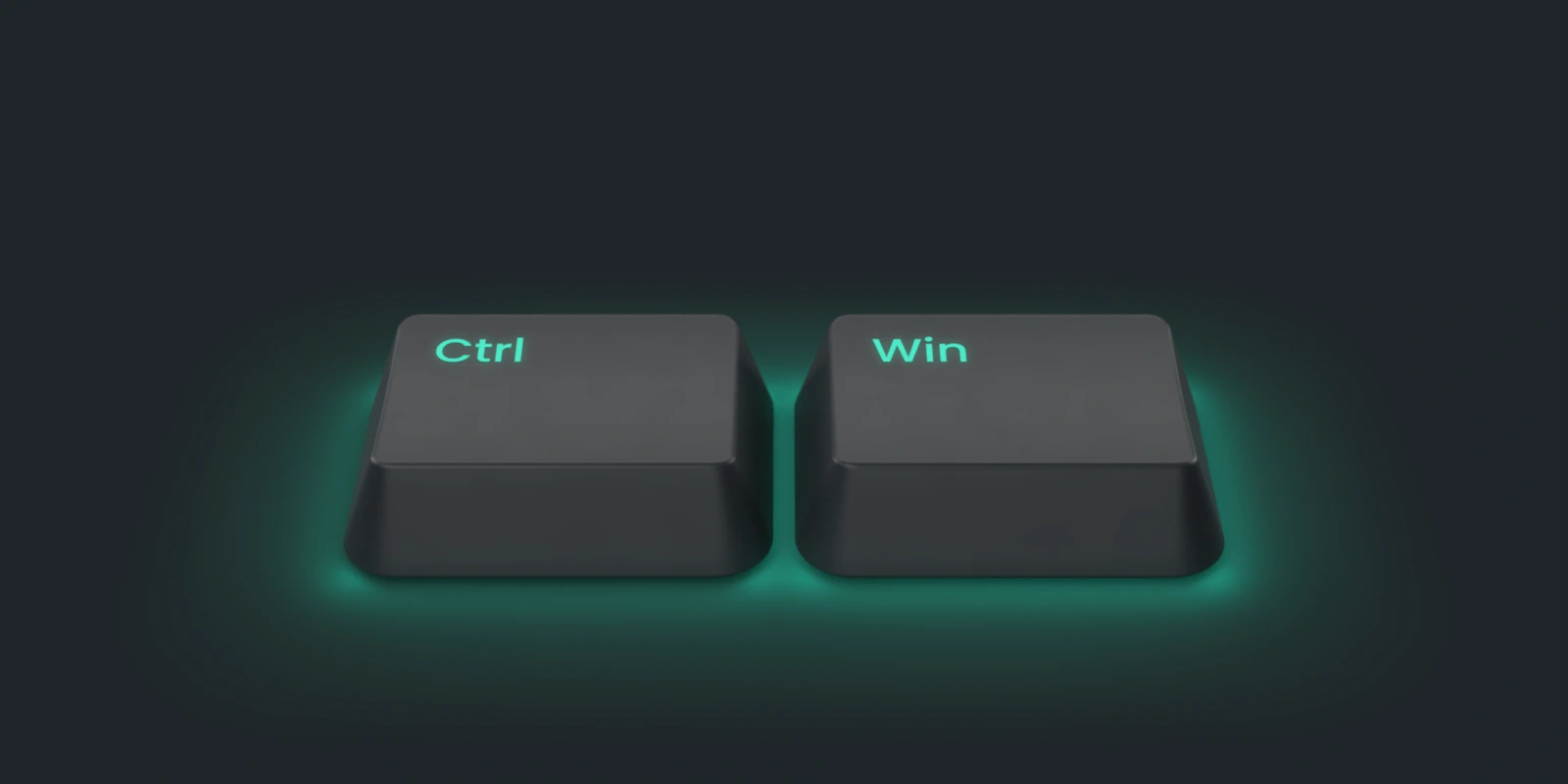
Hold a key. Speak. Keep working.
Deixis is free, needs no account, and runs on your own device. Everything on this page is in the current release.
v1.3.2 · 64‑bit Windows 10/11 on Intel or AMD · macOS 13 on Apple silicon · 51 MB · nothing else to install · also for Windows · Android on Google Play
Facts about Handy checked on against handy.computer. Deixis facts are from its documentation for the current release. Something out of date? Tell us.