The OpenWhispr alternative with no cloud switch to get wrong
Deixis is an OpenWhispr alternative for people who want dictation that only ever happens on their own device: hold a key, speak, and the words land at your cursor, recognised on your PC, Mac or Android phone, free, with no account. OpenWhispr is open source under the MIT licence, runs on Windows, the Mac and Linux, and lets you choose local or cloud recognition; Deixis is free for everything local but proprietary, and it dictates in English.
That makes this a closer call than most pages on this site, because OpenWhispr can be fully local too. The difference is that with OpenWhispr, local is a setting you choose and then keep checking. Setup asks you to pick, and its pages disagree about which way it leans: the home page says "Cloud is a choice, not a default", while its IT network allowlist calls OpenWhispr Cloud "the default after onboarding". And the engine is set three times, once each for dictation, meetings and uploads. The Deixis app has no cloud recognition to set. Its cleanup runs as rules on your PC with no model at all, it is on Android today, and the same key grabs, annotates and records your screen.
OpenWhispr wins a lot, and the list below is long and plain about it: the source, Linux, up to sixty languages, an iPhone app in the App Store, files you already have, meetings it notices for you. If one of those is why you are looking, it is the better tool. If what you want is a voice that cannot leave the device, read on.
Why switch
What you gain, and what you give up
Why Deixis
- Recognition that cannot go to the cloud. The Deixis app has no cloud speech recognition to switch on. Dictation and meetings are recognised inside the app, on your processor, under every setting and on every plan. OpenWhispr can be just as local, but it is a choice you make and keep making: its privacy help page sets the engine separately for dictation, note recording and audio upload, and its HIPAA page warns that moving dictation to local "does not move Audio Upload off the cloud". When a mode is on its cloud, your custom dictionary terms go with every request, and its help pages say it keeps the transcript text (its privacy policy of 1 October says only a usage record, unless you turn on cloud backup). With Deixis there is no recognition setting to audit, because no setting sends your dictation audio anywhere.
- Cleanup on your PC, with no model to run. OpenWhispr's cleanup is a language model pass, on by default; to keep that text on your machine you run a local model, which its own cleanup page says is slower than the cloud on most hardware. Deixis tidies dictation with rules on your PC out of the box: filler words out, your dictionary applied, the first word capitalised and the sentence closed, with no provider and no model. A language model comes in only once you set one up, and then by default only when the rules are not enough. You choose: When it helps, Every time, or Never.
- Cleanup that knows where the words are going. When Deixis does hand a sentence to a language model, on your own key, a model on your machine or Pro, it says which app and which field the text is going into, so a commit message, a chat reply and a ticket come out punctuated differently. Only the names travel, never the window title and never a screenshot. OpenWhispr's cleanup page lists what it changes, filler words, grammar and punctuation, and says nothing about the app you are in.
- Android, on Google Play. On Android Deixis is a floating microphone bubble that dictates into any app, with meetings recorded and transcribed on the phone, and the same on-device recognition as on the desktop. OpenWhispr's own phone page answers the Android question: "Not yet".
- Meetings with no monthly allowance. OpenWhispr's plans page gives meeting recording 5 hours a
month on Free and 20 on Pro, unlimited from Business at $16 per user a month. Deixis records a
meeting with
Ctrl+Win+Mand transcribes it on your PC for as long as you talk, free, with no account, on Windows and Android. Both tools label the voices in a meeting on your own machine and remember the ones you name. - Screen grabs, annotation and screen recording, on the same key.
Ctrl+Win+Sfreezes the screen, you drag a region, and add arrows, boxes, numbered steps or a pixelated redaction.Ctrl+Win+Vrecords the screen to a video, transcribed on your PC when a microphone is set for recordings. Free mode lets you narrate while you grab, pick and select, and hands you one note. OpenWhispr's meeting page says it "never records your screen, on any platform", and its docs list no screenshot or recording tool; the one screenshot it takes goes to its voice agent. And every note, transcript, grab and recording Deixis makes is an ordinary file in one folder, Markdown, PNG and MP4, without asking; OpenWhispr mirrors its notes to Markdown files once you switch on Save notes as files.
Where OpenWhispr still wins
- Open source, under the MIT licence. The desktop app's source is on GitHub, "free for personal and commercial use", so you can read how audio is captured and sent, build it yourself or fork it. Its security page notes that the cloud service behind it is separate and run by the company. Deixis is proprietary: you take our published list of what leaves on trust, or watch the network yourself.
- Linux. AppImage, deb, rpm and tar.gz builds for 64-bit Linux, with its docs covering X11 and Wayland. Deixis has no Linux build.
- Up to sixty languages. Its languages page says you can pick 60 in the app today, with auto-detect, depending on the engine (its website says 100+, which the same page explains is the range of the Whisper model family). Deixis's speech models are English models.
- Bigger local models, and your graphics card. Whisper up to the large model, which can run on your graphics card through Metal, CUDA or Vulkan and falls back to the processor, plus Parakeet, Nemotron streaming and Cohere Transcribe; with live preview on, Nemotron shows partial text while you are still speaking. Deixis offers two English Whisper models, on the processor, and types when you let go.
- Older Macs. Its requirements page lists macOS 12 or later, on Apple Silicon or Intel. Deixis on a Mac needs Apple Silicon and macOS 13 or later.
- An iPhone and iPad app in the App Store. Its iOS page describes a keyboard for any app, with on-device transcription that is free and unlimited with no account, and meeting recording. Deixis's iPhone keyboard is a beta on TestFlight, not yet in the App Store.
- Files you already have. Drag in audio or video, upload a batch, or paste a YouTube or audio link, and it transcribes them. Deixis transcribes only what it records itself.
- Meetings it notices for you, on every desktop. It offers to take notes when your microphone has been busy long enough to look like a call or a calendar event is about to start, fills in the title and attendees from Google, Microsoft or Apple calendars, and cancels the echo between your microphone and the call, on the Mac and Linux as well as Windows. Deixis starts a meeting when you press the key, on Windows and Android, and asks you to wear headphones.
- An agent, an API and MCP. From Pro, a voice agent that types the result of a spoken instruction, a public API and an MCP server that connects Claude, Cursor or VS Code to your notes; chat over your notes on Business; and a command-line tool. Deixis has buttons and webhooks that you point at scripts and URLs of your own, and no MCP.
- A BAA for health data. Its HIPAA page says it holds a HIPAA attestation, acts as a Business Associate, and signs a BAA on request on the Business plan and above, before any health information goes through its cloud. Deixis offers no BAA: your audio never leaves your device, but if your compliance team needs that agreement from the vendor, OpenWhispr can sign one and Deixis cannot.
- A dictionary that fills itself in. For up to 30 seconds after a paste it watches for your corrections and adds the fixed word on its own, it imports and exports a list, and snippets expand a spoken phrase into saved text. In Deixis you add a word yourself, one key press.
What you get
More than dictation. One key, and everything behind it.
Hold the key and press a letter: free mode, a grab, a meeting, a recording, a translation, your own buttons. All of it on your own device, all of it free, none of it behind an account.
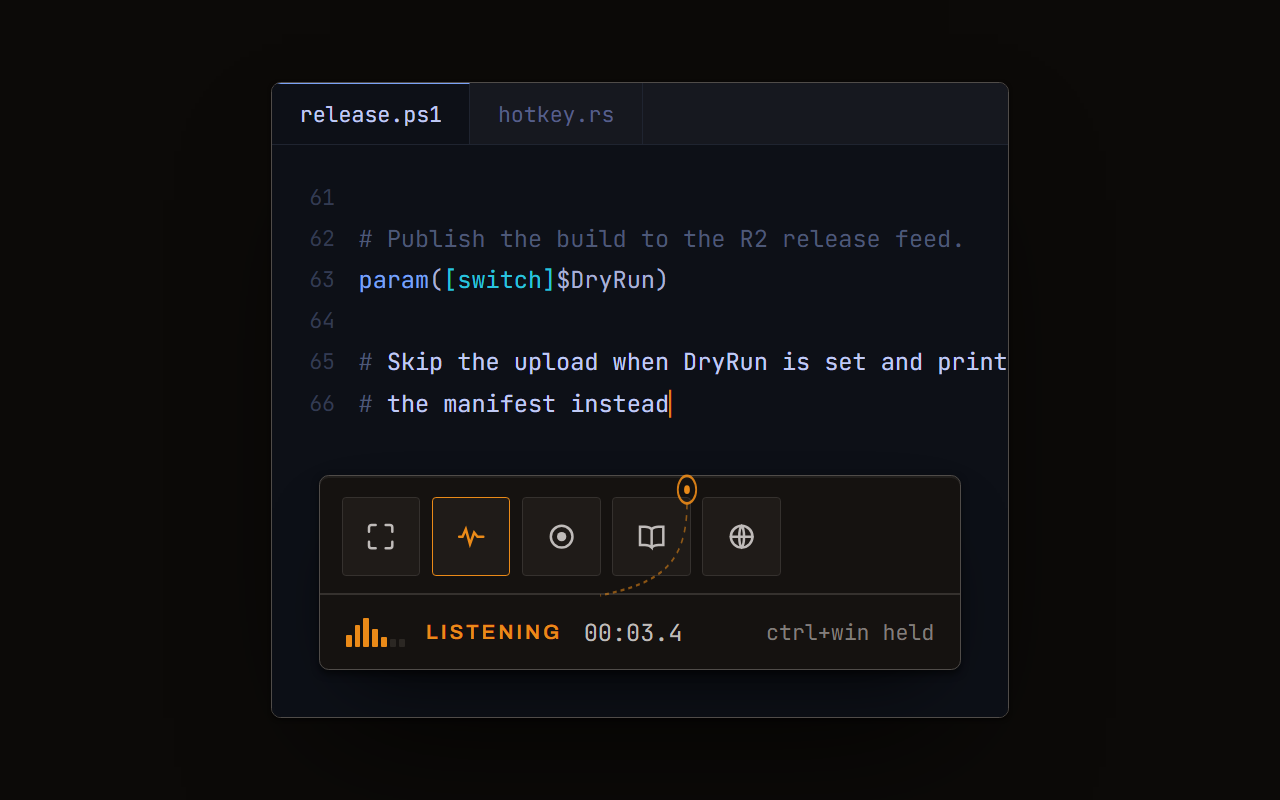
Dictation, where your cursor is
Hold a key, speak, release. Clean, punctuated text lands in whatever has focus, on your PC, your Mac and your phone, with your clipboard handed back.
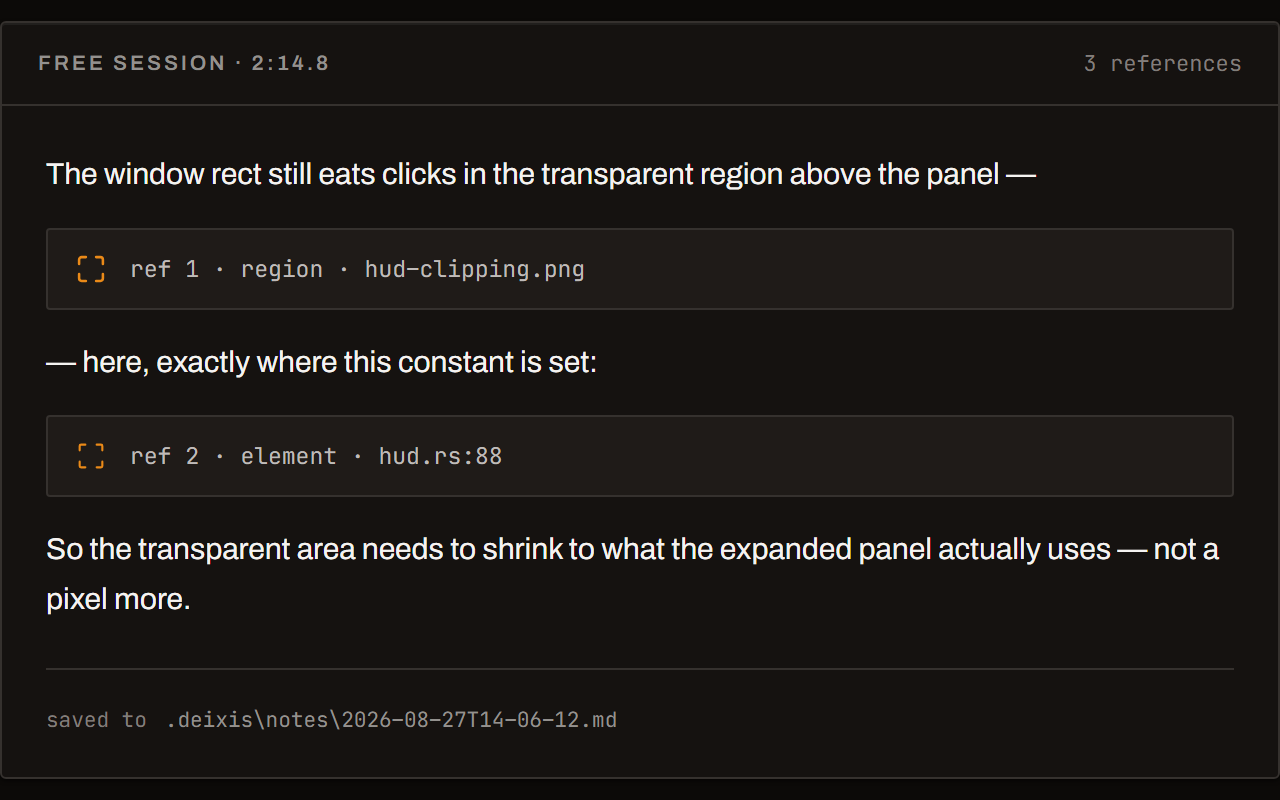
Free mode: talk and point
Narrate for as long as you like while you grab a region, pick a button on screen or take a selection. One note, what you said interleaved with what you pointed at, pasted where you finish and saved as Markdown.
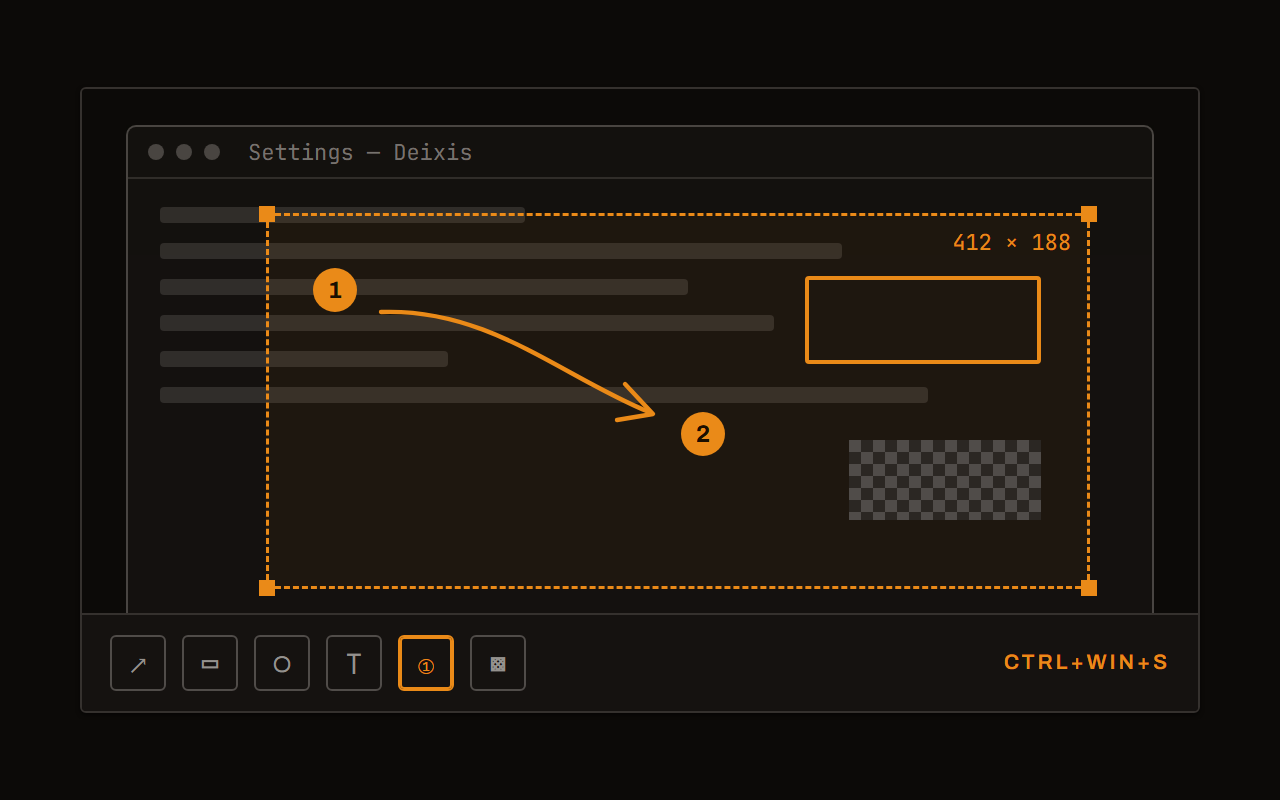
Screen grabs, annotated
Freeze every screen at the keypress, drag a region, add arrows, boxes, text and numbered steps, and pixelate what is private. Saved as a PNG that stays editable.
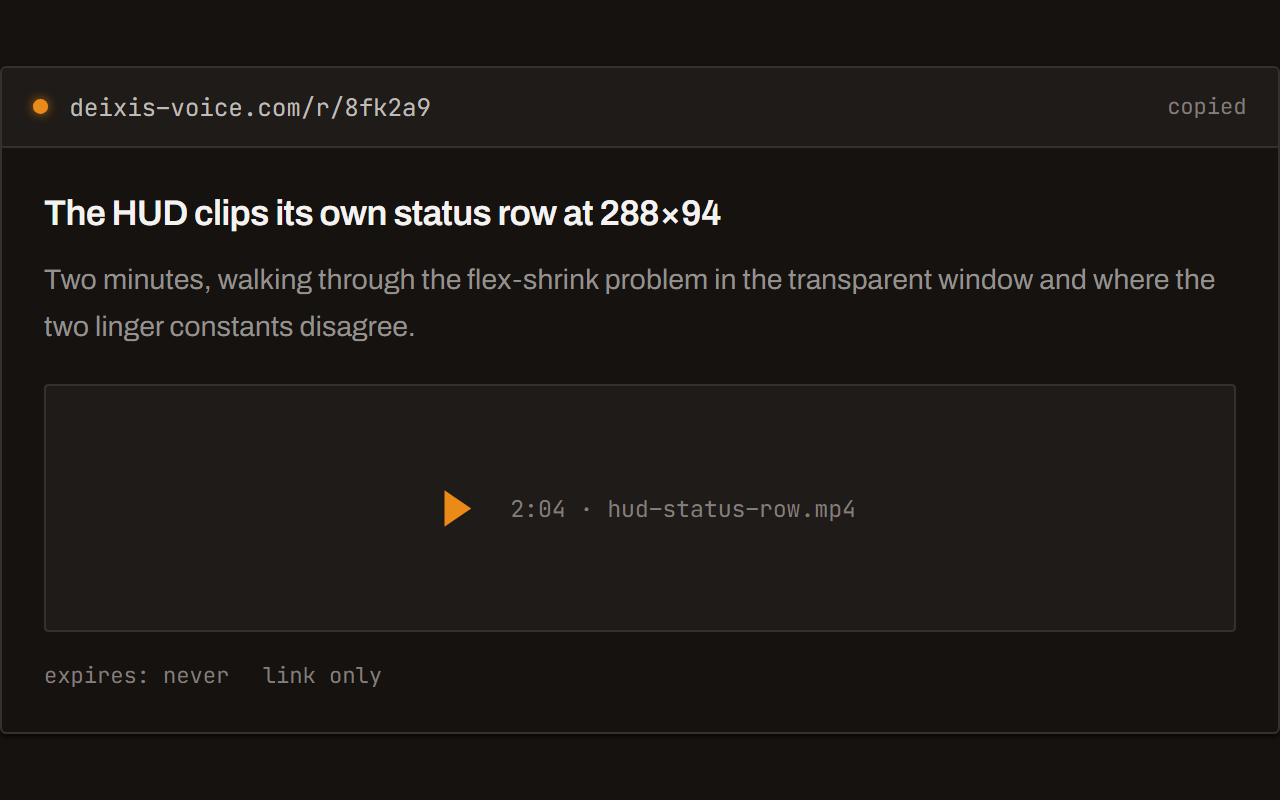
Screen recording, shared as a link
Record the screen with your narration. The recording writes itself up with a title, chapters and a summary, and from your Deixis account it shares as a link anyone can open without one. The Loom you can stop paying for.
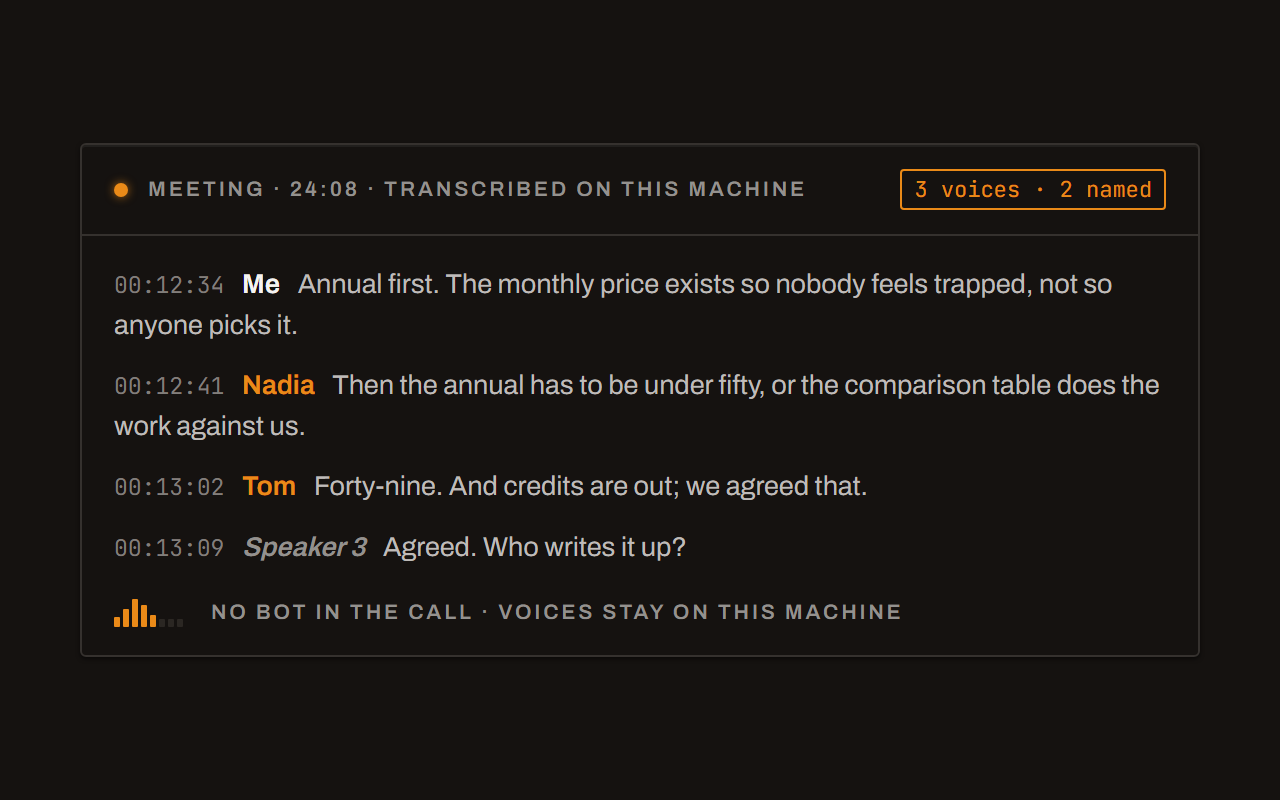
Meetings, no bot, names included
Your microphone and the other side, transcribed on your machine while the call runs. Deixis tells the voices apart and remembers the ones you name, and never uploads a voice.
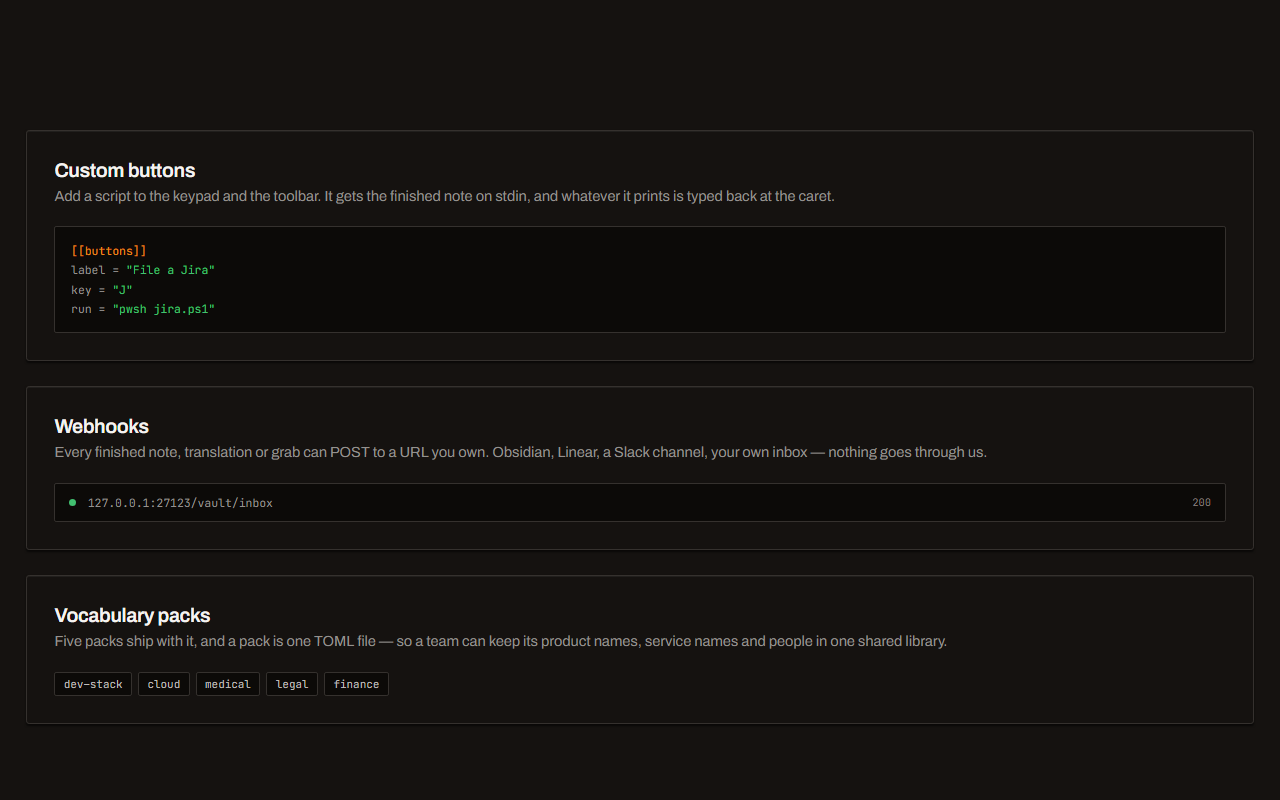
Your own buttons and workflows
Add a button to the palette: it gets the note on stdin and types back whatever it prints. Send finished notes to any URL you own. Chain steps: read the text off a screenshot, translate it, summarise it, post it.
Side by side
OpenWhispr and Deixis, side by side
| Row | Deixis | OpenWhispr |
|---|---|---|
| Runs on | Windows 10 and 11 (64-bit, on an Intel or AMD processor with AVX2: 2013 and later; no build for Windows on ARM), Mac (Apple Silicon) and Android (a dictation bubble in any app, plus meetings), with an iPhone keyboard in beta on TestFlight and not yet in the App Store. Meetings run on Windows and Android. One engine on all of them, and dictation audio never leaves the device. | Windows 10 or later (x64 only), macOS 12 or later (Apple Silicon or Intel), Linux (x86-64), iPhone and iPad |
| Speech recognition happens | On your own device, inside the app, on every platform. Your audio never leaves it. | On your device or in the cloud, your choice |
| AI cleanup happens | On your device, with no provider at all. Or, if you want more, Deixis's cloud, your own Ollama, or your own key. Your choice, in one setting. | On your device or in the cloud, your choice |
| Leaves your machine | Text only, and only once you switch a cloud feature on, plus, on Windows, one key you press to check your own Claude plan. Never audio, never screenshots, never window titles. | Audio, text |
| Account needed | None, ever, for anything that runs on your device. The cloud extras have a seven-day trial you start with an email code. No card. | Optional |
| Price | Free forever for everything local, meetings included. Pro is $49 a year for the cloud extras with nothing to set up. | Free tier: unlimited on local models or your own key, plus 2,000 cloud words per rolling 7 days; $8 a month; $80 a year; those are Pro; Business is $16 per user a month |
| Your transcripts live | In plain files, in one folder you own and can back up. Uninstall Deixis and every note is still readable. | On your device and in the cloud |
| Make it yours | Add your own buttons that run a script, send finished notes to any URL you own, and switch on vocabulary packs for your field. | A custom dictionary that can learn from your corrections, snippets that expand a spoken phrase, translation on its own hotkey, a voice agent and a chat agent on the model you choose, Google, Microsoft or Apple calendars for meetings, a public API and an MCP server from Pro, a command-line tool, and MIT-licensed source you can fork. |
OpenWhispr facts from openwhispr.com, plans, its privacy policy, security, source, licence, requirements, windows, iphone, processing, data, retention, compliance, cleanup, dictionary, languages, meetings, network, agent and models, read on 7 October 2026. “Not documented” means those pages did not say.
OpenWhispr is open-source dictation under the MIT licence, published by Gizmo Labs: press a hotkey, speak, and the text is pasted at your cursor, recognised either on your own computer by a model you download, or in OpenWhispr's cloud, on your own provider key or on your company's cloud account. Its network allowlist calls OpenWhispr Cloud the default after onboarding, and the engine is chosen separately for dictation, meeting recording and audio upload. Cleanup by a language model is on by default, and the desktop app keeps your dictation audio on your computer for 30 days unless you change it.
What leaves your machine, and what leaves theirs
Deixis publishes every byte it sends, as a table, because there is so little of it. Here is that table beside what OpenWhispr's own pages say.
| What | Deixis | OpenWhispr |
|---|---|---|
| Audio | Never. Recognition happens inside the app on your device; the recording, the model and the transcript stay there. | In local mode, nothing: its help page says the audio is transcribed on your device. With OpenWhispr Cloud, which its network allowlist calls the default after onboarding, the audio goes to its servers and on to the model provider, together with the model, your language if you set one, and your custom dictionary terms; it says the audio is processed and discarded, never stored. With your own key, the audio goes straight to that provider. The engine is set separately for dictation, meeting recording and audio upload, so each has to be checked.OpenWhispr's servers and its model provider, or the provider whose key you entered · every dictation, meeting or upload whose engine is on a cloud mode |
| The dictated text | The sentence you just dictated, your vocabulary, and your previous sentence in that fieldthe endpoint you chose · only with a cloud endpoint set, and by default only when the local rules are not enough | The transcript, to whichever model runs cleanup, which is on by default and can run locally instead. Its help pages say that with OpenWhispr Cloud it keeps the transcript text and its metadata; its privacy policy, updated 1 October 2026, says it keeps a usage record but not the text itself unless you turn on cloud backup, which is off by default on the desktop. Notes you share or put in a team space are stored in its cloud whatever that setting says, and the text of a note in its cloud is sent to OpenAI to index it for search.OpenWhispr's cloud and its language-model providers, or your own · each cloud transcription and each cloud cleanup; backup and sharing only when you turn them on |
| Context around the text | The names of the app and the field the text is going into. Never the window title, never a screenshot.the same endpoint · with that request | A screenshot of the display your cursor is on, with each voice-agent command, but only once you turn on Share screen context, which is off by default. Its help page says ordinary dictation never sends one, and that the image is used for that one request and is never saved, added to your history or logged.the model your voice agent is set to · only with Share screen context on, when you press the voice-agent hotkey |
| Telemetry and analytics | None. No account, no telemetry, no analytics, no crash reports. | Usage analytics are off by default in the desktop app, and its help page says that with them off nothing about your usage is sent. Its privacy policy adds that OpenWhispr Cloud requests are logged against your account, with the audio's length, the provider, model, language, word count and timings, whatever your settings, and that its iPhone app carries AppsFlyer attribution (only if you allow tracking), RevenueCat and Superwall.OpenWhispr, and those vendors on the iPhone · analytics only if you switch them on; service logs with every cloud request |
| Update check | Nothing but the request; the version check happens on your PCapi.deixis-voice.com · every launch, and when you ask in Settings | An update check at launch; its Windows page says it tells you when an update is available and downloads only when you agree. Its privacy policy says GitHub receives your IP address, app version and platform, and no account or content data.GitHub · at every launch |
| Model download | Nothing but the requesthuggingface.co · once, when you press Download on first run | A download request: its privacy policy says Hugging Face and GitHub receive your IP address, app version and platform, and no account or content data.Hugging Face and GitHub · when you choose a local model, which is not needed for a cloud-only install |
| Account and sign-in | An email address, only if you choose to start the trial, plus the partner tag from a partner download link and the first partner website that connected to Deixis on this computer, if there are anythe Deixis endpoint · when you start the trial | No account for local dictation or your own key. OpenWhispr Cloud needs sign-in with Google, Apple on a Mac, Microsoft or email; its privacy policy lists your email, name, a hashed password and, for each signed-in session, the IP address and the browser or device type.OpenWhispr, and Stripe for a paid plan · when you choose OpenWhispr Cloud or buy a plan |
| Integrations | The finished note, and for a screenshot its file name, never the imagea URL you added yourself · on finish, only for destinations you added | Calendar events stay on your device unless you ask the agent about them. Web searches the agent runs go through OpenWhispr to Exa, its cloud agent keeps a long-term memory of your conversations with Mem0, and apps you connect through its API or MCP server can read and change the notes you allow.your calendar provider, Exa, Mem0 and the apps you connect · only when you connect a calendar, use the agent or connect an app |
Before you switch
Before you switch
Who should not switch
If you want software whose source you can read and build, stay with OpenWhispr: Deixis is proprietary. If you are on Linux, there is no Deixis build. If you dictate in a language other than English, OpenWhispr's models cover dozens and Deixis's are English models. If your work is transcribing recordings and videos you already have, OpenWhispr takes the file or the link and Deixis does not. If you want meetings recorded on a Mac, prompted by your calendar, or your notes reachable from Claude or Cursor over MCP, those are OpenWhispr's. If your Mac has an Intel processor or runs macOS 12, or most of your dictation happens on an iPhone, OpenWhispr's app is in the App Store and Deixis's keyboard is still a beta. If your compliance team needs a signed BAA, OpenWhispr offers one on Business. And on Windows, Deixis needs an Intel or AMD processor with AVX2, from 2013 or later; neither tool has a build for Windows on ARM.
Making the switch
Five minutes, and most of it is the one download.
The key
OpenWhispr's Windows page gives Ctrl+Win as its default dictation hotkey, so your hands already
know where to go. What changes is the gesture: OpenWhispr starts on a tap and stops on the next one
by default, with hold as an option, and Deixis is hold to talk, release to type. To keep listening
without holding, double-tap the chord, and double-tap again to stop. If you keep both installed
while you try Deixis, quit OpenWhispr or change its hotkey first, because both answer to the same
chord. Deixis's own chord can be changed in Settings → Hotkey.
The speech model
First launch shows one Download button, 142 MB, and you are dictating. If you ran Whisper base locally in OpenWhispr, this is the English-only version of the same model. Settings offers a larger English model, 465 MB, more accurate and about three times slower to decode, and it swaps in with no restart.
Your words
There is no importer for an OpenWhispr dictionary, but its Export dictionary action gives you the
list, and the Deixis dictionary is a plain file you can paste it into. Only the first 36 terms steer
recognition itself; past that, put corrections in as replacement rules, which are unlimited. Five
vocabulary packs ship in the box, for software, finance, business, medicine and law, a click each.
After that, select a word anywhere and press Ctrl+Win+D.
Cleanup
Deixis works with no provider: the rules on your PC handle the tidying. If you liked the polish a language model gave every sentence, Settings → Cleanup is one choice: Deixis's cloud, a model on your own machine, or your own key, and how often, When it helps, Every time or Never.
What to clear on the way out
OpenWhispr's desktop app keeps your dictation audio on your computer for 30 days by default, and its privacy policy says uninstalling it does not delete what it stored. Export the notes you want as Markdown first, then use Reset app data under System → Data Management in its Settings. A plan bought in its iPhone app is cancelled through Apple; one bought on its website, by writing to its support.
Before you ask
Questions people search for
Is OpenWhispr free?
Yes, for local use: its plans page says local models and your own API keys are unlimited on every plan, and the Free plan, which does not expire, adds 2,000 words of OpenWhispr Cloud transcription per rolling seven days and 5 hours of meeting recording a month. Pro is $8 a month or $80 a year. Deixis is free for everything that runs on your device, meetings included, with no allowance to watch; Pro, at $49 a year or $10 a month, is only for the managed cloud extras.
Is OpenWhispr safe and private?
In local mode, by its own account, nothing is sent: the audio is transcribed on your device. On OpenWhispr Cloud the audio goes to its servers and a model provider and, it says, is discarded rather than stored, while your dictionary terms travel with each request; its help pages say the transcript text is kept, and its privacy policy says only a usage record is, unless you turn on cloud backup. The desktop app also keeps dictation audio on your computer for 30 days by default. Because the source is MIT-licensed you can check the app yourself. The Deixis app gives you no cloud mode to check: recognition happens on your device under every setting.
OpenWhispr or Wispr Flow: which is more private?
OpenWhispr, if you use its local models. Wispr Flow's own pages say transcription always happens in its cloud and that you sign in before you dictate, while OpenWhispr can transcribe on your computer with no account, and its source is open. The Deixis app sits with OpenWhispr's local mode minus the cloud option: on-device recognition is all the app does. Our Wispr Flow page has the detail.
Does OpenWhispr work on Windows?
Yes, on Windows 10 or later with a 64-bit x64 processor; there is no ARM build. Its default hotkey
there is Ctrl+Win, hold-to-talk works, and a bundled helper captures the other side of a call,
though its Windows page notes that the new Microsoft Teams client does not always expose its call
audio. Deixis needs Windows 10 or 11 on an Intel or AMD processor with AVX2, from 2013 or later, and
has no ARM build either.
Is OpenWhispr on Android?
Not yet: its phone help page says an Android app is being built, with no date. Its iPhone and iPad app is in the App Store. Deixis is on Google Play today, a floating microphone that dictates into any app, with meetings recorded and transcribed on the phone and the recognition on the device.
Is Deixis open source like OpenWhispr?
No. Deixis is proprietary, and free for everything that runs on your device; OpenWhispr is MIT-licensed. What Deixis publishes in place of its source is the list of every byte the app sends, and it is short: two calls a fresh install makes by itself, which carry nothing but the request, and beyond those only what you switch on or press a button to send. If reading the code is the requirement, choose OpenWhispr.
Keep reading
Related pages
Best dictation software for Windows
Fifteen Windows dictation tools compared, every fact dated from the maker's own pages — including what our own tool cannot do. Read the disclosure.
Offline dictation on Windows
Dictation that works with no internet: speech recognition on your own device, free, no account. Which Windows speech-to-text tools genuinely run offline.
The Wispr Flow alternative that keeps your voice on your PC
Wispr Flow transcribes in the cloud and needs an account. Deixis recognises speech on your PC, Mac or phone, free, with no sign-in and no audio leaving.
The Windows voice typing alternative that works offline, on your own PC
Win+H voice typing sends your voice to Microsoft and needs the internet. Deixis recognises speech on your own PC, offline, free, with no account.
The Typeless alternative that never uploads your voice
Typeless processes your voice on its cloud servers and needs a sign-in. Deixis recognises speech on your PC, Mac or phone, free, no account, no cap.
The Dragon alternative without the price tag
Dragon Professional has no price on its page and needs activation, a profile and 12 GB. Deixis dictates on your PC for free, with no account and no upload.
Hold a key. Speak. Keep working.
Deixis is free, needs no account, and runs on your own device. Everything on this page is in the current release.
v1.3.2 · 64‑bit Windows 10/11 on Intel or AMD · macOS 13 on Apple silicon · 51 MB · nothing else to install · also for Windows · Android on Google Play
Facts about OpenWhispr checked on against openwhispr.com. Deixis facts are from its documentation for the current release. Something out of date? Tell us.