The VoiceInk alternative for Windows
VoiceInk does not run on Windows. Its own download page asks for Apple Silicon and macOS 14.4 or later, and that is the end of the story for your PC. Here is the good news: the thing you liked about it, speech recognition on your own machine with nothing uploaded by default, is exactly how Deixis works on Windows, and Deixis takes the idea further than VoiceInk does. It runs on your Mac and your phone as well, so switching is one tool everywhere, not a trade of one platform for another.
Hold a key, say the sentence, let go. The text is typed where your cursor was, in your editor, your terminal, a ticket, a chat window, with your clipboard put back afterwards. Deixis already knows which app and which field the words are going into, so a commit message and a Slack reply come out punctuated differently without you building a mode for either. And it tidies your dictation on your PC with no key, no provider and no account, where VoiceInk's enhancement is something you switch on in a mode, with a provider or its own model to set up first.
VoiceInk is a good tool with a loyal following, and there are honest reasons to want it, which this page lists plainly below. But if you have a Windows PC and want to stop typing today, with nothing to sign in to and nothing to pay for anything that runs locally, Deixis is the better choice, and this page shows why.
Why switch
What you gain, and what you give up
Why Deixis
- One tool, on every device you own. Windows, Mac and Android, and an iPhone keyboard in beta, with the same on-device speech recognition on each; your dictation audio never leaves any of them. VoiceInk needs an Apple Silicon Mac on macOS 14.4 or later. Deixis runs there too, and on the PC beside it: a Windows 10 or 11 PC with an Intel or AMD processor with AVX2, from 2013 on, from one small installer, with the speech model downloaded once on first run.
- Field-aware, with nothing to configure. VoiceInk gets app-specific behaviour once you have built a mode, chosen its trigger and written its prompt. Deixis sends the name of the app, the control and the field along with your words, so a terminal, an email body and a ticket title are each handled correctly from the first sentence, with no mode to make.
- Cleanup that needs no provider. Out of the box Deixis tidies your dictation on your PC with rules, no key and no server. VoiceInk's default mode is plain dictation, and its AI enhancement runs only once you have switched it on in a mode and set up a provider: its own Refine model if your Mac has the memory for it, a cloud service under your own key, or Ollama or a command-line tool on your Mac. Deixis offers a managed cloud with nothing to set up, your own Ollama, or your own key, and the rules-only mode is what you get by default.
- What cleanup sends is deliberately small. When Deixis does escalate a sentence to a language model, it sends the transcript, your vocabulary, and the names of the app and the field. Never the window title, never a screenshot, never text read off your screen. VoiceInk's screen, clipboard and selection context are switches you turn on per mode, and its plain dictation mode sends none of them, which is good; Deixis has no such switch to leave off.
- Screenshots, screen recording, and talking while you point, in the same key. Freeze the screen, drag a region, add arrows, boxes, numbered steps or a pixelated patch over a secret, and save; every grab stays re-editable. Record the screen with your voice over it, with nothing to install. Or open a free session and narrate for as long as you like while grabbing a region, picking a button on screen or taking the text you have selected, and what you said and what you pointed at come out as one note, ready to paste into a bug report. VoiceInk is a dictation tool and does none of this.
- Meetings, with the people in them told apart. Press one chord and Deixis records your microphone and the system audio, transcribes both on your PC, and tells the remote voices apart. Name a voice once and Deixis recognises that person in later meetings; the voiceprint is a mathematical fingerprint that stays on your machine, is never uploaded, and can be deleted per person. No key, no upload.
- Nothing to sign in to, no key to paste, no clock. VoiceInk's trial runs seven days; after that, a purchase brings a licence key by email to paste into the app, and activating it needs a network connection. Deixis never asks for any of that: dictation, meetings, screenshots, the dictionary and all five vocabulary packs are free forever, and the only trial is the one you start yourself, by email code, for the cloud extras.
- Everything is a file you own. VoiceInk keeps history in a local database and exports to CSV. Deixis writes notes, transcripts, screenshots and settings as ordinary files in one folder. Back it up, search it with anything, uninstall Deixis tomorrow and it is all still there.
Where VoiceInk still wins
- Pay once. $25 for one Mac with a lifetime of updates, $39 for two and $49 for three, after a seven-day trial, with a 14-day money-back guarantee. Deixis is free for everything that runs on your own device and charges only for the optional cloud extras, by subscription.
- The source is public. VoiceInk is built in the open under GPL v3, and you can build it yourself if you want to read every line first. Deixis answers the same trust question a different way: a one-page table of every byte that leaves your machine, linked at the bottom of this page.
- Transcribes recordings you hand it. Drop in an audio or video file in any of fourteen formats, from MP3 and M4A to MOV and Opus, and get a transcript. Deixis transcribes what it records, live dictation, meetings and screen recordings, and does not take a file you made elsewhere.
- Speaks more languages. Its multilingual Parakeet and Whisper models, and Apple's own speech framework on macOS 26, cover languages beyond English. Deixis dictates in English: its speech models are English models.
- Its own cleanup model, on the Mac. VoiceInk Refine tidies punctuation, capitals, filler and spoken self-corrections on the Mac itself, with no key and no server to run; it needs an Apple Silicon Mac with 16 GB of memory. Deixis's rules need nothing at all, but a language model on your own machine means running one yourself, through Ollama or a similar local server.
- Words while you speak. With a Parakeet or Nemotron model, or one of several cloud services, VoiceInk shows the text in its recorder as you talk. Deixis types it when you let go of the key.
- Modes you design, with a long menu behind them. A mode with your own prompt switches on when Mail or Cursor is in front, when a browser is on a particular domain, when you say a trigger phrase or press its own shortcut, and each mode picks from a long list of cloud transcription and enhancement services under your own keys, Refine, Ollama, or a command-line tool on your Mac. If you switch it on for a mode, VoiceInk can also read text off the active window and hand it to the enhancement model as context. Deixis adapts to the field automatically, keeps the provider choice to one clear setting, and never reads the screen for cleanup, which is a feature to some readers and a gap to others.
What you get
More than dictation. One key, and everything behind it.
Hold the key and press a letter: free mode, a grab, a meeting, a recording, a translation, your own buttons. All of it on your own device, all of it free, none of it behind an account.
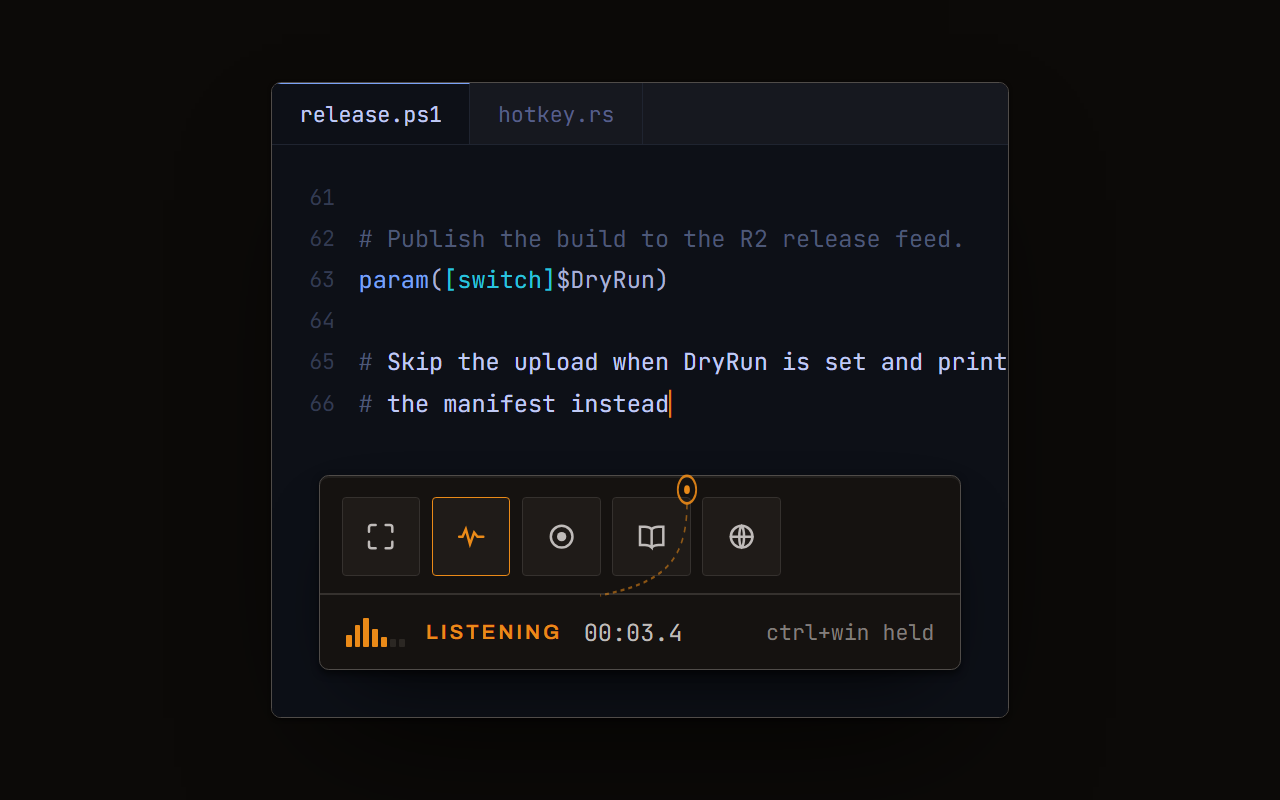
Dictation, where your cursor is
Hold a key, speak, release. Clean, punctuated text lands in whatever has focus, on your PC, your Mac and your phone, with your clipboard handed back.
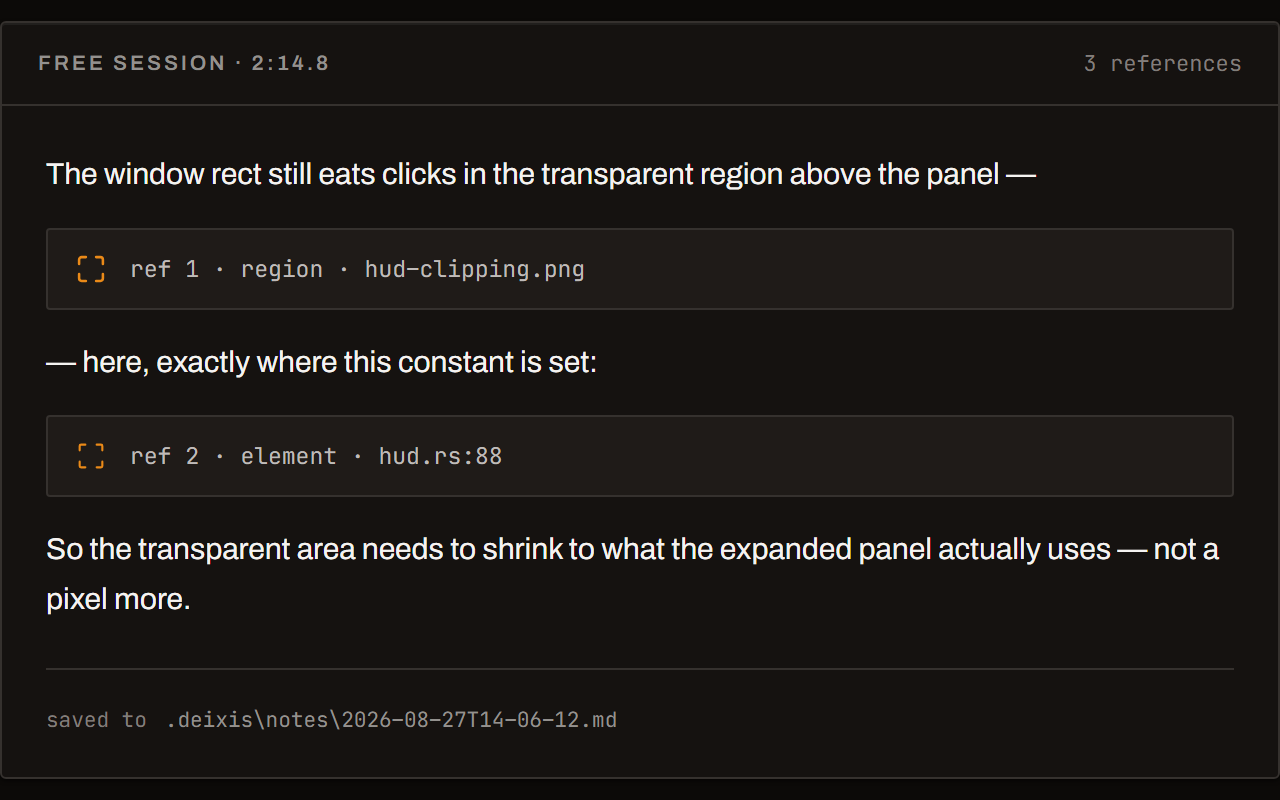
Free mode: talk and point
Narrate for as long as you like while you grab a region, pick a button on screen or take a selection. One note, what you said interleaved with what you pointed at, pasted where you finish and saved as Markdown.
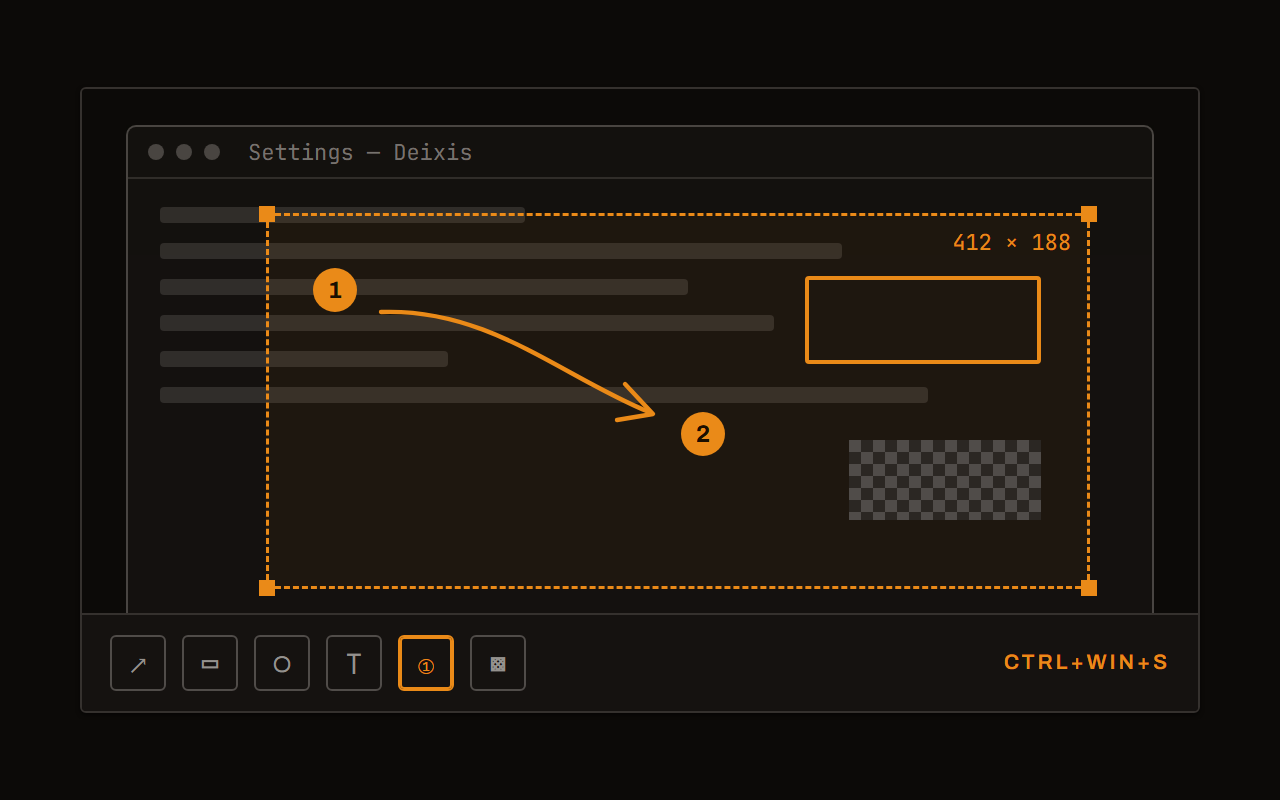
Screen grabs, annotated
Freeze every screen at the keypress, drag a region, add arrows, boxes, text and numbered steps, and pixelate what is private. Saved as a PNG that stays editable.
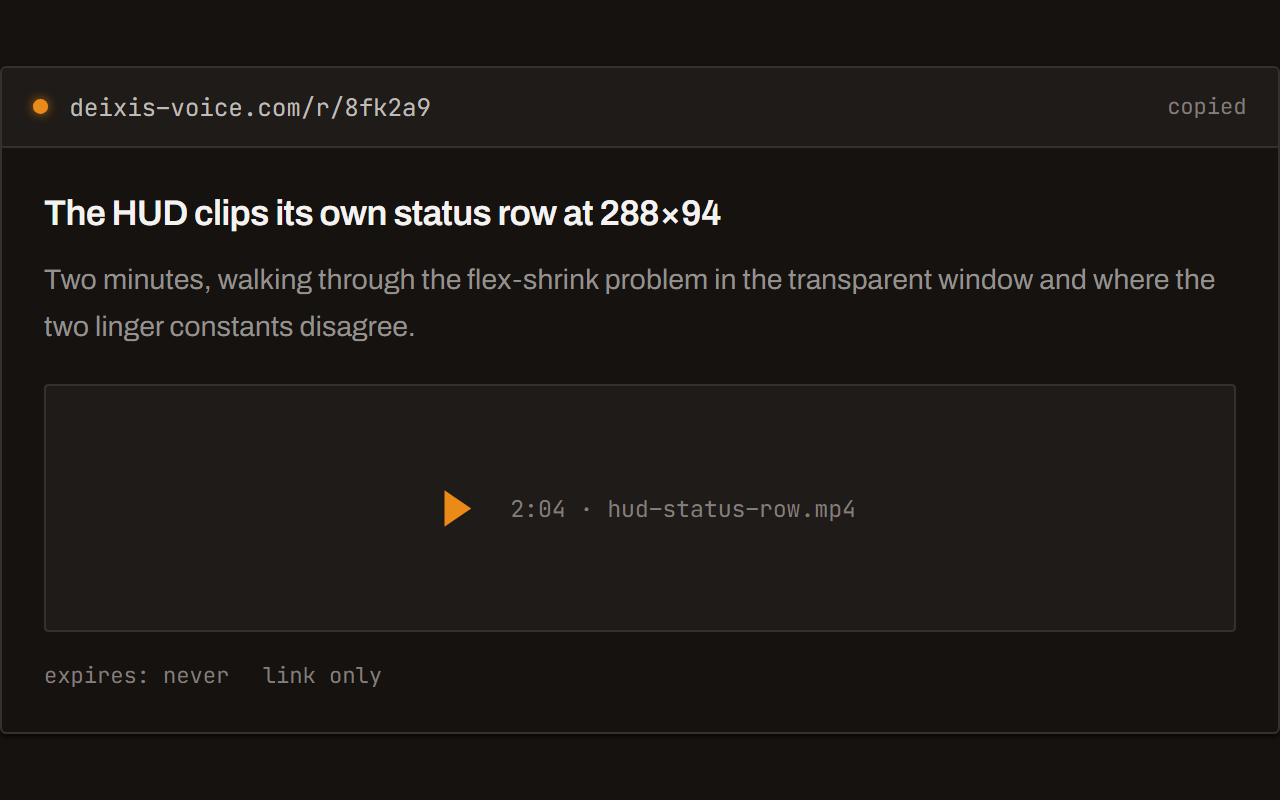
Screen recording, shared as a link
Record the screen with your narration. The recording writes itself up with a title, chapters and a summary, and from your Deixis account it shares as a link anyone can open without one. The Loom you can stop paying for.
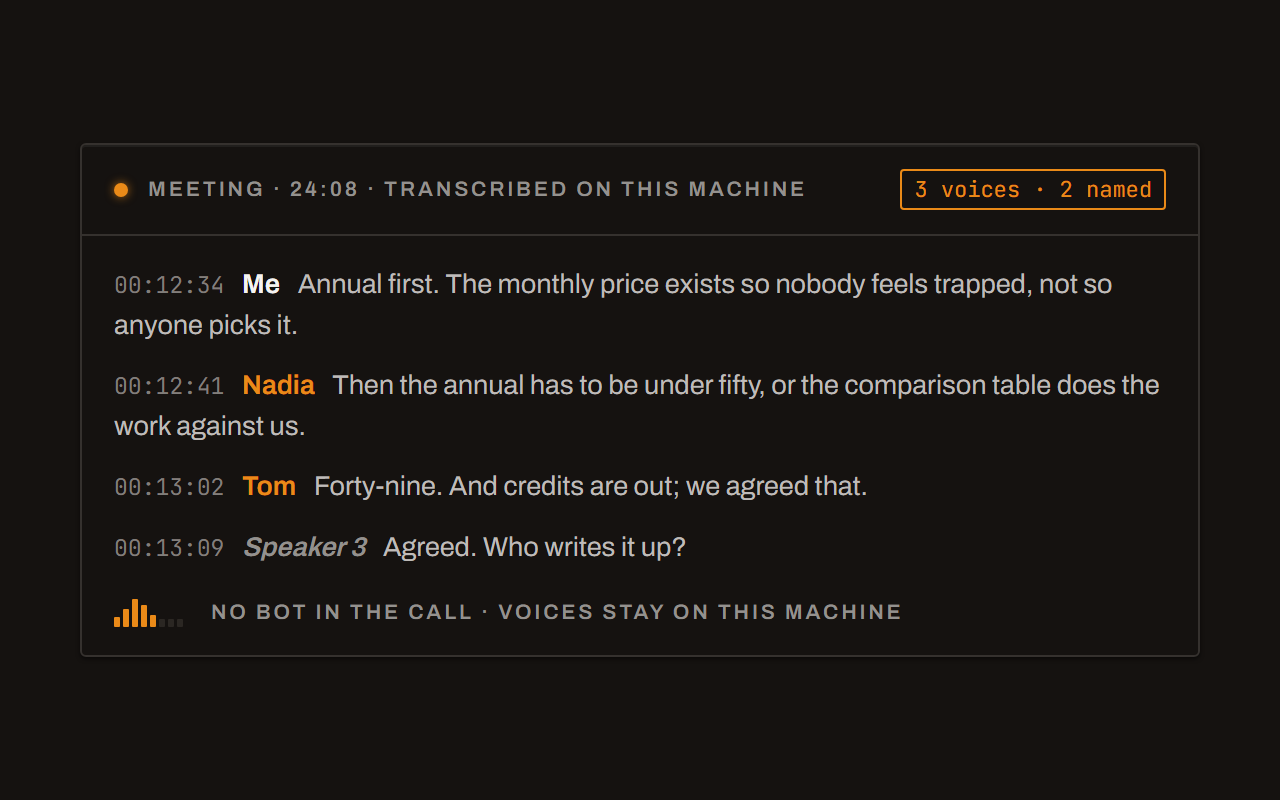
Meetings, no bot, names included
Your microphone and the other side, transcribed on your machine while the call runs. Deixis tells the voices apart and remembers the ones you name, and never uploads a voice.
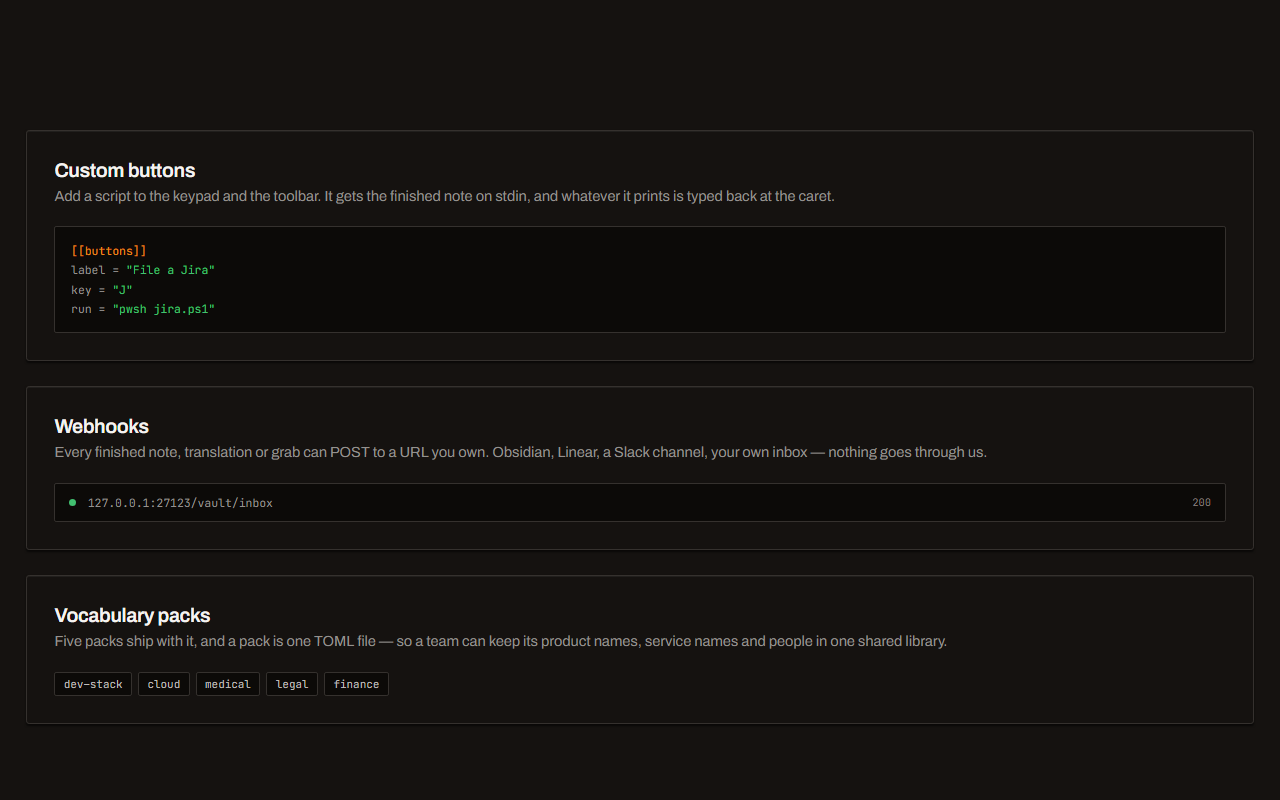
Your own buttons and workflows
Add a button to the palette: it gets the note on stdin and types back whatever it prints. Send finished notes to any URL you own. Chain steps: read the text off a screenshot, translate it, summarise it, post it.
Side by side
VoiceInk and Deixis, side by side
| Row | Deixis | VoiceInk |
|---|---|---|
| Runs on | Windows 10 and 11 (64-bit, on an Intel or AMD processor with AVX2: 2013 and later; no build for Windows on ARM), Mac (Apple Silicon) and Android (a dictation bubble in any app, plus meetings), with an iPhone keyboard in beta on TestFlight and not yet in the App Store. Meetings run on Windows and Android. One engine on all of them, and dictation audio never leaves the device. | macOS |
| Speech recognition happens | On your own device, inside the app, on every platform. Dictation audio never leaves it; a meeting's, only if you turn on cloud processing on Android. | On your device or in the cloud, your choice |
| AI cleanup happens | On your device, with no provider at all. Or, if you want more, Deixis's cloud, your own Ollama, or your own key. Your choice, in one setting. | On your device or in the cloud, your choice |
| Leaves your machine | Text, and only once you switch a cloud feature on, plus, on Windows, one key you press to check your own Claude plan, and, on Android, a meeting's audio if you turn on cloud processing for meetings. Never a dictation's audio, never screenshots, never window titles. | Nothing |
| Account needed | None, ever, for anything that runs on your device. The cloud extras have a seven-day trial you start with an email code. No card. | not documented |
| Price | Free forever for everything local, meetings included. Pro is $49 a year for the cloud extras with nothing to set up. | Free tier: a seven-day trial; the source is public under GPL v3, and a copy you build yourself is free but misses the automatic updates and priority support of a bought copy; $25 one-time |
| Your transcripts live | In plain files, in one folder you own and can back up. Uninstall Deixis and every note is still readable. | On your device |
| Make it yours | Add your own buttons that run a script, send finished notes to any URL you own, and switch on vocabulary packs for your field. | Modes you design that switch by app, website domain, a spoken trigger phrase or a shortcut, with your own prompts; your own keys for a long list of cloud transcription and enhancement providers, or any OpenAI-compatible endpoint; its own on-device cleanup model, VoiceInk Refine, or Ollama or a command-line tool on your Mac for local enhancement; the source is public under GPL v3 |
VoiceInk facts from tryvoiceink.com, its privacy policy, its docs, its download page, its context-awareness docs, its cloud-provider docs, its local-model docs, its licence docs, its settings docs, its history docs, its mode-trigger docs, its vocabulary docs, its file-transcription docs, its iOS page, its source on GitHub and its Refine docs, read on 27 September 2026. “Not documented” means those pages did not say.
VoiceInk's default is local: its privacy policy says transcription happens on your device and nothing leaves unless you switch on an optional cloud service, under your own key. It is Mac software, for Apple Silicon on macOS 14.4 or later, sold once from $25 for one Mac, and its source is public under GPL v3. A separate iPhone and iPad version is free during its beta.
What leaves your machine, and what leaves theirs
Deixis publishes every byte it sends, as a table, because there is so little of it. Here is that table beside what VoiceInk's own pages say.
| What | Deixis | VoiceInk |
|---|---|---|
| Audio | A dictation's, never: recognition happens inside the app on your device, and the recording, the model and the transcript stay there. A meeting's, only if you turn on Deixis cloud processing for meetings on Android: its audio, in pieces, each its own request, and Deixis stores and logs none of itapi.deixis-voice.com, then Whisper on Cloudflare Workers AI · only on Android, after a meeting ends, with cloud processing switched on in Settings › Meetings — on Wi-Fi, or on mobile data only if you choose | Nothing, by default: the privacy policy says all transcription happens on your device by default and no data leaves your computer unless you choose an optional cloud service. Audio goes to a cloud transcription provider only if you add your own key for one and pick its model.a provider you choose, if any · only when a cloud transcription model is selected |
| The dictated text | The sentence you just dictated, your vocabulary, and your previous sentence in that fieldthe endpoint you chose · only with a cloud endpoint set, and by default only when the local rules are not enough | Nothing, by default. With a cloud enhancement provider connected under your own key, the transcribed text goes to it; the policy says only the text, never the audio, is sent for enhancement.a provider you choose, if any · only when a mode has AI enhancement on with a cloud provider |
| Context around the text | The names of the app and the field the text is going into. Never the window title, never a screenshot.the same endpoint · with that request | Selected text, the clipboard, and text read off the active window on the Mac — the docs say the screenshot itself is never the payload, only the text extracted from it. Each source is a per-mode switch you turn on yourself, and a plain dictation mode never sends context.the enhancement provider you chose · only in a mode with that source switched on, when AI enhancement runs |
| Telemetry and analytics | None. No account, no telemetry, no analytics, no crash reports. | not documented |
| Update check | Nothing but the request; the version check happens on your PCapi.deixis-voice.com · every launch, and when you ask in Settings | An update check in the background while Auto-check Updates is on, and on demand with Check for Updates. The docs do not say what the request carries.not stated · in the background, when the setting is on |
| Model download | Nothing but the requesthuggingface.co · once, when you press Download on first run | A model download when you press Download on a local model card: Parakeet, Nemotron, Whisper, Cohere Transcribe and SenseVoice for speech, and VoiceInk Refine for cleanup; Apple Speech is built into macOS 26. The docs do not say what the request carries.not stated · when you download a model |
| Account and sign-in | An email address, only if you choose to start the trial, plus the partner tag from a partner download link and the first partner website that connected to Deixis on this computer, if there are anythe Deixis endpoint · when you start the trial | A licence key, emailed after purchase and pasted into the app. Activation checks the key with the licensing service and needs a network connection; keys and the Macs they cover are managed on the payment provider's portal. The docs do not say what the check carries.the licensing service · when you activate a purchase |
| Integrations | The finished note, and for a screenshot its file name, never the imagea URL you added yourself · on finish, only for destinations you added | not documented |
Before you switch
Before you switch
Who should not switch
If you dictate in a language other than English, wait: Deixis's speech models are English models. If turning other people's recordings into text is a big part of your day, keep a tool that takes a file, because Deixis will not. If your policy is open source or nothing, VoiceInk's public source is the honest reason to stay. There is no Linux build. And if your PC is older than 2013, its processor lacks the AVX2 instructions Deixis's speech engine is built on, and the app will stop rather than run slowly; there is no build for Windows on ARM either.
Making the switch
Five minutes from installed to dictating. Here is what maps to what.
Dictation
VoiceInk's recording shortcut, in its push-to-talk setting, becomes the one gesture Deixis is
built around: hold Ctrl+Win, speak, release, and the text lands at your cursor with your
clipboard restored. You can change the chord in Settings if another suits your hands better.
Double-tap it instead for hands-free mode, which keeps listening until you double-tap again and
then pastes the whole note at once; that is the closest thing to VoiceInk's toggle setting.
The speech model
VoiceInk asks you to pick a model from a catalogue and download it. Deixis shows one Download button on first launch: press it, wait for a file about the size of a short video, and you are dictating. Settings offers a second, larger model that is more accurate and slower to decode, and it swaps in without a restart. There is no catalogue to study, because Deixis ships two English models that are known to work on any PC it installs on.
Your words
VoiceInk splits this into Vocabulary, which its docs say guides the transcription models that
support it and the enhancement step, and Word Replacements, which rewrite the transcript exactly;
its Auto Learn can add vocabulary for you from corrections it spots. Deixis has the same two ideas
in one dictionary: the vocabulary half biases the speech recognition itself, so a name you add is
heard right rather than fixed afterwards. Add a word without leaving what you are doing: select it
anywhere and press Ctrl+Win+D.
Corrections for a word it keeps mishearing go in as fixes, once, and hold forever. Five vocabulary
packs ship in the box, for software, finance, business, medicine and law, and switching one on
takes a click; drop in your own pack beside them if you have one.
AI cleanup
VoiceInk's modes and prompts become one setting in Deixis, Settings → Cleanup, with three positions: When it helps, Every time, and Never. When it helps is the default: rules on your PC handle most sentences, and only a request like "make this a bullet list" or a long unpunctuated stretch goes to a language model, if you have set one up. Every time sends each sentence for better prose and accepts the short wait. Never keeps dictation off the network entirely. Where the language model runs is your choice too: Deixis's cloud with nothing to set up, a model on your own machine through Ollama, or your own key. Whichever you pick, the byte table linked at the bottom of this page says in plain words what each choice sends.
Meetings, screenshots, recordings
Ctrl+Win+M records a meeting, both your voice and theirs, and transcribes it on your PC, with
the remote voices told apart and a voice you have named recognised the next time it speaks. S
freezes the screen for a grab you can annotate. V records the screen with your narration. T
translates whatever you have selected, and F starts a free session where you talk and point. All
of it lands in one folder as files you can open with anything, and any of it can be posted to a URL
you own or handed to a script you wrote, through custom buttons and webhooks.
Before you ask
Questions people search for
Is there a VoiceInk for Windows?
No. VoiceInk's own download page asks for an Apple Silicon Mac running macOS 14.4 or later, and it has no Windows build to offer. Deixis is built on the same principle, speech recognition on your own device with nothing uploaded by default, and it runs on Windows, and on the Mac and the phone as well, so a switcher keeps one tool everywhere. It goes further: field-aware cleanup with no provider to set up, no account, and everything local free forever.
Does Deixis work offline like VoiceInk?
Completely. Dictation, hands-free mode, screenshots, meeting recording and transcription, the dictionary and the rules-based cleanup all run with no network at all. The only calls a fresh install makes on its own are an update check and, when you open the Settings window, a check for an announcement from us, and neither request carries anything about you.
Do I need an API key for AI cleanup in Deixis?
No. Deixis tidies your dictation with rules on your PC out of the box, and that costs nothing and needs nothing. If you want a language model to polish every sentence, you have three ways to get one: let Deixis run it in its cloud, point it at Ollama on your own machine, or use your own key. VoiceInk's enhancement always needs a provider chosen and set up first.
Does Deixis read my screen the way VoiceInk's context feature can?
No, and that is on purpose. When Deixis escalates a sentence to a language model it sends the sentence, your vocabulary and the names of the app and the field it is going into, never the window title and never anything read off your screen. VoiceInk's screen context is a per-mode switch that, once on, sends text read off the active window to the enhancement provider, never the screenshot itself; Deixis has no such feature to switch on.
Can I use my Ollama models with Deixis?
Yes. Point Deixis at your own Ollama in Settings → Cleanup, name the model, and cleanup, translation and meeting notes all run on your hardware with nothing sent anywhere. If that server is down, Deixis falls back to its rules rather than to the network, deliberately.
How does the price compare?
VoiceInk was a one-time $25 for one Mac when we checked, after a seven-day trial. Deixis is free forever for everything on your own device, with no account, no key and no trial clock: dictation, meetings, screenshots, both speech models and all five vocabulary packs. Pro, at $49 a year or $10 a month, adds the managed cloud extras with nothing to set up, and your own key makes those free too.
Keep reading
Related pages
Best dictation software for Windows
Fifteen Windows dictation tools compared, every fact dated from the maker's own pages — including what our own tool cannot do. Read the disclosure.
Offline dictation on Windows
Dictation that works with no internet: speech recognition on your own device, free, no account. Which Windows speech-to-text tools genuinely run offline.
The Superwhisper alternative for Windows
Superwhisper on Windows still trails its Mac version. Deixis ships whole on Windows, and runs on Mac and phone: recognition on your device, no account.
The Willow Voice alternative for Windows that keeps dictation on your PC
Willow Voice dictates through the cloud and needs an account. Deixis does it on your Windows PC, sends no audio anywhere, and is free with no sign-in.
The Aqua Voice alternative for Windows where nothing leaves your PC
Aqua Voice sends your audio to the cloud and starts you on 1,000 free words. Deixis runs on your Windows PC, uploads nothing, and is free with no account.
The MacWhisper alternative for Windows
MacWhisper has no Windows build. Deixis is the same idea on Windows, and on your Mac and phone too: speech recognition on your device, no account, ever.
Hold a key. Speak. Keep working.
Deixis is free, needs no account, and runs on your own device. Everything on this page is in the current release.
v1.3.2 · 64‑bit Windows 10/11 on Intel or AMD · macOS 13 on Apple silicon · 51 MB · nothing else to install · also for Windows · Android on Google Play
Facts about VoiceInk checked on against tryvoiceink.com. Deixis facts are from its documentation for the current release. Something out of date? Tell us.